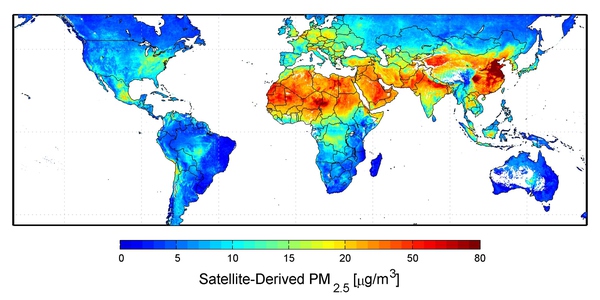
The map is hard to ignore. Aaron van Donkelaar and Randall Martin, using NASA satellite data, produced a global PM2.5 picture published in Environmental Health Perspectives. It was one of the first attempts to expose worldwide PM2.5 levels. Forget the technical details of satellite-based PM2.5 prediction for a moment; the red-purple blob over China is the part everyone notices. A reading of 80 is not considered severe pollution in China these days; under the newer standard, above 75 and below 115 is 'light pollution.' The old standard only tracked PM10. The data are from 2001–2006, when many people had not even heard of PM2.5. Now it is a familiar presence—an old friend of the Chinese people, as the joke goes.
A course on chemicals and health brought up the U.S. Clean Air Act this week, which is a good excuse to look at history. Anyone trained in environmental science knows the eight major pollution incidents; five were air pollution, two heavy metals, one persistent organic pollutants. So the air we breathe today is in some ways a rerun of what older industrialized countries went through decades ago. Back then, telephones and telegraphs were the main communication tools, so there was no constant data stream to ruin your morning mood. The difference is that we already know we are living through an environmental pollution event that will be considered severe decades from now. As Romain Rolland put it, 'There is only one heroism in the world: to see the world as it is and to love it.' Whether or not we feel heroic, the truth is already all over social media.
What are the harms? 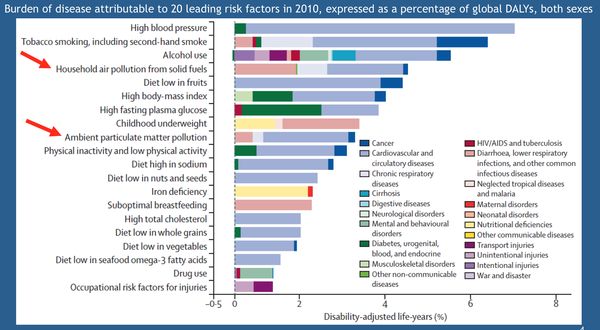 This figure comes from a Lancet study on the top 20 external risk factors for disease over 10 years and their effect on lifespan. Two arrows stand out: household air pollution from solid fuel burning (yes, being a coal-burning cook can shorten your life) and outdoor particulate matter pollution. Both are in the top ten. The data make it clear that air pollution is not a good thing.
But how did research get from noticing pollution to acting on it? The U.S. path is instructive. 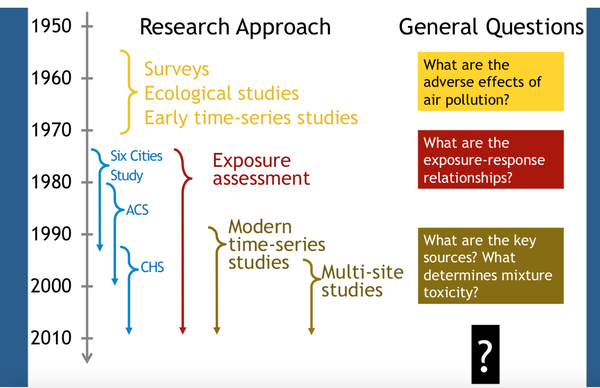 This is also a rough history of environmental science. First came surveys and observations to confirm whether a pollutant caused harm. People may say, 'But people died—what is there to confirm?' Scientific research demands rigor: control variables, extract key factors from observational data, run laboratory randomized trials. That is what researchers consider reliable. Second came toxicology and exposure assessment, determining the effects of pollution components and environmental exposure levels, then using that for risk assessment. It is worth being clear: determining exposure levels and hazards is a scientific question, but risk assessment is not a natural-science question; it belongs to decision-making and management. The third stage is control. That stage has to deal with sources and with combined toxicity: even if you understand the harm of one or several components, whether they actually cause harm together needs separate study—there may be enhancement or antagonism.
The U.S. passed the Clean Air Act in this process and set standards to stop air pollution. It is a model of science-driven policy. The act explicitly requires state governments and the EPA to refer to the latest scientific research. Go to the EPA website today and most environmental issues or pollutants you care about have topic pages, with reference lists and data charts that reflect that science-driven principle. Compare that with China's environmental ministry website: you can find lists of acceptance reports, but simply dumping project reports into a category without integration is formalistic and unprofessional. Chinese scientists publish many high-level papers with government funding, but those findings are not well presented, and other countries end up borrowing the conclusions. The act is amended over time, so it has feedback: keep what works, update as technology advances.
Does the Clean Air Act actually work? Standards have costs, and from a practical view no one wants a losing deal. 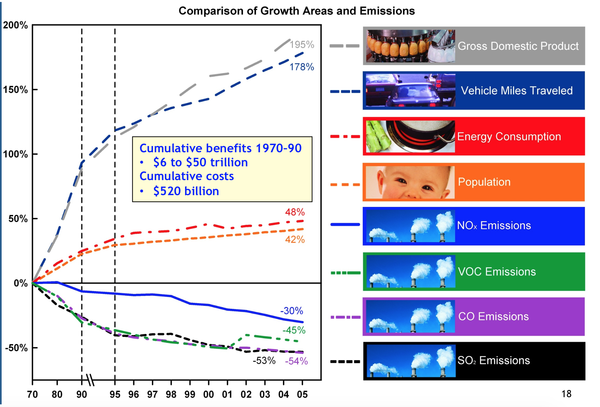 The U.S. GDP, population, energy consumption, and motor vehicles all grew, while emissions of nitrogen oxides, sulfur oxides, carbon monoxide, and volatile organic compounds fell. It is not only the U.S.: China's data over the past 20 years also show declines—except for PM2.5 and PM10. Controls on sulfur and nitrogen oxides started relatively early and are technically supported. PM10 and PM2.5 control technologies should also be mature, but they may not be economically worthwhile or the current industrial and energy structure may be problematic. Still, with strict regulations, the outlook is not bad.
Standards rest on assumptions. Lower concentrations are assumed to mean lower impacts, but whether that relationship is linear needs study, which brings us back to risk assessment. That is also where current Clean Air Act revisions get difficult: 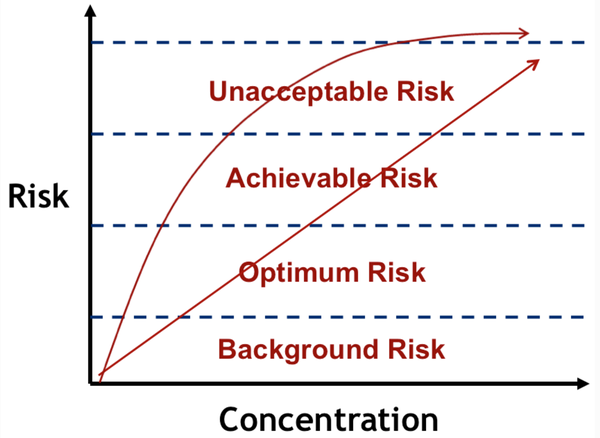 Reducing the same concentration does not reduce risk equally at different concentration levels. Decision-makers usually do that accounting themselves, and there is a lot hidden in it.
Finally, some intuitive numbers: 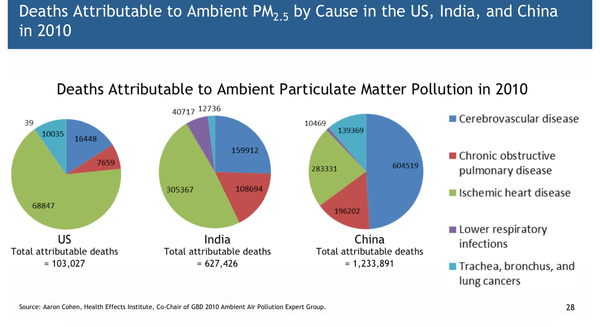 This shows estimated deaths from particulate matter pollution in 2010 for the U.S., India, and China—1.23 million. Whatever the data's reliability, we are indeed in the middle of a serious pollution event.
A few caveats are worth keeping in mind. The death-toll figure has a source below the chart, but I have doubts; without peer-reviewed papers to support it, I cannot say much. My personal view: even without the other two countries' numbers, that figure is not small. On the act's role: Europe and the U.S. have reduced pollutants, but that may not be only because technology is good or regulation is strict; industrial structure has changed, and big polluters have moved elsewhere. So the Clean Air Act's effect has to be seen in a larger context. What I admire most is the EPA's science-driven principle. Which pollution is worse? Researchers seeking funding will always describe their field as hugely dangerous to attract attention—this is true in China and abroad. Pulling one hazard statement out for media hype can distort it. Water, air, and soil are environmental media; harm comes from individual or combined effects of certain pollutants, so dose determines effect. Dose here means exposure dose, not concentration in the environment. Some pollutants are highly toxic but degrade quickly; some are not very toxic but become more toxic after degradation; some are high in concentration but low in bioavailability. The problem is complex and must be examined case by case.
On nitrogen oxide control: coal-fired desulfurization and denitrification and vehicle exhaust denitrification are indeed being promoted in China, and many people have experienced this. These indicators are single components, technology is specialized, and control is relatively easy. PM2.5 is not a fixed-composition substance, and worse, it is a secondary pollutant—many primary pollutants transform under specific meteorological conditions. Controlling it is complex and currently not fully understood. Whether PM2.5 source-control technology is mature—I have not investigated deeply, and my conclusion may be wrong. On PM2.5 and latitude: good observation; if interested, read the original paper. My view: because PM2.5 formation requires meteorological conditions, some places, such as tropical regions, may have faster natural removal; in others, such as the Sahara, PM2.5 basically comes from desert dust and differs in composition from PM2.5 produced by industrial countries. Excluding places with deserts at the same latitude, the rest are mostly industrial areas. On environmental ethics: I do not know much, but without technological progress, the natural environment cannot support too many human demands. Under technological limits, you cannot simultaneously enjoy high-energy modern life and excellent environmental quality. If energy consumption means declining environmental quality, then it is a zero-sum game: if you enjoy it, someone else cannot. Currently developed countries enjoy it; with technological progress, it may be possible for everyone to enjoy it. But technology alone is not enough; economics and other factors matter too. It is an unclear problem.
As I write this, Beijing's air quality index is 195. The view outside is hazy. No wind, no rain, no Olympics—another weekend indoors.