The exhibition of Yinshan rock art from Bayannur at the Sichuan Art Museum brings together oil paintings, Chinese ink paintings, rubbings, original rock art pieces, and replicas. The walls hold artists’ interpretations rather than the mountain itself, yet the painted surfaces still carry the brown stones at the foot of the Yinshan range and the ancient herders who once moved beside them.
Look closely: sheep and cattle, perhaps a tiger; human figures, animals, the sun, the moon—a whole world pressed into marks.
At the foot of the mountain, the stones seem to speak. One rock face is a life condensed. Countless travelers have passed, people arriving and leaving.
Everyone may carry greed, anger, delusion, pride, and doubt—what of it? The long current of history leaves no trace, but the rock art goes on telling the story.
This image feels closer to sculpture: it has thickness, the wear of history, simple lines, and the touch of ancient hands.
Birds, too, pause before the rock art. The art belongs to nature, and nature is its home.
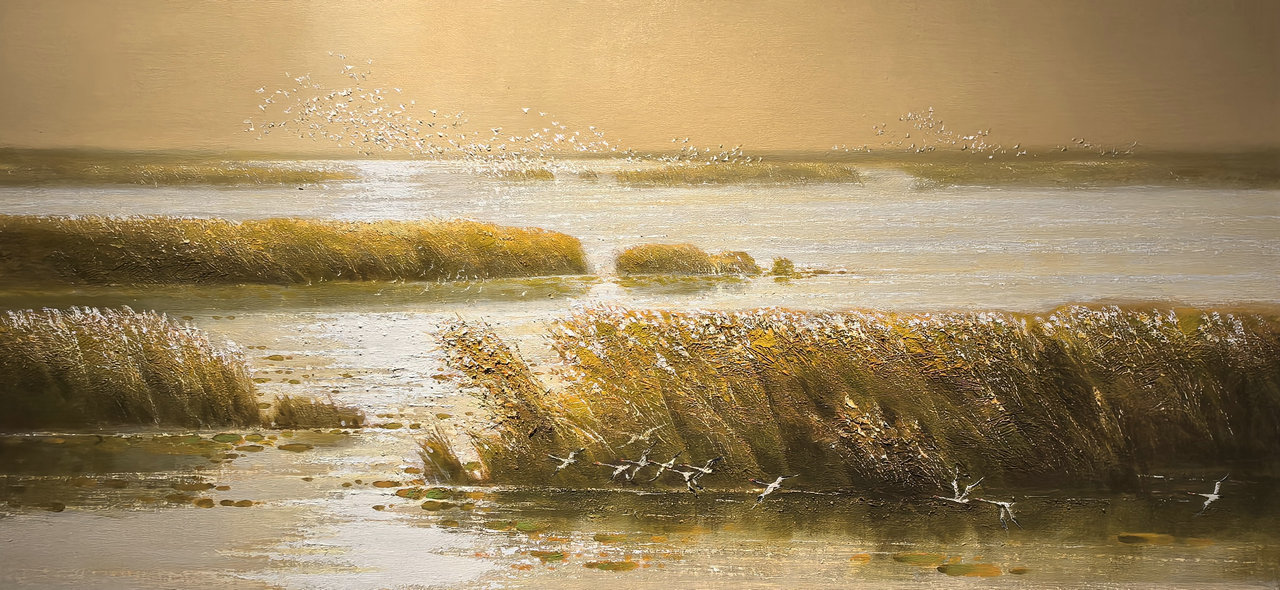
Perhaps this place once had dense grass, a setting sun, reeds, and flocks of birds gathering...
Once, sheep were fat and horses strong. Herders rode out and drove their flocks through the mountain pass where rock art covers the stone...
A shepherd leans against the rock art, auspicious clouds above, birds flying past, the old man smoking a pipe, sheep grazing—and a dog as well.
After a thousand years, sunflowers bloom; people continue, nature cycles, and bones return to the earth and back again. The Yinshan rock art remains as witness.
Yinshan rock art consists of images carved or pecked into the rocks of the Yinshan Mountains. It extends across the Neolithic, Bronze, and Iron Ages, through the Qin and Han dynasties and into modern times—several thousand years in all. The Yinshan region was a grazing and hunting ground in antiquity, and the images reflect the life and religious ideas of hunters and herders. Their creators belonged to early tribal peoples such as the Xiongnu, Tiele, Turkic, Tangut, and Mongol. Among the most numerous and finely carved subjects are animals: sheep, wolves, deer, dogs, rabbits, eagles, cattle, and ostriches. Deities, spirits, and half-human, half-beast figures appear in large numbers, along with mixed human-animal faces. Some human-like faces are only a head shape—bald and unadorned, or with long braids, or wearing feathers or antlers.