
A couple of months ago, I tried using ChatGPT to help draft an article introducing eBPF. The result was full of errors, and I ended up rewriting it almost from scratch. That experience left me with a pretty blunt conclusion: content generated by ChatGPT is not something I can trust on its own. Since then, I’ve stopped using it to write articles.
That judgment comes from two basic observations.
First, ChatGPT is built on a language model, not on facts. Facts are not its foundation. What it is very good at is understanding the form of your question and replying in a way that sounds appropriate.
Second, because it answers by following learned patterns, it cannot guarantee that what it says is correct. Its job is to produce responses that are fluent, polished, and convincing. And yes, in terms of organizing text and phrasing things clearly, it often does a decent job. But after spending enough time with it, you start to notice that these patterns are not especially profound. A lot of its answers stay on the surface. In that sense it reminds me of GitHub Copilot: it cannot really write sophisticated code, but it can help produce ordinary, standardized code quickly—and to be fair, that already has real value.
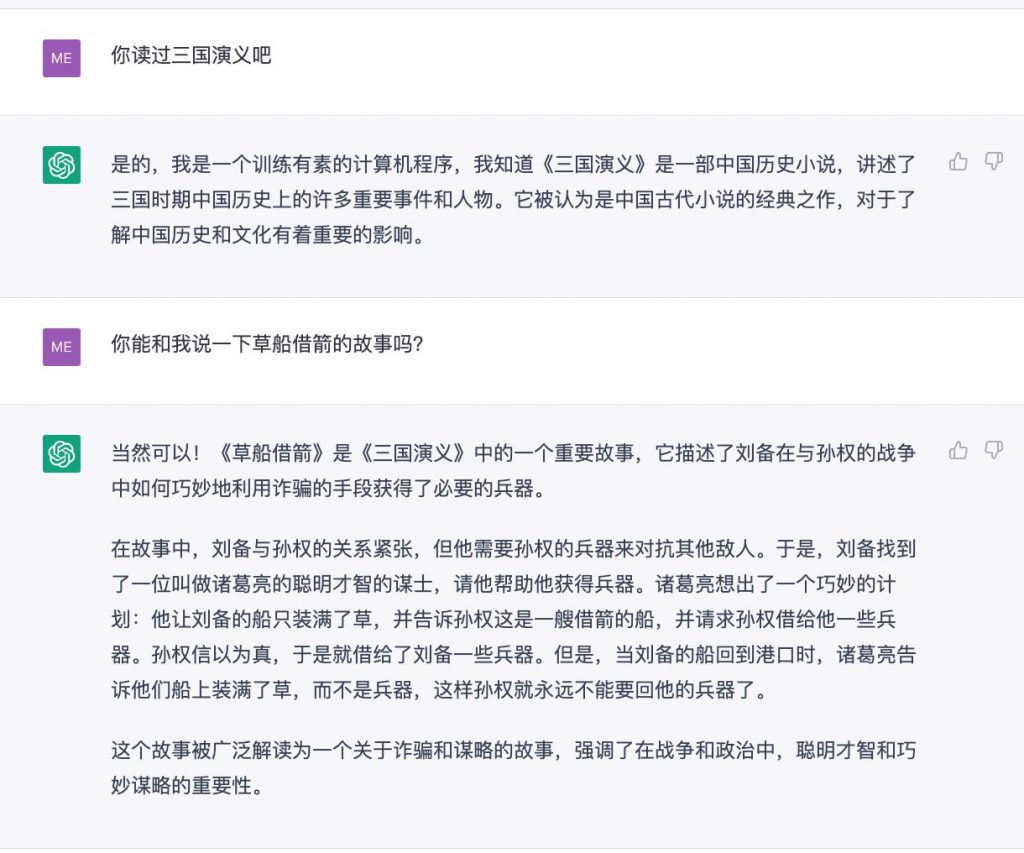
At the end of the day, ChatGPT is still just a language model. If you do not give it enough data and information, it will very often drift into making things up.
Seen from that angle, tools like ChatGPT can absolutely become useful assistants. They may replace a lot of entry-level knowledge work, but they are not yet in a position to replace specialists, and I suspect that will remain difficult for quite a while. Even so, that is already impressive, because a huge amount of ordinary work really is repetitive and time-consuming.
But there is one non-negotiable condition: the content it produces must be true and reliable. Without that, none of the convenience matters much.
What really changed my thinking was looking at ChatGPT from another direction—especially after watching Microsoft’s presentation, Introducing your copilot for the web: AI-powered Bing and Microsoft Edge. That was when it clicked for me why Google could lose roughly $100 billion in market value. The core issue is simple: Google’s dominance in search has been challenged in a way it never has before.
To understand why, it helps to ask what search engines actually solve for users.
Search engines are great at a few things:
- Indexing knowledge and information: news, stocks, history, documentation, quick answers.
- Finding providers and services: online stores, repair services, software, and so on.
- Ranking for accuracy and usefulness: a good search engine uses ranking algorithms to push the most relevant, authoritative, and useful material toward the top.
That last point matters a lot. Traditional search engines have been strong precisely because they can surface reliable information efficiently.
But search also has obvious limitations.
The first is that search engines are keyword-driven, not semantic-driven. They do not truly understand what you mean; they only react to the words you type. That leads to the familiar routine:
- You keep tweaking and expanding keywords to improve the results.
- You repeatedly filter and refine what comes back.
The second limitation is that a search engine can present content, but it cannot interpret it for you. Once you have the links, the burden shifts back to you:
- You open a page, read halfway through it, then realize it does not contain what you need.
- You find the right topic, but the explanation is too obscure, too technical, or too hard to follow, so you go looking for a more beginner-friendly version.
- No single page gives a complete answer, so you end up assembling one yourself from multiple sources.
- What search returns is mostly fragments. It is not naturally structured into something coherent.
The third limitation is that search has almost no memory or contextual continuity. One query and the next are basically unrelated unless you do all the work of connecting them yourself.
That becomes a real problem because the more you learn, the more questions branch out from what you already know. In practice:
- As your research splits into subtopics, you are the only one managing the structure. The search engine does not care about that thread of thought, so each new search feels like starting over.
- If you are building something customized—say, a travel plan—you have to collect pieces from many separate searches and manually combine them into one usable result.
Now think about what ChatGPT-style systems are actually good at. Their strength is generating content based on a user’s intent and presenting it in a usable form. The weakness, again, is reliability.
So what happens if you combine the strengths of both sides? What if you feed ChatGPT with the trustworthy content that search engines are already good at finding?
That would be a genuinely powerful next-generation search engine, because it directly addresses the shortcomings above.
- You can describe what you want in a full sentence or paragraph, and ChatGPT can understand the semantics.
- Because it grasps intent better, it can do a better job selecting which search results actually match what you need.
- It can generate a TL;DR, turning a long article into a short, readable summary.
- It can organize information, merging and structuring content from multiple pages.
- It can maintain conversational context, helping you continue searching, refining, and expanding within the same topic instead of resetting every time.
Once ChatGPT can fully leverage the accuracy and reliability of search-engine content, its capabilities are no longer held back in the same way. At that point, AI is not replacing search—it is supercharging it.
That is why Bing combined with ChatGPT became the most serious challenger Google has ever faced.
And I do not think the impact stops at search. My feeling is that any software or service tied to information or text processing is going to be reshuffled by this kind of AI. This is likely the beginning of another major technology wave.
Copilot-style interaction is very likely to become a standard feature of the next generation of software and applications.