Chiefs is, on the surface, a crime novel about a sheriff chasing a serial killer across decades. In practice, it is also a novel about how the American South changed—slowly, violently, unevenly—under the pressure of the Black freedom movement.
It is the first book in Stuart Woods’s Will Lee series, though that label is a little misleading, because “Will Lee” turns out to be less one single protagonist than a name passed through generations.
The setting is Delano County, a fictional county in Georgia: small-town, Southern, politically intimate, and deeply structured by race.
Below are heavy spoilers.
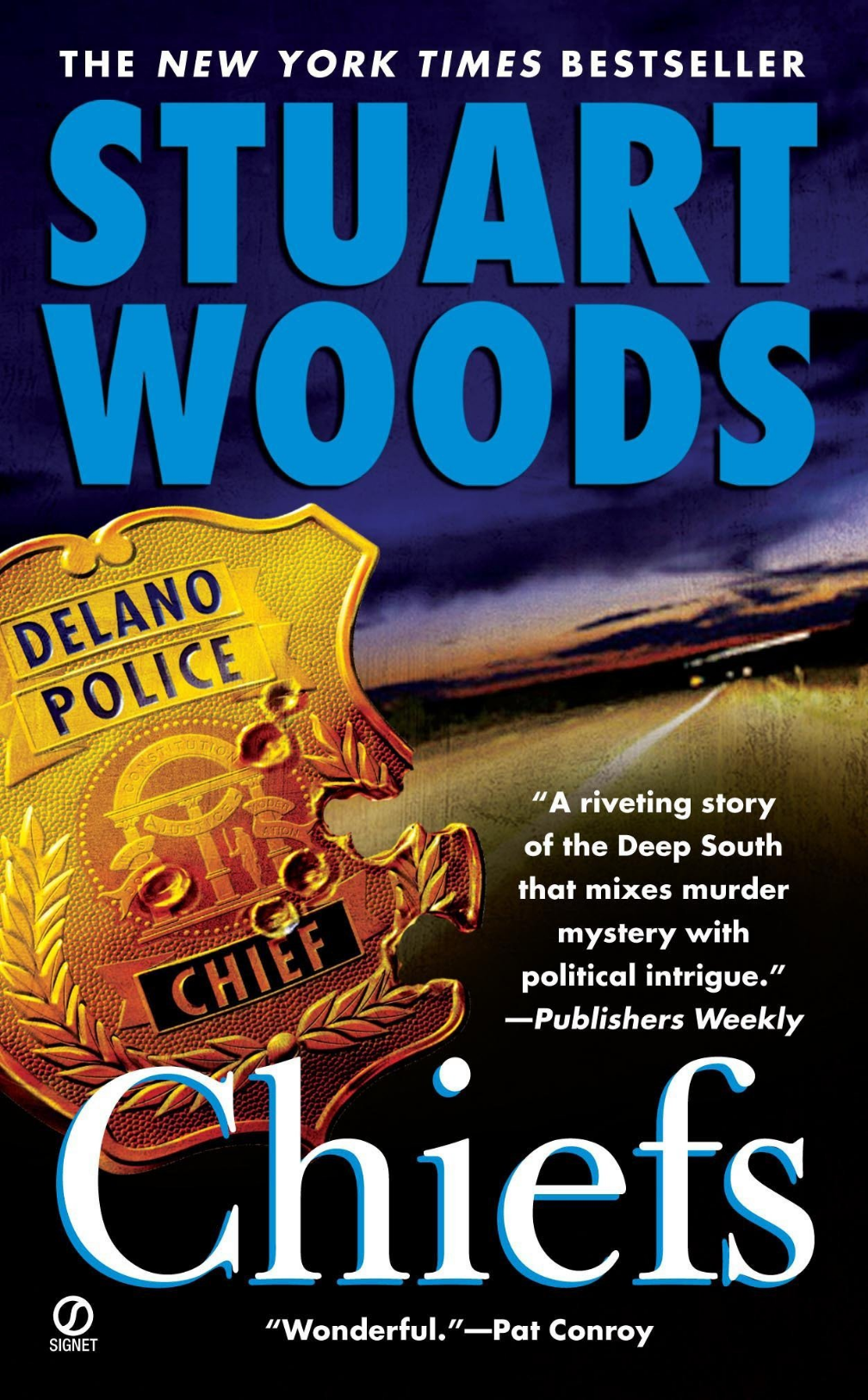
One county, three eras, one buried crime
The novel begins in the 1920s. Will Lee, a white farmer in Delano County, can see that he is about to lose the fight with debt. The harvest is not improving, the bank is closing in, and he decides to give up his land and sell it back to the bank. With his future in farming gone, he applies to Hugh Holmes, a member of the county commission, for the job of chief of police.
The title sounds grander than the reality. Delano County barely has a police force at all. The place has never been attractive enough to recruit experienced law officers from outside, so Holmes has to look locally for someone young, honest, dependable, and acceptable to the county’s power structure. Will Lee fits the role.
His years in office go relatively well. He brings some order to traffic, keeps basic peace, and helps people where he can, including abused women who have little protection otherwise. But two murders stay with him. Years apart, the bodies of two boys are found in Delano. Both have bruising around the wrists, and both have been whipped in an unnervingly symmetrical way, as if the killer were methodical to the point of compulsion.
The land Will surrendered to the bank is leased to Hoss Spence, a wealthy local man and a vicious racist. When Spence’s son gets into trouble and Will Lee arrests him, Spence redirects his anger toward the Black Cole family, who are friendly with Will. Spence abuses Cole brutally, forcing him into swamp labor until disease and physical collapse leave him unable to work.
Will tries to help where he can. He finds work for Mrs. Cole, but the pay is meager. Their son, Willie, steals from the shop where he helps out and is sentenced to community labor. Because he feels for the family’s situation, Will allows Willie to return home at night. One day Willie is late reporting back because his father’s condition has worsened.
On the way to find the boy, Will stumbles onto a clue tied to those old murders. That discovery alerts the killer, who follows him to the Cole home. In the chaos, Willie’s delirious father mistakenly kills Will Lee. Willie’s mother tells her son to run at once. His father is later hanged.
War changes the South before politics catches up
The story then shifts to the 1940s, after World War II. Men return home carrying not only medals and trauma, but new expectations.
Will Lee’s son—also officially named Will Lee, though widely called Billy—begins his political ascent with Hugh Holmes’s backing. Sonny Butts, the son of a woman whom the elder Will had once helped escape domestic abuse, becomes the new chief of police. A young Black veteran named Marshall uses money saved during military service, along with a bank loan, to open an auto repair shop.
This is where the novel’s historical undercurrent becomes especially sharp. The white supremacist order has not disappeared. The Ku Klux Klan is still active, and Marshall becomes one of its targets. Billy does what he can to shield him, but Holmes warns him not to reveal himself too openly on race before he has secured election to the state legislature. Political timing matters; moral timing matters too; the novel is interested in the damage caused when the two do not align.
Billy hesitates at the worst possible moment. He misses the most urgent plea for help from Marshall’s wife. Marshall is then jailed by Sonny Butts on a pretext, beaten, and killed.
Sonny himself is in danger of losing his job. At exactly that moment, he gets a fresh lead on the old case of missing white boys. He had already found records left by Will Lee and had become interested in the disappearances. Hoping to save his reputation, he goes after the killer personally. One lapse is enough. He is captured and buried alive.
The 1960s: civil rights, backlash, and the return of Willie Cole
By the 1960s, Delano County gets a new chief of police: Tucker Watts, a retired military officer appointed with the support of Billy, who has by then become lieutenant governor. Tucker is the first Black chief in Delano’s history.
He proves highly capable. He stabilizes law enforcement and improves local civic conditions. Yet in the South of that period, competence is no shield. After he gives Hoss Spence a speeding ticket, Spence turns the incident into political ammunition. Billy’s enemies accuse him of trying to buy Black votes by imposing a Black police chief who supposedly hates white people.
At the same time, Tucker begins to see the old pattern in the long-running disappearances of white boys. As he pushes further into the case, the rumors around him intensify. Billy loses momentum in his run for governor and is forced back into a state senate race instead.
Tucker nearly gives up. What steadies him is encouragement from a reporter with The New York Times. He invokes the Lindbergh Law to bring in the FBI and launch a search of the killer’s farm. The search appears to fail completely. Nothing is found, Billy’s political future hangs by a thread, and the operation looks disastrous.
Then, as the search party is leaving, someone trips over an obstacle. That obstacle turns out to be Sonny Butts’s police motorcycle—the same one he was riding before he vanished.
The case finally breaks open. The death toll is forty-three.
While digging into the story, the reporter uncovers Tucker Watts’s hidden identity: he is Willie Cole, the Black boy who fled Delano years earlier after Will Lee’s death.
The ending refuses to belong to one person alone
By the close, everything arrives at once. Billy wins the governorship. Tucker becomes a public hero. The reporter gets the first major scoop. And Hugh Holmes, the man who spent years trying to build Delano County into something respectable, realizes that the county’s name will now be permanently tied to this infamous case. The shock and grief overwhelm him, and he dies that same night.
It is, in one sense, a triumphant ending. In another, it is soaked in loss. The killer is caught, but forty-three people are dead. A Black child who once had to flee returns under another name as a symbol of justice, but only after surviving a system built to crush him. Political progress comes, but late, compromised, and always entangled with calculation.
Why the novel’s racial history matters
What stays with me most is not only the mystery plot, but the way the book threads the Black freedom struggle through the changing life of one county.
The standard shorthand for U.S. civil rights history often places the movement’s peak in the 1960s, which is true enough as far as mass visibility goes. But that can flatten the question of why such force gathered then, rather than simply implying a smooth climb from emancipation in the 1860s to the protests a century later.
The novel offers one striking answer through conversations between Hugh Holmes and Billy: World War II.
Many Black men served in the war. In that wartime environment—still unequal, but in key ways more open than the Jim Crow South they came from—Black soldiers could be promoted for merit, treated with a degree of dignity, and in some cases rise to positions where they commanded white soldiers. That experience mattered. Once someone had lived in a world where discipline, authority, and achievement were not automatically denied by race, it became much harder to return home and quietly accept a social order built on ritual deference, where every Black person was expected to bow before every white person.
Delano had white reformers and local people of conscience even before the war, people trying in limited ways to improve Black education and living conditions. But the real rupture comes after the war. Black veterans return with saved wages, start independent businesses, seek public roles, and know more clearly how to resist the idea that injustice is simply fate.
That is the deeper movement running beneath the murders. The investigation stretches across decades, but so does the transformation of Black political and social life in the South. The book never lets those two stories separate.
A final oddity: the Will Lee problem
One small but persistent source of confusion is the naming. This is called the Will Lee series, but the name keeps recurring across generations. The first Will Lee is the farmer-turned-chief in the 1920s; later, his son is officially also Will Lee, though almost everyone calls him Billy while he is growing up and even as an adult—until formal politics suddenly restores the official name.
It gives the series a dynastic feeling, but it can also be strangely disorienting, especially in a novel already spanning multiple eras, offices, and identities.
There is also a brief historical note worth keeping in mind: the Lindbergh Law, which plays a role late in the story, had a wide-reaching impact in American criminal law. It originated in response to the Lindbergh baby kidnapping case, the same case often cited as part of the inspiration behind Agatha Christie’s Murder on the Orient Express.