The foundation of a rational system
In an age of rapid discontinuity, every serious decision-maker eventually faces a deeper challenge than strategy alone: the challenge of upgrading how they think. This is not just a professional transition, but a shift in consciousness.
Viewed by depth, human thinking can be understood as moving through four levels: sensory thinking, rational thinking, philosophic-scientific thinking, and awakened wisdom.
Within that ladder, first principles occupy a special place. They are the logical singularity of a rational system. They are not conclusions extracted from experience. They are the starting assumptions from which a system can be rebuilt. When used well, they illuminate innovation, help us cross moments of discontinuity, and make possible the leap to a true second curve.
If we remain trapped inside habits of perception, we can only repair the surface. If we break out of that enclosure and reconstruct from the bottom layer up, we gain the chance to build something durable on top of collapsing foundations.
- Sensory thinking relies on intuition and accumulated experience, and easily falls into survivorship bias through induction.
- Rational thinking uses logic to establish internally consistent proof.
- Philosophic-scientific thinking takes first principles as its basis and reconstructs reality through axiomatic reasoning.
- Awakened wisdom reaches toward the source of the world of ideas and the ultimate code of existence.
Why induction dominates ordinary thought
Induction is humanity’s default cognitive setting. It is built into the way we survive. We turn specific experiences into abstract knowledge, and that process accounts for most of what people call everyday knowledge. But nearly all of it rests on a non-logical leap.
Spatial and temporal induction
Two common forms of induction shape ordinary judgment:
- Spatial induction assumes that what is true in one part is true everywhere. If the swans seen in Europe and Africa are white, one may jump to the claim that all swans are white—until black swans appear in Australia.
- Temporal induction assumes that what has happened will continue to happen. Because the sun has risen every day in the past, we assume it will rise tomorrow as well.
The hidden assumption behind induction
Induction works only because it quietly depends on a continuity assumption: that time and space do not undergo sudden rupture. This assumption cannot itself be proven. It is simply trusted.
That is the limit of induction. Once reality reaches a point of discontinuity, accumulated experience can fail all at once.
Why humans prefer survival over truth
The reason people lean so heavily on induction is not that it guarantees truth, but that it minimizes cognitive cost. At the bottom, this reflects a kind of principle of least action: the brain economizes effort.
Humans often trade truth for survival efficiency. It is cheaper to use patterns than to build proofs.
<table> <thead> <tr> <th>Dimension</th> <th>Survival-seeking (induction / experience-driven)</th> <th>Truth-seeking (first principles / logic-driven)</th> </tr> </thead> <tbody> <tr> <td>Core goal</td> <td>Preserve survival and reduce cognitive energy use</td> <td>Pursue essence and ultimate truth</td> </tr> <tr> <td>Nature of thought</td> <td>Inertia of experiential continuity</td> <td>Discontinuous breakthrough through logic</td> </tr> <tr> <td>Logical force</td> <td>Achilles’ heel: can be falsified, but not proven</td> <td>Truth-preserving: true premises yield true conclusions</td> </tr> <tr> <td>Cost of thinking</td> <td>Very low cost, but easily swallowed by hidden black holes</td> <td>Extremely high cost, requiring difficult logical derivation</td> </tr> </tbody> </table>Deduction: the pillar of rational thought
If induction is “describing the picture you see,” deduction is closer to a logical algorithm. It does not rely on the clutter of direct experience. It aims at self-consistency within reasoning itself.
Aristotle’s syllogism
The classical form of deduction is the syllogism. If the major premise and minor premise hold, the conclusion follows necessarily.
<table> <thead> <tr> <th>1 2 3</th>
<th>大前提:所有人都会死。 小前提:苏格拉底是人。 结 论:所以苏格拉底也会死。</th>
</tr>
</thead>
<tbody>
<tr>
<td></td>
<td></td>
</tr>
</tbody>
</table>
When logic is more real than facts
At a higher level of philosophic-scientific thinking, logic becomes the only true entity. What matters most is not the scattered surface of facts, but the underlying structure that explains them.
Newton did not derive mechanics by summarizing steam-engine experience. He first grasped the abstract logic of mechanics through F=ma, and that logic later guided countless engineering solutions. For advanced thinkers, practice does not lead logic; logic leads practice.
The dilemma of premises
Deduction is powerful because it preserves truth—if the premises are true. But that “if” is fatal.
When the major premise ultimately comes from induction, the whole chain remains fragile. To escape an infinite regress of justification, reasoning must eventually return to a meta-level starting point outside the system itself: first principles.
What first principles actually are
A first principle is the foundational assumption on which a rational system stands. It is the meta-premise that makes the system possible.
Three aspects matter most:
- It can be understood as a logical singularity, a first cause, or a self-evident axiom.
- It follows a one-way law: from first principles, an entire system can be deduced, but the system itself cannot be reverse-engineered back into its first principle.
- What serves as a “central idea” in a parent system may become the first principle of a child system.
A useful example is Newton’s F=ma. For Newton, it was a conclusion within a deeper theoretical structure. For James Watt, it functioned as a first principle that helped support improvements to the steam engine and opened the door to industrial transformation.
Aristotle described first principles as the most basic propositions or assumptions within a system—propositions that cannot be omitted, removed, or violated.
A similar intuition appears in Laozi’s line: “The Dao gives birth to one, one gives birth to two, two gives birth to three, and three gives birth to the ten thousand things.” The “Dao” here plays the role of the unshakable foundational assumption.
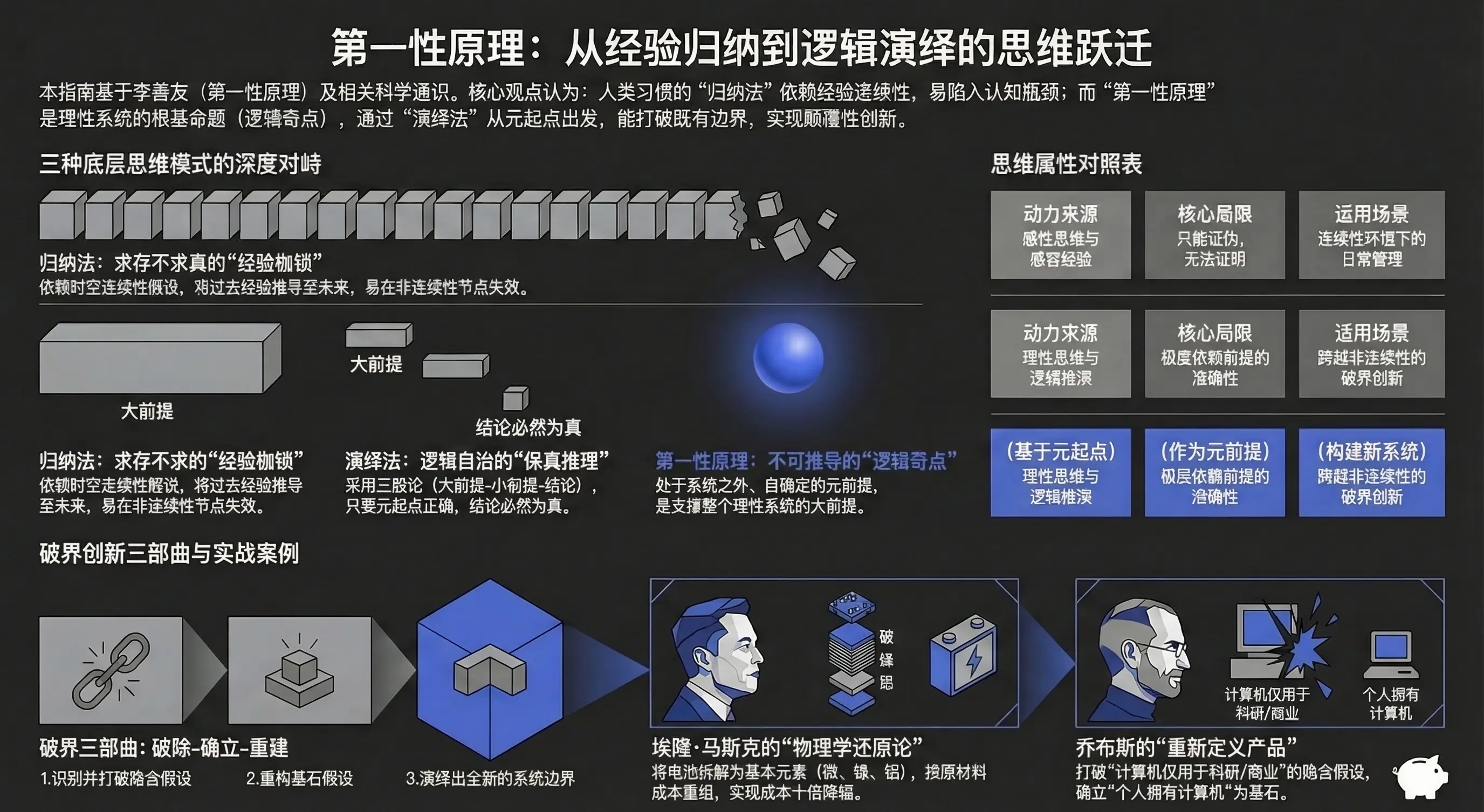
Induction, deduction, and first principles compared
These three modes of thinking do not operate at the same level.
<table> <thead> <tr> <th>Comparison</th> <th>Induction</th> <th>Deduction</th> <th>First Principles</th> </tr> </thead> <tbody> <tr> <td>Nature of thought</td> <td>Sorting and grouping sensory experience</td> <td>Necessary derivation through rational logic</td> <td>Meta-premise of the system; logical singularity</td> </tr> <tr> <td>Certainty</td> <td>Cannot be proven; remains a hypothesis awaiting refutation</td> <td>Absolutely truth-preserving if the logic is valid</td> <td>Self-grounding axiom; does not require proof</td> </tr> <tr> <td>Effective boundary</td> <td>Continuous environments and routine operations</td> <td>Crossing discontinuities; foundational R&D</td> <td>Strategic reconstruction and boundary-breaking innovation</td> </tr> <tr> <td>Hidden assumption</td> <td>Spatiotemporal continuity; future equals past</td> <td>Premises must be true</td> <td>Final endpoint of the deductive system</td> </tr> </tbody> </table>Axiomatic thinking: the highest form of rational construction
Axiomatic thinking begins with first principles and builds a system of proof from them. In this view, all serious knowledge is fundamentally a proof system. Any claim that has not undergone logical proof remains, at best, an unverified proposition.
The example of Euclidean geometry
Euclid’s achievement was not merely mathematical. It was methodological. With a very small set of foundational assumptions, he transcended the prison of sensory intuition and derived the entire system of plane geometry.
The five common notions of Euclidean geometry:
- Things equal to the same thing are equal to one another.
- If equals are added to equals, the wholes are equal.
- If equals are subtracted from equals, the remainders are equal.
- Things which coincide with one another are equal to one another.
- The whole is greater than the part.
The five postulates specific to geometry:
- A straight line can be drawn from any point to any other point.
- A finite straight line can be extended continuously in a straight line.
- A circle can be drawn with any center and any radius.
- All right angles are equal to one another.
- Through a point not on a given line, there is one and only one line parallel to the given line.
This is what first-principles reasoning looks like in its purest form: few assumptions, vast consequences.
A three-step method for boundary-breaking innovation
Real innovation is not cosmetic improvement. It is not patchwork from the outside. It comes from breaking the cognitive black holes that define the limits of the old system.
A practical sequence can be described in three moves:
1. Break
Identify and shatter the hidden assumptions.
First principles both support a system and imprison it. They define its horizon. In that sense, they are also its black hole. The first move is philosophical: step outside the system and question what everyone inside it treats as common sense.
2. Establish
Set a deeper foundational assumption.
A new system needs a new meta-premise. That new premise must usually sit at a deeper level and in a higher dimension than the old one, often drawing strength from more fundamental disciplines.
3. See
Deduce a new system from the new foundation.
Once the foundation changes, a new boundary can emerge through deduction. The former bottlenecks of the old system become irrelevant because the frame itself has been replaced.
How paradigm shifts happen in science and business
The logic above is not abstract theory alone. It appears repeatedly in major scientific and commercial shifts.
<table> <thead> <tr> <th>Case</th> <th>Hidden assumption (old paradigm / black hole)</th> <th>Breakthrough point (new foundation)</th> <th>Result</th> </tr> </thead> <tbody> <tr> <td>Non-Euclidean geometry</td> <td>Space is flat (the fifth postulate)</td> <td>Space may be non-flat (curved surfaces)</td> <td>Opened the way for Riemannian geometry and later supported general relativity</td> </tr> <tr> <td>Astronomical revolution</td> <td>Heavenly bodies must move in uniform circles</td> <td>Abandon the circular-orbit assumption in favor of ellipses</td> <td>Kepler built a simpler and more powerful planetary system</td> </tr> <tr> <td>Rise of IBM</td> <td>Computers are only for elite scientific markets</td> <td>Computers have vast commercial potential</td> <td>It came to dominate the large commercial computer market and define the IT industry</td> </tr> <tr> <td>Fall of DEC</td> <td>Computers serve only institutions and business organizations</td> <td>Individuals and households also need computers</td> <td>Apple ushered in the personal computer era</td> </tr> <tr> <td>iPod Shuffle</td> <td>Music listening requires a screen and song-selection buttons</td> <td>Users do not need to search for songs; random playback is enough</td> <td>Radical simplicity made the screen problem irrelevant</td> </tr> <tr> <td>Arrival of the iPhone</td> <td>A phone must have a fixed physical keyboard</td> <td>A touchscreen can replace physical keys</td> <td>The phone was reinvented and the mobile smart era began</td> </tr> </tbody> </table>In each case, the decisive move was not optimization inside the old model. It was replacing the assumption that defined the old model.
Organizational renewal: Microsoft’s second-curve transformation
The same pattern appears at the level of institutions. When Satya Nadella took over Microsoft, the company’s revival was not merely strategic. It was ontological in an organizational sense: the underlying assumptions of the company were rewritten.
<table> <thead> <tr> <th>Dimension</th> <th>Ballmer era (confined to the first curve)</th> <th>Nadella era (renewed on the second curve)</th> </tr> </thead> <tbody> <tr> <td>Core mission</td> <td>A PC on every desk (already achieved)</td> <td>Empower every person and every organization on the planet</td> </tr> <tr> <td>Cultural foundation</td> <td>Fixed mindset: prove you are the smartest</td> <td>Growth mindset: shift from “know-it-all” to “learn-it-all”</td> </tr> <tr> <td>View of talent</td> <td>Know-it-alls</td> <td>Learn-it-alls</td> </tr> <tr> <td>Strategic focus</td> <td>Windows-centered, closed competition</td> <td>Mobile-first, cloud-first, open empowerment</td> </tr> <tr> <td>Organizational condition</td> <td>Internal warfare and entropy growth</td> <td>Collaboration and co-creation around a new second curve</td> </tr> </tbody> </table>This is what first-principles transformation looks like in management. The change is not confined to products or market tactics. Mission, culture, talent philosophy, and strategic architecture all have to be reset at the level of first assumptions.
Finding the “one” that governs your system
In a world shaped by complexity, mediocre thinking spends its energy on branches and leaves. Exceptional thinking works on roots.
First-principles thinking demands more than courage to observe. It requires the foresight to think beyond what observation alone can offer. Its task is to break the prisoner’s dilemma of inherited cognition and locate the “one” that determines the fate of a life system, a company, or a civilization-scale project.
Only by identifying and practicing the first principle that truly belongs to your system can you build a real truth-seeking structure—one that can survive discontinuity rather than be shattered by it.