The term 'middle class' gets used as if everyone agrees on what it means, but the closer you look, the less stable the category becomes. Is it a level of income, a bundle of assets, a set of habits, or a position between the rich and the poor? The answer changes the count. One view is optimistic: incomes are rising, so the middle class must be growing. A more pessimistic view is that the middle class measured by property is growing, while the middle class measured by property and spirit together is shrinking. The disagreement is not mainly about numbers. It is about what kind of society the numbers are supposed to describe.
Some people prefer 'middle stratum' to 'middle class' because 'class' can suggest opposition and conflict. In China, at least, there is no obvious irreconcilable conflict between strata. The two terms mean roughly the same thing in academic writing, but the softer wording avoids implying a society divided into hostile camps.
What Counts as Middle Class
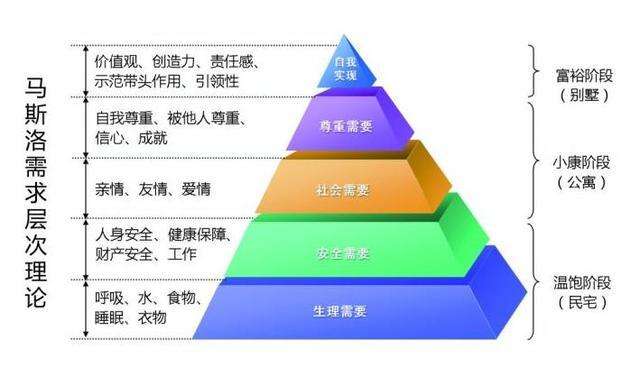
There is no single accepted definition and no widely agreed quantitative threshold. At best, the middle class is understood as the group between the wealthy and the poor. A common description says that lower-level physiological and safety needs are met, middle-level emotional and esteem needs are reasonably satisfied, but the person has not reached the stage of pursuing self-actualization. Because families are the basic unit of society and most wealth is held by households, the middle class is largely made up of middle-class families.
Such people usually do mental work or technical manual labor, earn mainly from wages and salaries, are well educated, have professional knowledge and strong occupational ability, and possess corresponding household consumption capacity. They tend to have some leisure, care about quality of life, and have a degree of management or control over their work. They are also expected to have civic awareness, public morality, and a certain level of cultivation. In economic, political, and cultural terms, they sit in the middle of society.
The usual traits can be summarized this way: basic physiological and safety needs are satisfied; emotional and esteem needs are partly satisfied; material and spiritual life is reasonably comfortable but has not reached the pursuit of self-actualization; work is mostly mental or technically based manual labor; income comes mainly from salary; education and professional skills are relatively strong; household consumption power is meaningful; there is some leisure and a pursuit of quality of life; and there is public morality and cultivation.
This description mostly points to well-paid white-collar workers and skilled blue-collar workers. It generally excludes business owners, the 'gold-collar' group whose income depends heavily on equity incentives and dividends, people who became wealthy through demolition compensation and urban-rural conversion, and of course lottery winners. The definition is broad, but it is not unlimited.
Maslow Behind the Language
The talk of physiological needs, safety, emotion, esteem, and self-actualization comes from Abraham Maslow. In his 1943 paper on human motivation, the American psychologist proposed a hierarchy of needs: physiological, safety, social, esteem, and self-actualization. Lower needs are more basic and must be met first. Once a lower need is satisfied, it stops motivating the person in the same way, and a higher need takes over.
A simple example makes the point. If someone has not solved hunger, talking about ideals and achievement may interest him very little, while the prospect of eating braised pork at noon may immediately wake him up. For someone who has rich meals and social dinners every day, braised pork may produce nausea rather than excitement. It no longer motivates. The same person might be very interested in how to stay healthy while eating heavily every day, or in learning something that would let him achieve the same results without so many dinners.
The middle class described above roughly corresponds to people who have met the first four levels of Maslow's hierarchy. It overlaps heavily with the Chinese idea of a moderately prosperous 'xiaokang' group, or at least the wealthier part of it.
Definitions Diverge Sharply Across Countries
The eight traits are descriptive, not measurable. Even the first item, basic physiological and safety needs being met, has no universal standard. In India, a largely vegetarian diet that is not finely processed may be the norm, while in China food is treated with much more care and refinement. Solving the same problem of eating enough costs very different amounts in the two countries. Safety works the same way. In Iran, a month without a car bomb or foreign military strike may feel safe; in a city like Guangzhou, a daytime robbery or even a theft can make people feel unsafe.
Education and health care show the same problem. If literacy is defined as being able to read or write in a language, Afghanistan's literacy rate is 28 percent while China's is above 99 percent. A middle-school education may count as well educated in Afghanistan; in China, at least a university degree is often expected.
The official or semi-official middle-class figures published by different countries make the gap clear. In India, a four-person household with monthly income between 20,000 and 70,000 rupees, roughly 2,000 to 7,000 yuan, is considered middle class. On that basis India had about 300 million middle-class people, around 22 percent of the population, in 2016. In the United States, a three-person household with annual income from 45,000 to 135,000 dollars, roughly 315,000 to 945,000 yuan, is middle class; a single-person household needs 26,000 to 78,000 dollars, roughly 182,000 to 546,000 yuan. That produced about 170 million middle-class Americans, around 52 percent of the population, in 2016.
China has no stable official definition. Sometimes the Credit Suisse figure is used: household net assets above 50,000 dollars, or about 350,000 yuan. On that basis China had about 109 million middle-class people, 10.7 percent of the population. Sometimes the World Bank figure is used: income above 10 dollars a day, or about 2,061 yuan a month. On that basis China had about 600 million middle-class people. In 2005, the National Bureau of Statistics used per capita GDP and purchasing power to conclude that middle-class household annual income was between 60,000 and 500,000 yuan, which implied 65.5 million middle-class people that year. Credit Suisse data put Japan's middle class, defined by household net assets of 157,000 dollars, at about 60 percent of the population in 2016.
These numbers cannot be compared across borders. A large middle-class group in one country does not prove that the country is more developed, and a smaller group does not prove that people are less happy. The category is always relative to the poor and the rich within the same country.
The Chinese Internet Standard
Chinese official statistics are inconsistent, but a fairly common internet standard circulates among netizens. It is far stricter than most official definitions. It includes: annual household income above 500,000 yuan; at least one mortgage-free home no smaller than a three-bedroom apartment; at least one mainstream-brand car; at least 1 million yuan in liquid assets such as cash, bank deposits, stocks, funds, or bonds; at least a formal university bachelor's degree, a stable job, and good social standing; a willingness to learn and a commitment to health; morality, basic civility, correct values, and social responsibility; some leisure for travel; a certain quality of life, such as enjoying concerts or ballet; spiritual pursuits beyond material ones, such as literature, calligraphy, painting, music, international cultural communication, or historical research; and an age between 25 and 45. The age requirement alone can feel like a trap: just as someone begins to think he qualifies, he may be too old.
If this standard were applied, China's middle-class population would be lower than the 2005 National Bureau of Statistics figure, even after more than a decade of rapid economic growth. This is one reason the middle class is more often counted by private institutions than by statistical bureaus. Definitions vary by country and by period, and the resulting numbers are not rigorous enough for official statistical logic.
Why the Middle Class Matters
Even when statistical bureaus do not publish a middle-class count, governments talk about the middle class because it performs several social functions.
First, it drives consumption. In any country the middle class is a major consumer force. Even in less developed countries, where the middle class is small and does not account for the largest share of consumption, it leads the structure and direction of consumption. When the economy weakens, governments think first of stimulating middle-class spending, because the middle class generally has liquid assets that can be spent. The wealthy have more property, but they are too few to contribute as much to consumption.
Second, it supports technological progress. The middle class holds much of the knowledge and skill in society and tends to be upward-looking. It has an interest in improving technology, processes, and equipment, which helps the whole society advance.
Third, it pushes social civilization forward. With more knowledge, the middle class tends to be more progressive in outlook and more concerned with personal value and respect. It is a major force for social equality. Progress in human rights, private property protection, and freedom of belief has often depended on middle-class pressure. Historically, the middle class played a key role in the Reformation, the Renaissance, the Enlightenment, the Industrial Revolution, the Commercial Revolution, the Glorious Revolution, the Meiji Restoration, the Hundred Days' Reform, and the May Fourth Movement.
Fourth, it supports stability. Better-educated people are generally more emotionally stable and less likely to take extreme action. The sharpest social tension is between the poor and the rich, and the middle class sits between them, able to communicate and mediate. In China this is especially true because many middle-class people grew up in poor families and still hope to become wealthy. They can bridge the two ends.
Why the Middle Class May Be Shrinking
As productivity rises, output becomes more abundant. Material thresholds will inevitably be passed. A purely economic definition of the middle class loses meaning. If the World Bank standard of 2,061 yuan a month is used, it will not be long before almost everyone in China qualifies, since even people on minimum living allowances may reach that figure.
The middle class has to be understood relatively, as a group between the living conditions of the rich and the poor. India, China, Japan, and the United States use income ranges that differ enormously, yet all call the people inside them middle class. If national borders are ignored, India's middle class may earn less than America's poor. The category cannot be separated from relative position. Even in a highly developed material world, society will still distinguish rich, middle, and poor, just as 1, 2, and 3 can be ranked and 10, 20, and 30 can also be ranked.
Countries pursue a large middle class because they want the stability and development that a middle class can provide. The ideal is an olive-shaped society: a small poor group, a large middle group, and a small rich group.
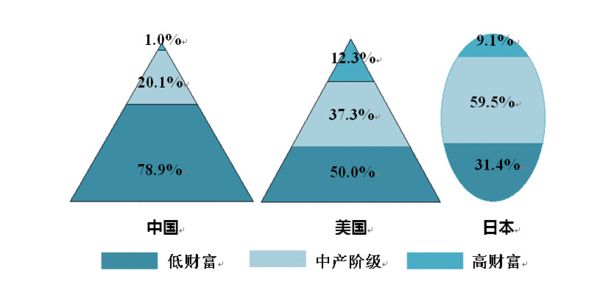
Japan comes closest to the olive shape, with the middle class at about 60 percent. China is a classic pyramid. According to CHFS, the China Household Finance Survey, the poor group is 78.9 percent. Under the Credit Suisse method the figure would be close to 89 percent.
This is why the pessimistic view holds that China's middle class is shrinking rather than growing, at least relative to the 2005 official statistics. Several forces point in that direction.
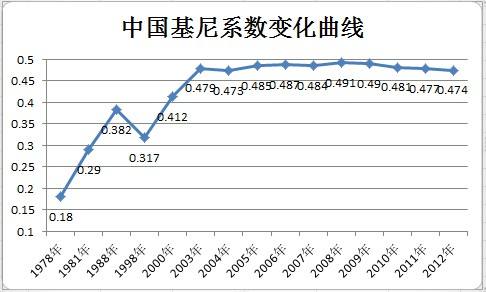
First, the wealth gap has widened and wealth is concentrating at the top. China's Gini coefficient has risen over recent years. This is not unique to China; it is a global trend. Production relies less on labor and more on machinery and equipment. A factory that once spent most of its investment on workers may now spend less than 30 percent on labor, with the rest going to equipment and land, both of which depend on capital. Capital matters more and labor matters less, so returns to capital rise. Capital is held mainly by the wealthy.
The middle class lives mainly on wages. Wage income leaves little capital for investment. What can a household invest with a few hundred thousand or a million yuan? It may not even be enough to open a restaurant. The middle class must rely on salary, and investment income is mostly out of reach. When the wealthy become wealthier, the middle class becomes relatively poorer.
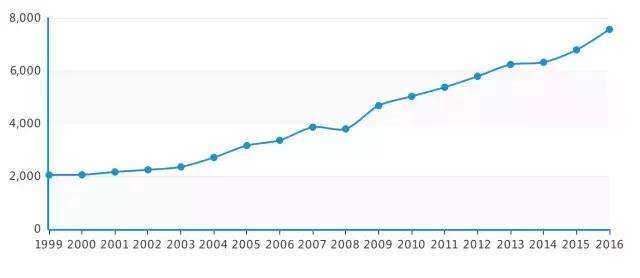
Second, rapid housing price growth has constrained middle-class asset growth. Since China's commercial housing reform in 1998, prices have generally risen, with only minor fluctuations. Housing absorbs a large share of middle-class assets. The internet standard includes a mortgage-free three-bedroom home, but in reality most buyers have mortgages. After monthly payments, disposable income may be less than 40 percent of nominal income. Counting such people as middle class by nominal salary alone is misleading.
Why does a mortgage matter for class status? Because housing prices fluctuate. They have risen for nearly two decades, but no commodity can rise forever. A class should not change because prices fall. If housing prices dropped sharply, many families would have negative equity and would be worse off than the poor.
Third, consumption habits are shifting toward spending ahead of income, and household net assets are falling. In April 2018, People's Bank of China data showed 535.2 billion yuan in new deposits, but the increase came mainly from the corporate sector. Household deposits fell by 1.32 trillion yuan, the largest monthly drop on record. A China Household Finance Report from Southwestern University of Finance and Economics found that the top 10 percent of savers held 75 percent of all savings, the next 35 percent held 25 percent, and the remaining 55 percent had zero savings. A Chinese Academy of Social Sciences housing report covering 2017-2018 said that by the end of 2016 the residential mortgage ratio had risen to 50 percent, close to the level in the United States before the 2007 subprime crisis. Household debt was mainly consumer loans, about two-thirds of resident debt and roughly twice operating loans. Within consumer loans, medium- and long-term loans, mainly mortgages, made up about 80 percent.
Consumption awareness is rising while saving awareness is weakening, so household net assets are shrinking. This conflicts sharply with the middle-class condition of 1 million yuan or more in cash or cash equivalents. Many families may earn 500,000 yuan a year, but few have a fully paid home and 1 million yuan in cash.
Fourth, work rhythms have accelerated and leisure has shrunk. High-income groups often work under heavy pressure. The 996 schedule, from 9 a.m. to 9 p.m. six days a week, has become common in some companies. High pay often means giving up leisure. The price is no time to travel, no time for musical theater, and sometimes no time to have children and enjoy family life. In Maslow's terms, their social needs are deeply unmet. They are spiritually poor.
Fifth, incomes have risen, but civility has not, and in some ways has regressed. As incomes rise, people depend less on one another, so moral constraints weaken. If someone behaves badly, a father's criticism may be heard quietly, a grandfather's criticism may be answered back, and a stranger's criticism may be met with hostility. If a person parks illegally and a passerby points out that parking is prohibited, the response may be 'none of your business' or a slap. When morality loses its hold, enforcing moral behavior becomes extremely costly.
People often speak from a high moral position when their own interests are not involved, but reveal their true priorities when interests are at stake. A compound with 100 cars and only 70 parking spaces will leave 30 cars outside. When the 70 spaces fill up and the guard refuses to let more cars in, the blocked owners will complain: why are they allowed and we are not, when we are all owners? If they are let in and park along the road, blocking traffic, other owners will complain: why does the guard not stop them? If the owners swap places the next day, the ones who had spaces the day before will complain just as loudly.
The same applies to public order, resource conservation, and care for others. Many people know that plastic products pollute the environment. When China banned plastic waste imports in 2018, people cheered and praised the country for choosing environmental and public health over short-term economic gain. Yet China is the world's largest consumer of plastic lunch boxes and disposable tableware. If someone who orders takeout frequently is urged to eat in a restaurant and reduce disposable packaging, the likely response is 'you're crazy.' Examples are easy to multiply.
If the current income-defined middle class were filtered by behavior, the result would be striking. Eliminate people who litter, and perhaps half would go. Eliminate uncivil driving, and half of the remainder might go. Eliminate wasting or damaging public resources, and perhaps less than one-eighth would remain.
Sixth, people are less interested in learning. Some people study continuously, but mostly for work skills, such as programmers learning programming languages. Fewer are interested in social science, literature, or art. Many believe that knowledge which does not produce income is unnecessary. Without learning, spiritual depth does not grow. Without knowledge, spiritual needs remain underdeveloped, and genuine spiritual satisfaction is hard to achieve.
Television dramas often show the newly rich. If told that he lacks cultivation or knowledge, such a character may slap down 10,000 yuan and say: 'What is knowledge? How much is it per catty? Give me 10,000 yuan's worth. If it is short of weight, give me 100,000 yuan's worth.' That is the typical figure who has money but does not qualify as middle class.
With economic development, income measured in money will keep rising, and the statistically defined middle class will grow. But when relative income, personal quality, learning habits, and leisure time are taken into account, the sociologically defined middle class is shrinking.
The point bears repeating: the middle class exists relative to the poor and the rich. No matter how much incomes rise, there will still be a relatively poor group. A society cannot be 100 percent middle class and rich. Across history, poor and rich have always been relative. Today's poor may eat meat, wear new clothes, and take the bus, a standard that only the rich could reach in feudal times. Does that make today's poor rich?
Suppose future transport offers cars, planes, and time machines. The poor drive cars, the middle class flies planes, and the rich use time machines. By today's standard, a person with a mainstream-brand car is middle class, but at that future point anyone who cannot afford a plane or a time machine is poor, even if the car is a Mercedes.