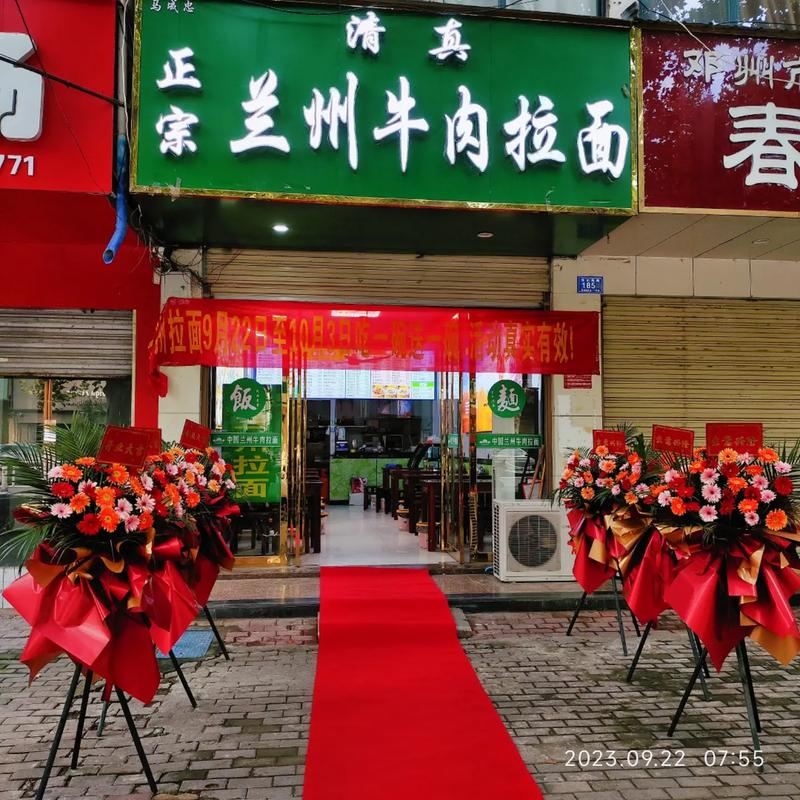
The town is small, and the snack scene is smaller. Even so, a few people and places have stayed with me, and I want to leave a small record of them—proof that these things were here.
Like Naruto, I am fond of noodles. In this town I keep an eye out for new noodle shops, and when one appears I have to go in and try it. So I was glad when this Lanzhou noodle shop chose our town. It is new only in comparison with the places I usually go to; by now it has been here almost a year.
The owner is from elsewhere. From his accent I took him to be a Hui Muslim from Lanzhou in Gansu. His household seemed to be six people: the owner, his wife, his son, his son's wife, his daughter, and his grandson. There were also two girls and three boys who looked as if they had come from the same place.
People from elsewhere are not quite the same as the locals here. The first difference is the accent. They have their own dialect, and when they serve customers they use a stiff, broken Mandarin. The tone is easy to imitate. Each time I went for noodles, I would mimic it and greet them in the same awkward way. They were hospitable and did not take offense. If anything, they treated me more warmly than the other customers.
The owner has a big beard, something like Afanti's in Xinjiang, and he always wears a small white six-cornered cap. His wife and daughter-in-law wear black silk scarves and do not take them off even in the hottest summer weather. The shop has several posters. One is large and introduces Lanzhou noodles; others show mosques and an illustrated menu. Under the menu pictures there is a note: Islamic custom, no outside food, no tobacco or alcohol, please cooperate.
The little shop means it. It sells no cigarettes and no alcohol, not even Sprite or Coca-Cola. The only thing to drink is free hot water. When it first opened, that was a little odd for this town. In summer, new customers who did not know the rule would call out for a bottle of beer or a pack of cigarettes. The answer was always the same: nothing in the shop. They had to go next door. I had eaten there enough to know the rule, so if I wanted a drink I bought it next door first, opened it, and carried it in. I had heard that in Gansu or in Hui Muslim areas, eating in their restaurant while drinking might earn you a hard look. But this is inland, and they are more relaxed about the rules. I often drank in the shop and never got the hard look.
The owner's son looked twenty-four or twenty-five, while the owner's daughter was only seven or eight. That surprised me. When I first saw the wife and daughter, I thought they were grandmother and granddaughter. These outsiders look older than the locals, especially the women. Someone in her forties can look like she is in her sixties. Life's hardships can age a person quickly.
Whether the shop is really from Lanzhou, or from somewhere else, does not matter as long as the noodles are good. It is like life itself: if you are happy, that is enough; there is no need to dig to the bottom of it. Perhaps they really are from Lanzhou, and my doubt is unnecessary. Perhaps they only use the Lanzhou name to make a little more money. If I asked, I would lose my appetite for the noodles.
However that may be, their Lanzhou noodles are good. After work, in my free time, I brought colleagues and high-school classmates there, and they all said the noodles were good without being prompted. The only place I can compare it to is a noodle shop near my university in Zhengzhou. Time has passed, and I cannot eat that Zhengzhou bowl anymore. Now I am lucky enough to have this one. Sometimes I think life has to move forward, so even in the sadness there is something to be glad about.
This afternoon, after basketball, I went and ate a big bowl. Four and a half yuan, filling and good, and the soup was especially tasty. The owner's son, the tall boy, had gone back home; I had not seen him on my last few visits. Today, as soon as I walked in, he grabbed my hand and greeted me loudly, this stranger whose name he did not know. My mood lifted at once.
Food, clothing, shelter, travel—all can be enjoyed. Here in this small town I often enjoy the happiness of a bowl of noodles. I am grateful to the people who give me that happiness. I am willing to spend some of my life remembering them, and I hope their lives become better too.