What systematic learning actually means
Systematic learning is not just “learning a lot.” It means building a complete enough grasp of a field that you can truly understand it and put it to use.
Take software development as a simple example. If you want to build software with a programming language, you cannot stop at learning a few bits of syntax. You need at least:
- the language’s syntax
- its standard library
- its third-party libraries
- and, if you want to write good software, some knowledge of software engineering
Knowing only one syntax feature is useless. Even mastering the syntax alone is still not enough if you know nothing about the libraries that make actual development possible. And even after you know syntax and libraries, writing strong software usually requires a broader engineering framework.
That is what systematic learning looks like: not isolated fragments, but a coherent whole.
Two traits define it:
- breadth
- depth
If you lack either one, it is hard to say you have really mastered a domain in a systematic way. But breadth and depth are only the visible signs. The real goal is something deeper:
genuine understanding.
Only when you understand a field can you actually use it.
Why the form of the medium matters
Learning always happens through some medium: books, television, newspapers, magazines, websites, video, social platforms, and so on. The form is not a neutral container. It shapes how you think.
This is why the old insight that the medium is the message matters so much. Earlier discussions of communication often focused mainly on content. But the form of the medium can matter just as much, and sometimes more, because it directly affects cognition.
So if your goal is systematic learning, choosing the right medium is not a side issue. It is central.
And the more difficult or complex the subject is, the more obvious this becomes.
Why books remain the best medium for systematic learning
For this kind of learning, books are the strongest option.
To see why, compare them with several common online formats.
Encyclopedia-style websites
These are often good for breadth, at least in a loose sense, but weak in depth.
Suppose you want to understand uncertainty seriously. A few encyclopedia entries may give you a neat overview, but that is nowhere near the richness of several major books built around the subject. A single page, however competent, cannot replace a full-scale treatment developed across multiple volumes.
Q&A websites
These have the opposite profile. Some answers can be impressively detailed, and the questions may cover many corners of a field.
But they do not naturally gather a domain into a structured whole. In practice, you cannot use them to assemble a field systematically with reliable breadth. And while some answers may go deep, their depth still usually falls short of a strong book.
Social platforms
This includes microblogs and instant messaging spaces.
For learning, these are almost useless. They have neither breadth nor depth, the fragmentation is severe, and the signal-to-noise ratio is poor.
Forums
These are not much better. They often share the same problems as social platforms.
Video platforms
Teaching videos have become popular, and some people place them on the same level as books.
Good instructional videos can absolutely offer both breadth and depth. But video still inherits the weaknesses of video as a medium. It is linear, harder to scan, harder to annotate deeply, harder to revisit efficiently, and often less friendly to careful comparison and slow reflection than text.
For systematic study, books still have no real rival.
From here on, it makes sense to focus on books.
Three kinds of reading: popular, introductory, and specialized
For systematic learning, books can be divided into three broad categories.
Popular reading
This is written for outsiders.
To be accessible, it usually avoids technical terminology and does not require prior knowledge from supporting disciplines.
Theoretical physics is a good example. It depends heavily on mathematics. Quantum mechanics leans on partial differential equations; general relativity relies on Riemannian geometry, differential geometry, tensor analysis, and more. Yet a well-written popular physics book can still be read by someone with no formal mathematical background.
That accessibility comes at a cost:
- popular books usually lack depth
- most of them also lack true breadth
- only a minority manage to achieve some breadth while staying accessible
A useful model here is the Very Short Introductions series from Oxford University Press. Since 1995, it has published concise, expert-written introductions to individual topics, usually around 100 to 150 pages, often with suggestions for further reading. By the third quarter of 2019, the series had grown to more than 600 volumes. It is a strong example of popular-level writing done well.
Introductory reading
This usually includes beginner textbooks.
The key difference from popular reading is that introductory books assume some background knowledge from prerequisite fields.
Again, think of theoretical physics. An introductory text assumes the reader already has the needed mathematics. It introduces physics, not math. The author is not obliged to stop and re-teach every mathematical tool used in the book. A reader lacking that foundation will quickly get lost.
That difference in assumed background creates a large difference in difficulty.
There is another major difference too: breadth.
Popular books usually do not provide a systematic map of a field. Introductory books, especially textbooks, usually do. In fact, if a textbook fails to provide adequate breadth, it is a poor textbook.
Specialized reading
Introductory books are generally broad enough, but they usually do not go very deep.
If you want real depth in a specific branch, you need specialized reading. This category is narrow by design. Its aim is depth, not breadth.
Academic papers often belong here, and so do certain advanced monographs focused on a specific subfield.
A quick comparison
<table> <thead> <tr> <th>Type</th> <th>Breadth</th> <th>Depth</th> <th>Threshold</th> </tr> </thead> <tbody> <tr> <td>Popular reading</td> <td>Usually limited; a few excellent works offer some breadth</td> <td>Limited</td> <td>Very low</td> </tr> <tr> <td>Introductory reading</td> <td>Usually broad enough</td> <td>Moderate</td> <td>Depends on the field</td> </tr> <tr> <td>Specialized reading</td> <td>Narrow</td> <td>Deep</td> <td>Usually high</td> </tr> </tbody> </table>How to choose books well
Start with the 80/20 reality
The Pareto principle shows up in books too. In any field, truly excellent works make up only a small fraction of what is available. In many mass-market areas, the ratio may be far lower than 20 percent—sometimes vanishingly small.
So if you want systematic learning, you should try hard to read the best books, not just any books.
Finding them efficiently is a big topic in itself, but the underlying point is simple: selection matters enormously.
Value diversity of viewpoints
Some fields contain competing schools or traditions. When you first enter such a field, it is wise to gain at least some familiarity with the major camps.
That helps prevent one-sided understanding.
It also sharpens critical thinking. Once you see where rival schools disagree, you can begin asking better questions:
- Why do these disagreements exist?
- What assumptions differ?
- Which side is more convincing, and under what conditions?
That habit is valuable far beyond the field itself.
Pay attention to writing style
Different authors explain the same subject in very different ways.
If a difficult field still feels opaque after one introductory book, try another author writing on the same topic.
Algorithms is a good example. Several classic books can all cover the field systematically while differing greatly in organization, emphasis, and style. A book that leaves one reader frustrated may be the one that finally makes the subject click for another.
The Feynman method: learning by trying to teach
What it is
The Feynman method can be summarized in one phrase:
learn by teaching.
When studying a field, imagine that you must explain a part of it to someone with very little background. In practical terms, this forces you to produce something like a popular-level explanation of a specific branch of the field.
That is much harder than it sounds.
What happens when you try it
In the ideal case, if you have truly mastered a topic, you should be able to explain it clearly to a beginner without much strain.
If you have not, several things tend to happen.
Situation 1: you do not even know how to begin
This is the worst case. It usually means your understanding is still missing a systematic framework.
The remedy is straightforward: go back and re-read the introductory material.
Situation 2: you keep getting stuck while explaining
This usually means you have some systematic grasp, but parts of the structure are still not properly connected in your head.
Where you get stuck is exactly where your blind spots are.
The fix is to strengthen those missing links.
Situation 3: you can explain it fluently, but beginners still cannot follow
In that case, the problem is not only knowledge. It is your ability to make things clear.
Ask the listener where they got lost. That point marks another blind spot—this time in your explanatory model.
An extra benefit people often overlook
The Feynman method strengthens perspective-taking.
To explain a subject to a novice, you must repeatedly shift into the novice’s viewpoint. Over time, that builds the ability to see from another person’s position.
That is useful not only for teaching and writing, but for communication in general.
After the basics: where should your time and energy go?
Some fields contain many branches. Others have only a few branches, but each one is deep enough to consume years.
If time and energy are limited, you cannot always master everything equally. That means making choices.
Two criteria matter most.
Foundational importance
Different branches within a field often depend on one another. When they do, the depended-on branch is more fundamental.
Programming is a simple illustration:
- syntax underlies standard libraries
- standard libraries support third-party libraries
- third-party libraries often build on both
So syntax is more foundational than the standard library, and the standard library is more foundational than third-party libraries.
The more foundational a branch is, the more seriously you should study it.
This is like constructing a building. Upper floors rely on lower ones. The lower the level, the stronger the structural requirements.
Practical use
This part is easier to grasp. If a branch is peripheral rather than foundational, the amount of effort it deserves depends on whether it is useful to you.
There is also a special form of usefulness worth noting: interest.
In many cases, what is pursued out of genuine interest turns out to be more durable and more productive than what is pursued only for short-term utility.
Why foundations matter more than immediate utility
A very common mistake—especially among younger learners—is to care only about what seems directly useful and ignore foundations.
On the surface, this looks efficient. In reality, weak fundamentals make it hard to reach a high level later. It is a classic case of trying to move too fast and ending up slower.
This weakness often shows up clearly when using the Feynman method. People who chase utility while neglecting foundations are much more likely to get stuck.
There is another payoff too: the more foundational something is, the more likely it is to transfer across fields.
That leads directly to the DIKW model.
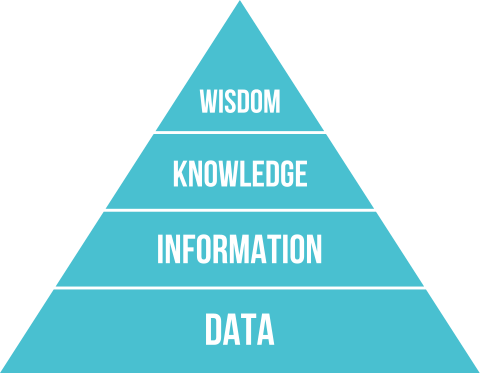
The DIKW model: Data, Information, Knowledge, Wisdom
The DIKW model began as a theory in knowledge management and has since been interpreted in several ways. The version here emphasizes the practical differences between the layers.
Data vs. Information
A weather station makes the distinction clear.
In different parts of a city, instruments record temperature readings at intervals. Each individual reading is data.
If you collect all the readings from a time period and process them—for example, by averaging them—you get the temperature for that period. That is information.
A single data point often means very little by itself. Information is what carries immediate meaning.
When you check the current temperature on a weather site, you are not looking at raw data. You are looking at information.
Information vs. Knowledge
Now imagine collecting daily temperatures for a city across many years. From that accumulation, you can reach conclusions about the climate: whether the city is generally hot or cold, or whether it is pleasant to live in. That kind of conclusion is knowledge.
Two differences matter here.
Lifespan
Information is short-lived. Knowledge lasts longer.
Today’s temperature is information. Few people care about the exact temperature on some random day many years ago, except perhaps specialists.
Fragmentation
Information is not only short-lived, it is also highly fragmented.
Knowledge is less fragmented and can be organized into a system.
This is one reason social platforms are so poor for learning. Most of what circulates there is information in the lowest sense: short-lived, fragmented, and quickly forgotten. Spending all day immersed in such material rarely leads to much durable gain.
Knowledge vs. Wisdom
The difference here is harder to explain, but also more important.
A useful way to think about it is through three kinds of questions:
- WHAT
- HOW
- WHY
Some interpretations of DIKW align these cleanly:
- information → WHAT
- knowledge → HOW
- wisdom → WHY
That mapping is useful, but it can be made more precise.
Knowledge is not limited to HOW. It can also include certain kinds of WHAT. For example, “Is this city’s climate pleasant?” is a WHAT-question, but the answer is clearly at the level of knowledge rather than raw information.
So what separates the two kinds of WHAT?
A practical answer is lifespan.
- Information answers short-lived WHAT-questions.
- Knowledge answers long-lived WHAT-questions and all HOW-questions.
That leaves wisdom.
Wisdom is most closely tied to WHY-questions.
WHY sits at a higher level than WHAT or HOW. If you can answer the WHY behind a branch of a field, that usually shows you truly understand it.
This is also why WHY-questions are so useful in interviews. They reveal whether someone has real understanding rather than memorized formulas. They are also harder to fake, because they usually do not have one standard canned answer.
Single-field vs. cross-field value
Another difference between knowledge and wisdom is scope.
Knowledge is usually attached to a particular domain. Wisdom may remain within one domain, but some forms of wisdom travel across many domains.
That second kind is far more valuable.
Cross-disciplinary wisdom
The clearest examples of wisdom are often ideas that begin in one field and then prove useful in many others.
Example: the indirect approach
B. H. Liddell Hart’s Strategy is built on military history. The historical campaigns and cases it analyzes count as knowledge. But the broader principle extracted from them—the indirect approach—belongs to wisdom.
And it does not stay inside military affairs.
The same strategic pattern can be applied in:
- trade conflict
- investing and speculation
- business competition
- personal career decisions
That is the signature of cross-disciplinary wisdom: it survives translation from one domain to another.
Example: entropy everywhere
Entropy is an especially rich example.
In simple terms, entropy refers to the degree of disorder in a system.
Entropy in thermodynamics
The idea originated in the second law of thermodynamics.
Clausius stated that in an isolated system, heat does not spontaneously flow from a colder body to a hotter one.
Lord Kelvin stated that in an isolated system, you cannot take heat from a single heat source and convert it completely into work without any other effect.
Boltzmann later got closer to the essence: for an isolated system, the disorder at the microscopic level tends to increase.
That shift matters. The earlier statements describe the phenomenon. The later one gets closer to the underlying nature.
And in general, the closer you get to essence, the closer you are to wisdom.
Entropy in information theory
Entropy is one of the core concepts of information theory, first developed by Claude Shannon.
Understanding information entropy helps make sense of many things in computing. For instance, it clarifies the logic of data compression. Once you grasp that, you also understand why truly random data cannot be compressed. No future compression algorithm, however sophisticated, can compress perfectly random data. That can be shown mathematically.
Entropy in cryptography
Entropy is crucial in cryptography as well.
A key generation function must draw on sufficiently high entropy so that attackers cannot easily predict the distribution of keys. In this branch of the subject, entropy is not a problem but an asset.
Entropy in management
Many startups are dynamic and creative when small, then grow sluggish and rigid as they scale.
There are many reasons for this, but one way to describe part of the problem is rising entropy.
A company with a few dozen people can often maintain relatively low disorder. Once it expands to tens of thousands, keeping that same degree of coherence becomes vastly harder.
In theory, an organization can reduce overall entropy by replacing stagnant parts with fresher ones, much like lowering entropy in a thermodynamic system by removing high-entropy material and bringing in lower-entropy material. In practice, of course, theory and practice diverge.
As the saying goes:
In theory, there is no difference between theory and practice. But in practice, there is.
Entropy in politics
Political systems also have bureaucratic structures. The larger the bureaucracy, the harder it becomes to keep the system at low entropy.
So the larger the bureaucratic machinery, the more likely it is to become rigid and inefficient.
Entropy in history
Much of premodern Chinese history can be described as dynastic cycles of order and disorder.
These cycles have many causes, but one of them lies in institutional self-collapse.
Large bureaucracies tend to grow larger. Power tends to seek more power. As the system expands, it becomes both more rigid and more resource-hungry, even though bureaucracy itself does not directly produce social wealth. By the end of a dynasty, the system can become too heavy for society to sustain.
Entropy in cosmology
The universe itself can be treated as an isolated system, so the second law extends all the way to cosmology. In that sense, the universe trends toward heat death.
For a literary expression of this idea, Isaac Asimov’s short story “The Last Question” remains a fitting choice.
Asimov is often remembered only as a giant of science fiction, but he was far broader than that. He wrote more than 500 books across a remarkable range of subjects, including a great deal of science popularization. That breadth was no accident. It reflects exactly the kind of systematic learning discussed here.
A practical path
If the goal is real mastery rather than scattered familiarity, the path is not mysterious.
Choose the right medium. Prefer books when the subject is deep. Move from popular works to introductory texts and then to specialized material. Select carefully, compare different schools and authors, and use teaching as a test of understanding. Give extra attention to foundational branches. And keep climbing from information to knowledge, and from knowledge toward wisdom—especially the kind that crosses boundaries between fields.
That is what systematic learning looks like when taken seriously.