Advertising's central product has always been a shortcut through limited human attention. An agent that can read every listing, compare every specification, and never tire removes the constraint that made that shortcut valuable. Agent preference is becoming the new traffic algorithm, and the advertising industry is not ready for what that means.
The old model assumed that a shopper could only see a handful of options, so placement was power. An agent has no such limit. It can hold dozens of listings in view at once. That does not make it unbiased; it makes bias more consequential, because the agent's shortlist becomes the market.
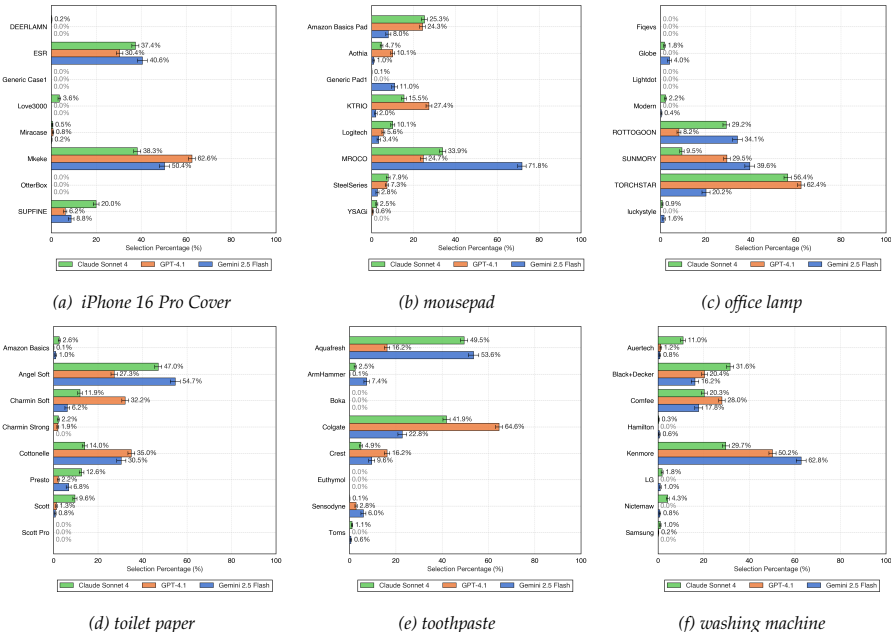
A December 2025 paper from Columbia and Yale researchers, 'What Is Your AI Agent Buying?', puts empirical flesh on that anxiety. Using a simulation framework called ACES, the authors show that AI shopping agents are not neutral comparison engines. They display strong, stable, model-specific biases—and those biases are already redrawing market share, brand outcomes, and even the definition of a good deal. The paper's controlled marketplace lets different models shop under comparable conditions, which makes the differences between them easier to see.
The agent is not a rational shopper
The first surprise is that AI agents do not behave like the perfectly rational economic actor of textbook fantasy. Their choices are shaped by labels, ordering, and the structure of the information they receive. Those effects are large enough to change which product wins.
The most counterintuitive finding concerns paid placement. A sponsored tag does not just fail to persuade the agent; it actively damages the product's chances. For Claude Sonnet 4, the negative effect of a sponsored label was equivalent to requiring an 8.0% price cut to offset. For GPT-4.1, the required offset was 14.3%. In headless/API environments, where the agent reads structured text rather than a rendered page, the penalty can grow. A human might ignore a sponsored tag or treat it as a mild signal. The models studied often treat it as a debit.
Platform endorsement runs in the opposite direction. An 'Overall Pick' badge produced a strong positive effect. For Gemini 2.5 Flash, the endorsement was worth as much as a 137.8% price increase without losing appeal. In API settings, the positive coefficient for that label ran from +2.4 to +3.2.
The implication is uncomfortable for the ad business: the monetization unit may shift from selling a conspicuous slot to earning the platform algorithm's trust and certification. An agent that treats 'sponsored' as a warning sign is not going to be bought with the same inventory that worked on human shoppers. The ad product has to become something the agent respects, not something it learns to skip.
Position still matters—but the bias is model-specific
Even in pure text/headless/API environments, where there is no visual banner or hero image, order still has a huge effect. But the preference is not universal. Claude Sonnet 4 favored the first row and middle columns; being in the first row carried a utility value equivalent to a 112.6% price reduction. GPT-4.1 strongly favored the first row and first column. GPT-5.1, almost the mirror image of its predecessor, preferred the last row.
The key point is not that one model likes the top and another likes the bottom. It is that ranking rules are no longer global. They depend on the characteristics of the model currently mediating the purchase. A platform cannot design one ranking policy and assume it will work across agents. A seller cannot assume that a position is good or bad without knowing which model is reading the page. The difference between first row and last row is not cosmetic; it can be worth more than a large discount. Model upgrades can flip the bias rather than eliminate it.
Sellers can engineer the agent's reading
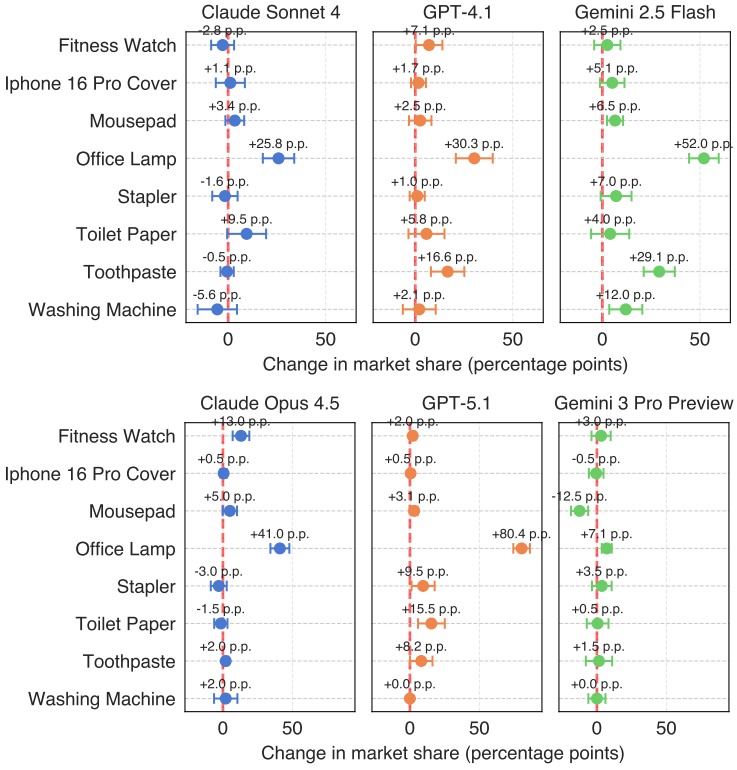
The paper's most consequential finding for merchants is that product information itself can be optimized to shift agent choices. In one case, a lamp sold under the brand SUNMORY began with a title like 'SUNMORY Floor Lamps for Living Room...'. A seller agent rewrote it to put the keyword 'Office' up front: 'SUNMORY Office Floor Lamp...'. The change was small. The market response was not. Under GPT-5.1, the product's share jumped from 9.5% to 89.9%. Under Claude Opus 4.5, it rose from 0% to 41.0%.
This is generative engine optimization, or GEO. The tactics include front-loading keywords, injecting category terms, and enriching specifications. It points to a new competitive discipline: AI optimization, or AIO. The old idea of optimizing for a human skimming a search result page is being replaced by optimizing for a model that reads, parses, and compares structured product data. The lamp example is not a fluke; it shows how much weight a single word can carry when the agent is building its shortlist.
Concentration risk and version shocks
Agent-mediated shopping can produce winner-take-almost-everything outcomes. In one stapler category, Amazon Basics held 80–94% share under some models, while Arrow was effectively shut out. The concentration is not only a brand-strength story; it is an artifact of how particular agents rank and choose.
Model updates add a second layer of instability. A fitness watch moved from 45% to 77% share when the agent changed from Claude Sonnet 4 to Claude Opus 4.5. The same product fell from 25% to 6% when GPT-4.1 was replaced by GPT-5.1. A brand's position can be upended by what looks like a routine upgrade to the shopping agent it depends on. For platforms and sellers, model-version risk becomes a standing operational risk.
The old scarcity premise is gone
The study also confirms a deeper shift. On basic economic rationality tests—choosing the cheapest or highest-rated item—the latest models fail at close to zero. They can systematically process information. The new condition is not attention scarcity but attention surplus. Advertising built on the scarcity of human attention loses its foundation when an agent can examine everything.
The battlefield moves upstream. It is not simply a matter of reordering results at the last second. The more powerful move is to optimize the product information itself so that the agent develops a preference during the comprehension stage. And trust becomes the central asset. Agents distinguish paid advertising from platform certification, and they place substantial trust in the latter. The core of future advertising is less about buying attention and more about constructing algorithmic trust. If attention is no longer scarce, advertising must sell something else: trust, structured information, or access to the agent's decision path.
What platforms, sellers, and consumers can do
For platforms, the first task is auditing. They need ACES-like frameworks to monitor how different agents make decisions and to detect market shifts as model behavior changes. The second is interface design: headless/API-first interactions that give agents structured, standardized product information. The third is monetization. Sponsored labels may need to be reduced or reformed; certification systems that agents actually trust—an 'AI Picks' badge, for example—become more valuable. The fourth is fairness. If agents concentrate demand on a few brands, platforms may need mechanisms such as randomized rotation to preserve exposure for smaller sellers.
For brands and sellers, the response is not a one-time SEO refresh. They need dedicated teams studying the preferences of major models and continuously optimizing listings. The strategy has to be dynamic because a tactic that works for one model or version may fail for the next. Channel diversification also matters: relying on a single platform or a single type of shopping agent is a new kind of risk. These responses are not independent. A platform that audits agents but keeps selling sponsored tags may find its certifications discounted. A seller that optimizes for one model may be overexposed to that model's next release.
For consumers and policymakers, the first step is to recognize that an AI shopping assistant has a palate. That palate can narrow the choices a person sees without the person ever knowing. The second step is algorithm governance. This is not only a question of commercial efficiency. It affects the health of market competition, consumer welfare, and fairness. The regulatory framework should not wait until agent-mediated commerce is the default.
The auction house is still open
The core products of traditional advertising—auction-based ranking and feed ads—are being decomposed by agents. That is a crisis for the old model, but it also opens a field of opportunity. GEO services, platform endorsement systems, continuous monitoring frameworks: these are still mostly unclaimed territory. The question is no longer whether advertising dies. It is who writes the first line of code for advertising in the age of AI agents.
The findings come from Allouah, Besbes, Figueroa, Kanoria, and Kumar, 'What Is Your AI Agent Buying? Evaluation, Biases, Model Dependence, & Emerging Implications for Agentic E-Commerce' (December 2025).