The key concepts below are the ones most people get stuck on first when trying to understand pension insurance from scratch:
- What is the “average social wage”?
- Is the social insurance contribution base the same thing as the average social wage?
- Contribution tiers and monthly payment amounts
- Your pension personal account and how the balance works
- A quick way to estimate retirement income
- The actual pension calculation rules
- What “retirement” really means
- The delayed retirement policy
1. What is the “average social wage”?
In simple terms, this refers to the average monthly wage of employees in the province or city during the previous year, as officially published by the local government. It matters because many pension calculations are tied to it.
For example:
- In Heilongjiang, the 2023 average monthly wage was 7,010 yuan.
- In Beijing, the 2023 average monthly wage was 11,761 yuan.
Heilongjiang’s figure was published for use in 2024 pension contribution and benefit calculations. Beijing’s figure was calculated from a weighted combination of average wages in urban non-private and private sector units, and is used to determine the upper and lower bounds for individual social insurance contribution bases.
So when people talk about the local “social average wage,” they usually mean this officially released benchmark from the prior year.
2. Is the contribution base the same as the average social wage?
Not necessarily.
The social insurance contribution base is determined with reference to the average social wage, but the two are not always identical.
Heilongjiang example
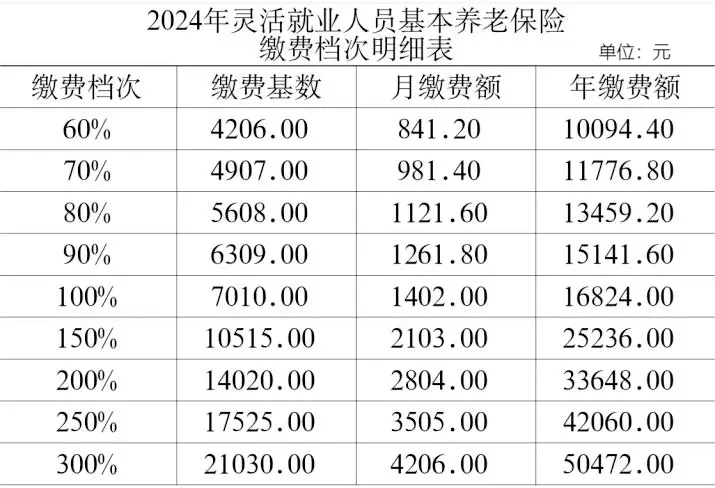
In Heilongjiang in 2024, the contribution base for enterprise employees at the 100% tier is exactly 7,010 yuan, which matches the local average social wage. The lower limit is 4,206 yuan, equal to 60% of 7,010.
Beijing example
In Beijing in 2024:
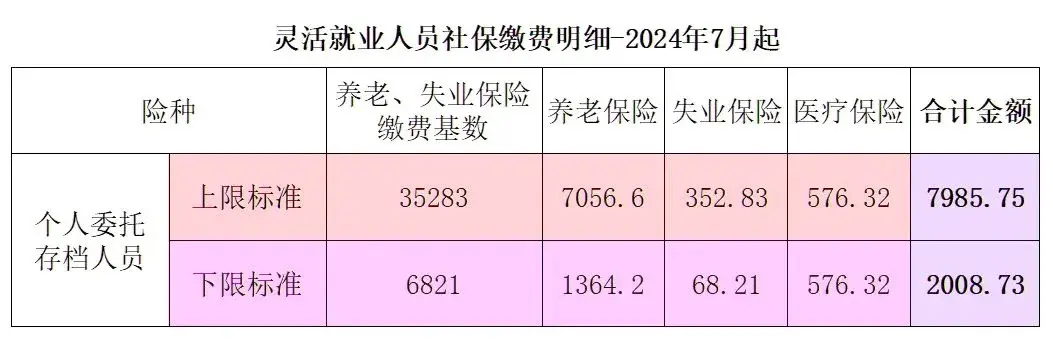
- the lower contribution base for enterprise employees is 6,821 yuan
- the lower contribution base for government and public institution employees is 7,057 yuan
These figures are both related to the local average social wage of 11,761 yuan per month, and 60% of that amount is 7,056.6 yuan, which rounds to 7,057 yuan.
What this shows is that the contribution base is linked to the average social wage, but local implementation can still be somewhat flexible. In Beijing, the lower base for enterprise employees is lower than that for public-sector employees, which suggests the city is using that flexibility in part to reduce the social insurance burden on businesses.
As a general rule under current policy, the lower limit of the contribution base is usually no lower than 60% of the average social wage, and the upper limit is usually no higher than 300% of it.
The contribution base only becomes equal to the average social wage under a specific condition:
only when the local policy defines the 100% tier using the previous year’s average monthly social wage, and the insured person actually chooses the 100% tier.
For instance, Heilongjiang’s average social wage in 2024 is 7,010 yuan, and the policy sets the 100% contribution tier at 7,010 yuan. In that case, someone contributing at the 100% tier does in fact have a contribution base equal to the average social wage.
3. Contribution tiers and monthly payments
Once you know the contribution tier, you can determine the monthly payment amount.
Under current rules, for flexibly employed individuals, the monthly pension insurance contribution is 20% of the contribution base.
Heilongjiang
For a flexibly employed person in Heilongjiang, the minimum monthly pension contribution is 841.2 yuan.
Beijing
For a flexibly employed person in Beijing, the minimum monthly pension contribution is 1,364.2 yuan.
One important extra note: Beijing does not allow non-Beijing hukou holders to participate in social insurance as flexibly employed individuals.
4. Your personal pension account and account balance
The 20% monthly pension contribution is split into two parts:
- 12% goes into the pooled fund
- 8% goes into your individual account
The pooled fund is the big shared pool. After retirement, part of your monthly pension comes from that pool according to the applicable rules, and another part comes from your personal account. Together, those make up your monthly pension payment.
Take the minimum flexible-employment contribution in Heilongjiang as an example. Out of the 841.2 yuan paid each month, 336.48 yuan goes into the individual account.
How to check the balance
Balance inquiries are generally handled through provincial government service platforms or mini programs.
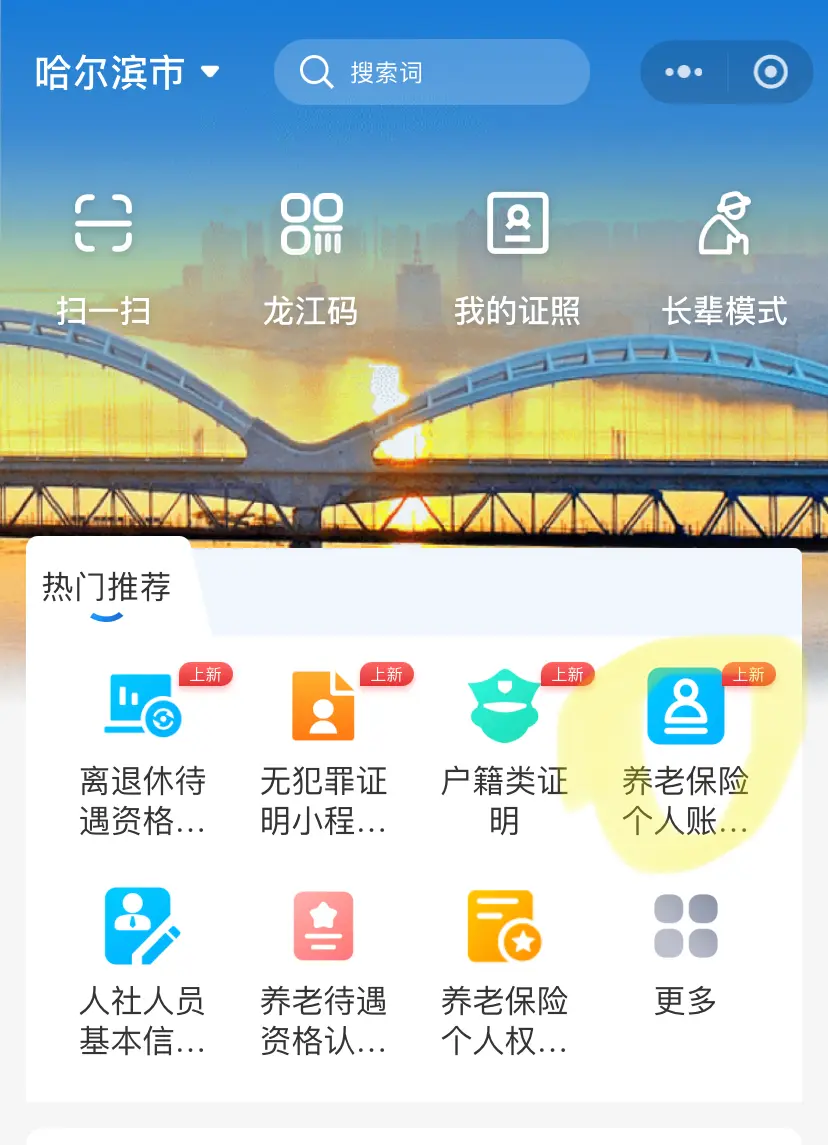
For example, in Harbin, you can use the “Heilongjiang Quanshengshi” mini program. After switching the city to Harbin, you can find pension insurance personal account inquiry in the featured section or under more services.
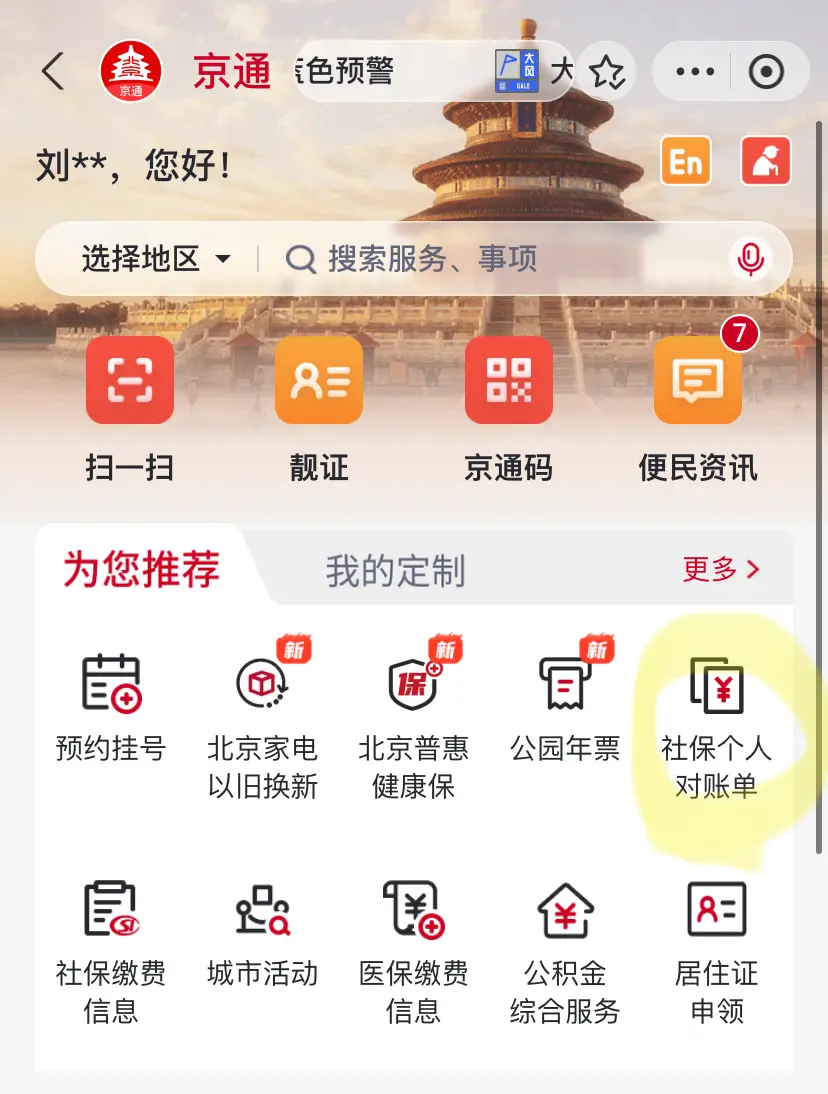
In Beijing, the balance can be checked through the “Jingtong” mini program under social insurance personal statement.
5. A quick estimate of retirement income
This is not an official formula. It is just a rough rule of thumb for getting a fast estimate.
The quick formula is:
= (缴费年限 + 个人账户余额(单位为万)) x 100
For example, if you have paid into the system for 20 years and your personal account balance has accumulated to 80,000 yuan, then:
(20 + 8) x 100 = 2800 / 月
That gives an estimated monthly pension of 2,800 yuan.
As an experience-based shortcut, this rough formula usually does not drift too far off in many ordinary cases.
6. How pension benefits are actually calculated
You can estimate future pension income using the formal rules, but nobody can know in advance what the average social wage, policy details, or other variables will look like decades later. So any calculation is still only an estimate based on current rules.
A retiree’s monthly pension is made up of three parts:
退休养老金 = 基础养老金 + 个人账户养老金 + 过渡性养老金
Basic pension
The basic pension formula is:
= (计发基数 + 计发基数 × 个人缴费指数 ) ÷ 2 × 缴费年限 × 1%
In this formula, the calculation base is used together with the person’s indexed average contribution wage. In Heilongjiang, for example, the calculation base can be treated as the same as the local average social wage.
It can also be written as:
= (P + P × i ) ÷ 2 × n × 1%
Now take a concrete example.
Suppose a flexibly employed person in Heilongjiang contributes at the lowest tier (60%) for 20 years, and assume the previous year’s average social wage at retirement is 8,000 yuan.
The article then gives a growth assumption for the social average base: if it grows by around 3% per year, after 20 years it becomes:
7010×(1+0.03)^20 = 12660
Using that figure:
= 12660 × (1 + 0.6)÷ 2 × 20 × 1%
The pooled portion comes out to about 2025 yuan per month.
Personal account pension
The personal account accumulation in this example is roughly 81,000 yuan. If you add a conservative 1% annual interest assumption, that becomes about 90,000 yuan.
The contribution accumulation shown is:
= 336.48 × 12 × 20
How much you receive from the personal account each month depends on the calculation month factor.
The commonly used factors are:
- retire at 50: 195 months
- retire at 55: 170 months
- retire at 60: 139 months
This number is only used to calculate the pension amount in the retirement year. It does not mean benefits stop after that many months; the pension is still paid for life.
Using 139 as the factor in this example:
Personal account pension = 90,000 / 139 = 647 yuan
Total estimated monthly pension
- pooled/basic portion: 2025 yuan
- personal account portion: 647 yuan
Total:
2025 + 647 = 2672 yuan / month
Because the assumptions in this example use fairly conservative interest and wage growth rates, the result still ends up fairly close to the quick estimate above.
As for the transitional pension, it is generally not something people born in the 1980s or 1990s need to focus on, so it can usually be ignored for a beginner-level understanding.
7. What does “retirement” actually mean?
In this context, retirement mainly refers to when pension benefits start being paid.
That point is easy to miss:
the age at which you retire determines when you can start receiving your pension, but it does not mean you are guaranteed to remain employed until that age.
Those are two different things.
8. The delayed retirement policy
Before the latest adjustment, the standard retirement age for male employees was 60.
A major policy decision published on September 13, 2024 set out a gradual delay of the statutory retirement age.
Starting from January 1, 2025:
- for male employees and female employees whose original statutory retirement age was 55, the retirement age will be delayed by 1 month for every 4 months until it gradually reaches 63 for men and 58 for that group of women
- for female employees whose original statutory retirement age was 50, the retirement age will be delayed by 1 month for every 2 months until it gradually reaches 55
Then, starting from January 1, 2030, the minimum contribution period required for monthly basic pension payments will gradually increase from 15 years to 20 years, rising by 6 months per year.
If someone reaches statutory retirement age but still falls short of the minimum contribution period, the rules allow them to make up the shortfall by continuing contributions or through a one-time supplementary payment, so that they can qualify for monthly pension benefits.
In practical terms, for many people born in the 1970s, 1980s, 1990s, and later, this means waiting up to three more years before they can start drawing a pension.
And there is a very real pressure point here: if someone loses work at 43 but cannot begin receiving a pension until 63, that is a 20-year gap to carry while still supporting parents and children.
There is also another long-term change worth keeping in mind. Right now, the minimum contribution requirement is 15 years, but by the time many current workers retire, the minimum is expected to be 20 years.