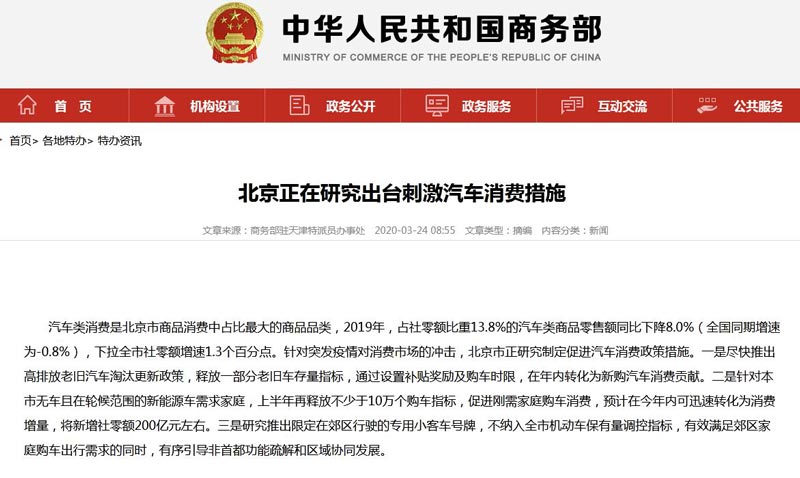
News briefly appeared that Beijing was considering adding 100,000 new-energy vehicle quotas and another 100,000 quotas for gasoline cars in 2020 as part of a broader effort to support an economy hit by the pandemic. The notice was later withdrawn, with the explanation that the policy was still under study and had been published by mistake before any final decision had been made.
Even though the announcement was pulled back, the fact that it surfaced at all suggests the idea had already entered serious policy discussion. And once a measure reaches that stage, there is usually a real possibility that some version of it will eventually be adopted.
The outline of the proposed measures was straightforward:
- Use subsidies to encourage owners of older cars to trade them in for new ones.
- Add 100,000 quotas for new-energy vehicles, which was estimated to generate about RMB 20 billion in vehicle purchases.
- Consider a special category of gasoline-car plates intended for suburban use, with the dual goal of easing pressure in the urban core while unlocking demand.
Against the backdrop of the auto market collapse in early 2020, it is easy to see why such ideas gained traction. According to industry association data, China produced 285,000 vehicles and sold 310,000 in February 2020, down 79.8% and 79.1% year on year. Passenger-car sales were only 224,000 for the month, down 86.1% from the previous month and 81.7% from a year earlier. At the same time, there were warnings that national GDP growth could decline by as much as 5% for the year. Consumption stimulus had become urgent, and many provinces had already started rolling out support measures, including policies aimed specifically at auto purchases.
Assuming Beijing ultimately does move ahead with these policies, the more interesting question is not whether more quotas would help, but which type of quota would be most effective and how they should be distributed.
Trade-in subsidies may not do much
The first idea—encouraging owners of older cars to replace them—sounds reasonable, but the actual effect may be limited.
The problem is simple: the amount of subsidy or tax relief the government can offer in a trade-in program is usually not large enough to change behavior in a difficult economic year. People who have held on to older cars generally do so because they do not want to spend more money on vehicles. Households that are financially comfortable and inclined to upgrade have often already done so. Once incomes and expectations worsen, the group that was reluctant to replace an old car becomes even less likely to respond to modest incentives.
The same logic probably applies to businesses. It is unclear whether large companies or public-sector entities would be included in such stimulus measures, but most firms in a downturn are more likely to cut spending than increase it. And if government departments themselves are eligible, the policy starts to look like moving money from one pocket to the other.
Additional new-energy quotas would be absorbed quickly
The second proposal—100,000 more quotas for new-energy vehicles—looks much more convincing.
Demand is already there. At the time, the queue for new-energy vehicle plates in Beijing included 467,360 individual applications and 5,633 corporate ones. Under those conditions, an extra 100,000 quotas would be taken up very quickly. The estimate that this could release around RMB 20 billion in vehicle spending also looks reasonable. On that basis, the average car price would be only about RMB 200,000, which is not an aggressive assumption.
The effect would not stop at vehicle purchases. Another 100,000 electric cars on the road would also support related sectors such as charging infrastructure and after-sales service. There is no precise figure here, but even a very conservative estimate of spillover equal to 10% of vehicle spending would imply another roughly RMB 2 billion in activity.
The suburban gasoline-plate idea is hard to define
The third proposal is where the policy design becomes messy.
The reported idea was to create Beijing plates for gasoline vehicles that would operate only in suburban areas. In practice, that distinction would be difficult to enforce in a city like Beijing, because there is no clean or universally accepted line between "urban" and "suburban." Drawing the boundary outside the Fifth Ring Road or the Sixth Ring Road would be arbitrary. Defining only the traditional core districts—Dongcheng, Xicheng, Haidian, and Chaoyang—as the urban area would not be much better, since districts such as Tongzhou, Changping, and Fengtai now also have high population density. Past traffic restrictions have already treated many nominally suburban areas the same as central districts.
There is also the environmental argument. If gasoline cars are considered a major source of pollution, then restricting them to one part of Beijing rather than another does not fundamentally change the fact that they are still operating within the same metropolitan area.
For that reason, if Beijing decides to add quotas for gasoline cars, it would make more sense to issue ordinary gasoline-car quotas rather than inventing a special suburban category. And instead of allocating them through the existing lottery system, the city should consider using an auction model like the one seen in Shanghai and some other places.
Why auctioning fuel-car plates makes more sense than a lottery
An auction proposal would be controversial, because many people immediately assume it is less favorable to them personally. But there are several reasons it may actually be the better approach.
1. It is fairer in a market with extreme scarcity
Beijing currently relies on a lottery for regular passenger-car plates. In the sixth allocation round of 2019, the individual success rate for an ordinary passenger-car quota was about 1 in 2,740—worse than many forms of gambling in practical terms. As a result, entire families often enter the lottery together. Some households never win, while others happen to win two or three quotas and then rent out the plates. Meanwhile, people and companies with genuine, urgent need for a car may remain unsuccessful for years and end up leasing plates or using out-of-town registrations in Beijing.
An auction separates urgent demand from casual demand. Those who truly need a car can obtain a plate first, which is arguably a more meaningful form of fairness than random luck.
Some would argue that auctions disadvantage low-income households. But Beijing already has extensive public transportation, and car-rental services are widely available. For lower-income residents, relying on public transit or occasional rentals may be more rational than taking on the cost of buying and maintaining a car. If a household is not especially concerned about annual vehicle expenses that can run to tens of thousands of yuan, then it is not really in the category most damaged by not winning a free plate.
2. It creates fiscal revenue when governments need it most
Auction proceeds would become government revenue and could then be directed toward public services and urban improvements that benefit the broader population. In a year when public finances are likely to come under pressure, plate auctions could partly offset that strain.
3. It reduces waste
In quota-restricted cities, license plates have effectively become a scarce resource. The problem with a free lottery is that it encourages inefficient use. Some people who win a plate buy the cheapest possible car simply to secure the registration, then barely use the vehicle at all. If plates are auctioned, almost nobody will pay for one only to let it sit idle. That alone would improve the efficiency of how a scarce public resource is allocated.
4. It could make the stimulus effect stronger
This point may sound uncomfortable, but it is still worth stating plainly.
Because Beijing plates are so hard to obtain, many people who want to buy a car—including many high-income consumers—cannot do so. An auction system would screen out much of the demand for sub-RMB 100,000 compact cars and shift the mix toward buyers willing to spend more. That would raise the average transaction price of newly purchased vehicles and increase the total consumption generated by the policy.
A more effective package: auction fuel quotas, then turn the proceeds into vouchers
If Beijing were to release 100,000 gasoline-car quotas through an auction, government revenue would likely reach at least RMB 5 billion, assuming an average plate price of RMB 50,000. In reality, the number could well be higher. If the average vehicle price is again estimated at RMB 200,000, then those 100,000 additional quotas would also translate into another RMB 20 billion in automobile purchases.
But the policy could go further.
Instead of leaving the auction revenue in general fiscal accounts, the city could distribute that RMB 5 billion back into the economy in the form of consumption vouchers. That would create a second round of stimulus. A cautious estimate would be that the vouchers could unlock more than RMB 20 billion in additional spending.
Tourism offers a simple example. If the travel and leisure market is suffering, the government could issue tourism vouchers. Imagine an annual park pass that normally costs RMB 200 and covers more than 100 attractions. The government contributes RMB 50, and the parks themselves absorb another RMB 50. The voucher still has a face value of RMB 100, which means the consumer pays only RMB 100 for a pass previously priced at RMB 200.
For consumers, that is effectively half price. For parks, it brings more foot traffic and creates secondary revenue from boating, small attractions, souvenirs, and other on-site spending. For the government, the benefit extends beyond the ticket itself through transport use, food and beverage spending, and possibly lodging if the policy attracts visitors from outside the city. Once that chain reaction starts, the total demand created by RMB 5 billion in vouchers could easily exceed RMB 20 billion.
What the total impact could look like
Put together, the numbers become significant.
If Beijing were to add 100,000 new-energy quotas and 100,000 gasoline-car quotas, issue the gasoline quotas through auction, and then recycle the auction revenue into consumer vouchers, the 200,000 additional plates could generate at least RMB 60 billion in direct spending.
That estimate comes from three parts:
- roughly RMB 20 billion from additional new-energy vehicle purchases,
- roughly RMB 20 billion from additional gasoline-car purchases,
- and more than RMB 20 billion from voucher-driven consumption funded by auction revenue.
And that is only the direct effect. Once the broader transmission through related industries is taken into account, the eventual impact could be far larger—possibly double that amount.
With Beijing’s 2019 GDP at about RMB 3.5 trillion, even RMB 60 billion in direct additional consumption would amount to around 1.7% of the city’s annual economic output. By that standard, a well-designed vehicle quota expansion would not be a marginal measure. It could be a meaningful stimulus tool—provided the policy is structured in a way that allocates scarcity efficiently rather than simply extending the flaws of the current lottery system.