In fact, something like a "no-suicide pledge" had already surfaced around 2013, though back then it was closer to a "pledge not to commit suicide." The idea was simple on the surface: the person signing it publicly declared that they would not choose suicide as the way to end their life. So if they later died, their death should be pushed into the public sphere for scrutiny—because once such a statement existed, their death could "only" be treated as either an accident or homicide.
"I am ( ). I will absolutely not commit suicide. If anything happens to me in the future, it is murder, and I ask the police to investigate thoroughly. Repost this and make your own pledge to prevent being 'suicided.' This pledge is spreading across Weibo. Mixed into it is a helpless form of resistance, and behind it lies a tragic backdrop—being 'suicided.' Closed information and the shadow of power are eroding our sense of safety. Post a pledge saying you won't commit suicide, and let your own small light resist crude darkness."
The irony is that this kind of pledge became briefly popular precisely because a real version had already existed. As early as 2010, Foxconn had employees sign what was essentially a passive clause during the series of worker suicides that year. Both current and newly hired employees were reportedly asked to sign a no-suicide commitment. From that point on, people started debating whether suicide could be bound by contract at all.
At first glance, the whole question feels wildly absurd. Is ending one's own life a right belonging to the individual? Across different legal traditions, ancient and modern, East and West, that has long been treated as a serious philosophical issue. But at least most people still retain some basic sense: this is a discussion about human nature and the meaning of life, not an actual mechanism of restraint. The 2010 no-suicide pledge and the later wave of online anti-suicide declarations were really just attempts to drag a philosophical problem into social operation. And the outcome was obvious enough—it never created much real legal force, because Chinese society still has not clearly settled whether suicide should count as a crime against life, or whether the social consequences triggered by suicide can themselves be treated as criminal.
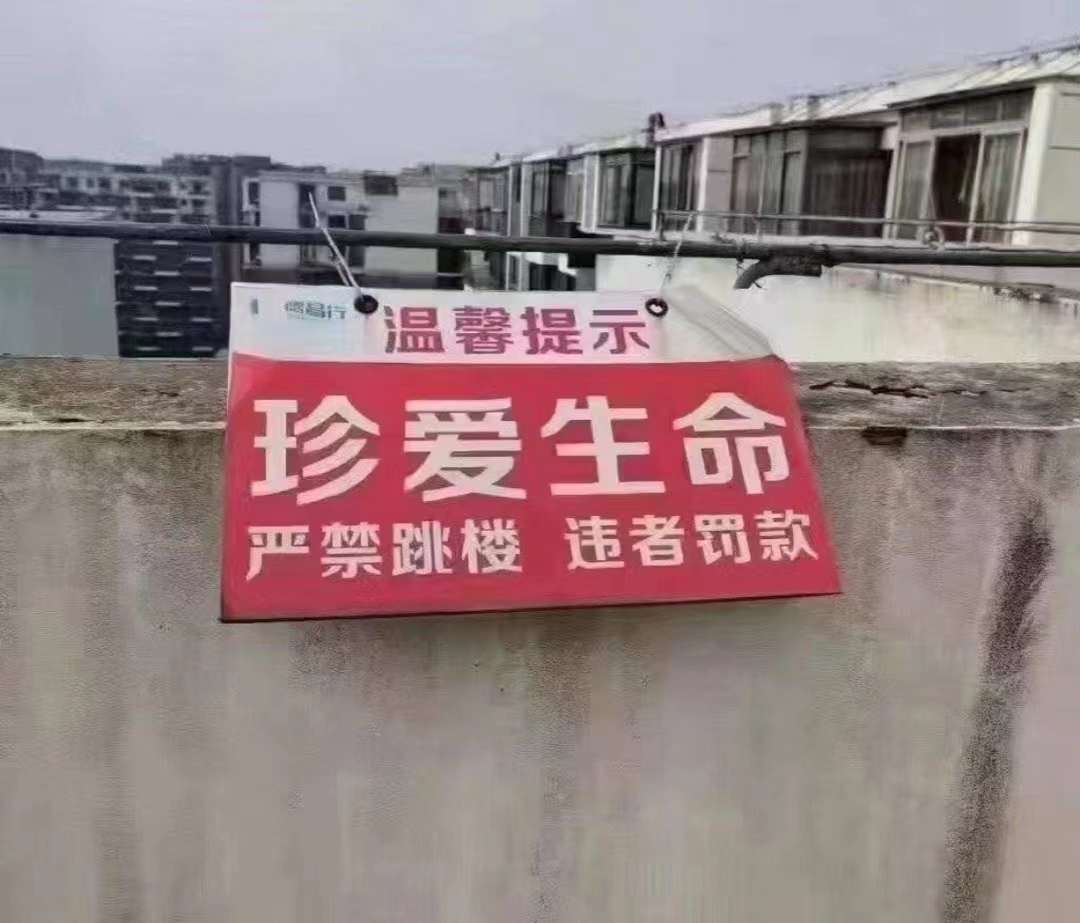
And then, ten years later, in 2022, it turned out the no-suicide pledge had never really disappeared. People were still trying to use contractual language to restrain the possibility of suicide. It is hard to tell whether this should be called a legal aspiration or just social absurdity in a purer form.
A few days ago, a widely circulated document claimed that a certain college was requiring students to sign a "No-Suicide Pledge." Setting aside, for the moment, whether the document was real, the interesting part is its internal logic. After all, if someone has once designed something called a "suicide vending machine," then absurd systems like this are naturally full of design inspiration.
The document only contained three clauses that prohibited—or more accurately, discouraged—suicide:
I will respect and cherish my own life and the lives of others, and I will never harm myself or others in an extreme way, and will never engage in suicidal behavior;
If I find myself feeling depressed and unable to control suicidal thoughts, impulses, or behavior, in an emergency I will call family, friends, or teachers to seek help and get through the difficulty. Their phone numbers are: ...
If I cannot reach the above contacts immediately, I will call 110, 120, or 119 for help.
— Circulated online as a "No-Suicide Pledge"
There are good reasons to doubt the document. First, in the version that circulated, "120" had been mistyped as "1120," which either suggests imitation or suggests that whoever produced it was in such a rush to make students sign that they made a basic error. Second, its structure is too simple. Even with minimal legal common sense, you can see how many possibilities it fails to regulate.
So instead of arguing over whether the document is authentic, it is more interesting to talk about the strange pleasure of examining what sits underneath it.
If you were the designer of this pledge, why would you create it? Put it back into real life and the answer appears quickly: because it is meant for students, its real purpose is to reduce the risk of parents causing trouble for the school after a student dies by suicide. When a student takes their own life within a school's sphere of management, there are always too many causes that cannot be fully explained. Even when everyone is told it was due to "personal reasons," suspicion keeps multiplying. And no matter what the reason was, surveillance cameras have an uncanny habit of "malfunctioning" at the crucial moment, which only makes the whole thing feel even murkier. From the point of view of the person being asked to sign, this obviously looks like one more way for a school to push responsibility away from itself.
But if you think a little further, the reason student suicides so often remain impossible to fully clarify has an even deeper source: once the person is dead, should their secrets be exposed to the public at all?
If the death was tied to bullying, the school may be the one least interested in disclosure. If it grew out of a relationship dispute, the dead person may end up being judged for that. There are also cases involving sexual orientation, illness, or no explanation at all—someone simply jumps, leaving nothing behind. Once you begin tracing the truth, far too many things get dragged out with it. Sometimes the only way to reach the truth is to strip the dead person bare again in front of the public, letting others criticize them, pity them, empathize with them, shame them, mock them, lament them. That is a brutal demand to place on someone who is already dead.
Because of this information imbalance, parents naturally feel the school must be responsible—after all, their child had been entrusted to the institution. But there is another issue that cannot be avoided: these are university students. Legally, they are adults. If adulthood means anything, why should they not be considered capable of making decisions, and promises, about their own life and death?
That brings the question back to philosophy. Since the nineteenth century, human societies have mostly answered whether suicide is a crime. Before the nineteenth century, suicide really was treated as criminal in many Western European countries. But the doctrine contained an obvious paradox. If someone attempted suicide and survived, what punishment should they receive? Death? And if someone succeeded, they were already dead—how exactly was the law supposed to punish them then?
The historical answer was grotesque enough: punish the body, or punish the soul. In many Western European systems, religion functioned as the final sanction for the "breach." A person who died by suicide could be whipped after death, or have a stake driven through the head or heart. Someone who survived an attempt could be sentenced to death. A suicide victim could be denied burial in consecrated ground, denied funeral rites, denied a priest's prayer.
And this is exactly the problem: whether an unblessed soul is actually judged and punished is something only the dead could confirm—and who on earth wants them to come back and report on it personally?
Seen from that angle, the no-suicide pledge almost starts to look useful. Leaving aside the more sinister motive of evading responsibility, does asking someone to promise not to kill themselves count as a kind of preemptive defense against the "crime" of suicide?
One more twist matters here. Suicide is not a crime in Chinese law. But when a person's suicide triggers widespread suspicion, public discussion, moral judgment, denunciation, praise, or some broader "negative social impact," that resulting disturbance can become something very clearly regulated. So if one wants to think in bureaucratic terms, perhaps prevention must still be prevention.
With that in mind, a few suggestions naturally follow.
1. Establish an underground party organization—literally underground. Its purpose would be to prevent people, after dying by suicide, from attempting to transmit false or unlawful information back to the human world by ghostly means. In other words, communications from below should also be regulated and reviewed, so that no one can exploit the route between the underworld and the living world to pass metaphorical knives to illegal organizations.
2. Strengthen the punishment system for the crime of suicide. Anyone who dies by suicide should be fined upon entry into the underworld. When opening their first account at the Bank of Heaven and Earth, they should be formally informed of the time, place, and offense for which they incurred a debt in the world of the living. That debt should automatically be transferred into their underworld account. In other words, if a suicide caused harmful consequences, then yes, the person should still be fined—they would simply continue their existence in the underworld with negative assets. Any paper money burned for them by the living should first be used to repay these substituted fines.
3. Build a proper underworld welfare system. To avoid a situation in which the deceased cannot maintain basic existence because of their fines, the underworld should establish a minimum subsistence guarantee for souls still repaying penalties from the world above. This would also help prevent ghosts from robbing one another's offerings and disrupting order below for no reason.
That may be the only truly coherent way to complete the legal logic of a no-suicide pledge.