On Saturday I joined a Scotland Heritage Tour, which is a polite way of saying a Scottish-themed coach trip of the sort where you sleep on the bus, wake up when it stops, take pictures, and get back on. It is my most usual way to travel. In Hangzhou I used those same kind of buses to visit six of the seven famous water towns, all except Zhouzhuang. They are fairly similar to each other, but the trips are easy, cheap in mental energy, usually decent, and now and then surprising.
During COVID-19 these group tours couldn't run, and the operators must have taken a beating. Now that they're back, the staff seem genuinely cheerful. I looked around the bus. I'd assumed this kind of elderly tour would be mostly couples. But when I actually counted, more than half of the passengers were older women traveling with sisters or friends; couples were under half. Make of that what you will. It suggests that a pack of girlfriends pooling their old age might be a perfectly workable plan.
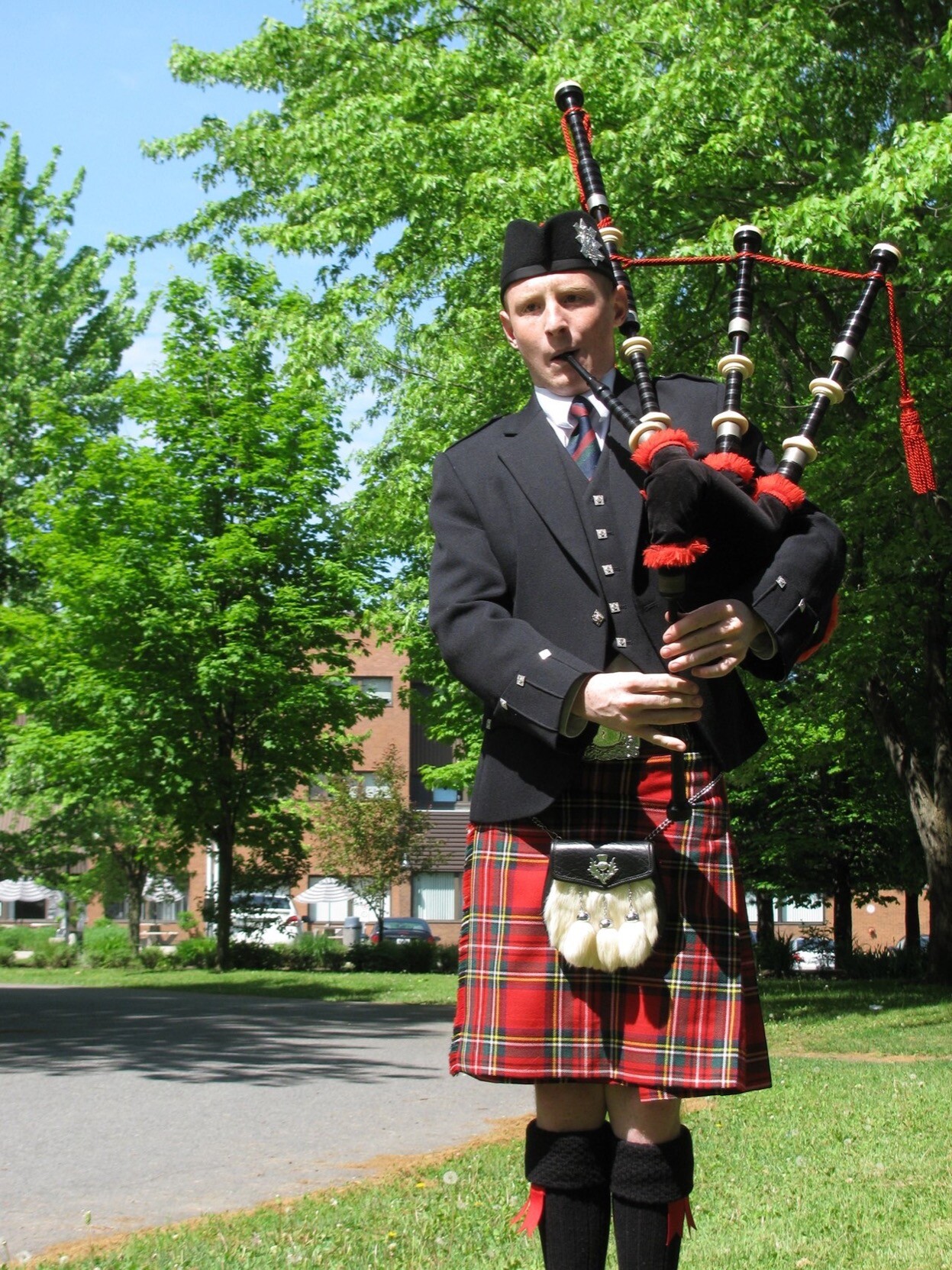
Our destination was Norfolk County, west of Toronto. There is a Scottish restaurant in a converted church. At the door a young man in a kilt and full bagpipe outfit was playing, cheeks puffed, droning and skirling away. The older passengers poured off the bus and lined up for photos. He was very accommodating. Presumably it's part of the job; if he does it often enough, it's also a living. The restaurant's stained glass reminded me of the windows I saw in churches in Montreal, though the craftsmanship here was in a different league. Perhaps it was a church feature of a particular period.
The photo below is from the internet; I didn't want to add to his workload.
The meal was Scottish, and genuinely unfamiliar to me: a thick soup of some unknown composition with bread, and some kind of meat pie. It wasn't bad. The main event came afterward. A large-bellied man dressed like the manager of a BBC period drama, something in the North & South or Cranford line, came onstage carrying an instrument I didn't recognize and started to sing.
He sang one song first, a pleasant tune that even people who didn't know it could clap along to. Then he said the next one would be something everyone knew. I wondered whether it would be Loch Lomond, the only Scottish song I can claim to know. It was.
You'll take the high road and I'll take the low road, and I'll be in Scotland afore you. Where me and my true love will never meet again, on the bonnie, bonnie banks of Loch Lomond.
The ballad is associated with Loch Lomond and with Prince Charlie's rebellion against English rule, which was crushed. A condemned soldier asked someone to carry his last letter home to his girlfriend. His letter and his soul were to take separate roads back to Scotland, but he and his love would never meet again on the banks of Loch Lomond.
There's a version on YouTube, and under it I found a comment that was almost a short story of its own. The commenter said the song had particular meaning for them: they were descended from Orkney Scots who had fought with Bonny Prince Charlie. After Culloden in 1745, when the Scottish clans were defeated, their ancestor David fled to the American colonies with his son Robert, leaving his older son John in Scotland to care for David's wife until they could be sent for. David and Robert settled in upstate New York and changed the family name from McGregor to Smith. But David's wife died before she and John could cross the ocean, and John, not wanting anything to do with his father and brother, joined the British army.
During the American Revolution, Robert fought with the Americans and John with the British. Family stories say they met at the Battle of Freeman's Farm in 1777, where John was wounded. Robert took his wounded brother back to his farm a few miles away; John died there after reconciling with him. His only request was that Robert deliver his bible to his wife in Kirkwall. Robert then journeyed back to Scotland for the first time since he had fled as a child, to carry out his brother's wish. The American and Scottish sides of the family are still close, the commenter wrote, and they get together now and then. The commenter lives down the road from Robert's farm, which is still in the family, and has twice visited Scotland, where a distant cousin still has John's bible. He always imagined the song as the two brothers speaking to each other in those last few hours they had together.
After lunch we visited a greenhouse nursery. The moment I walked in I was struck by the straight lines and the level of mechanization. It is a family operation: the older man who showed us around has run it for decades with his daughter and son-in-law. At the entrance a young man was helping load flowers; only when we were leaving did I hear them greet each other and realize he was the old man's grandson. The old man was spry enough that I would not have guessed he had a grandson that age.
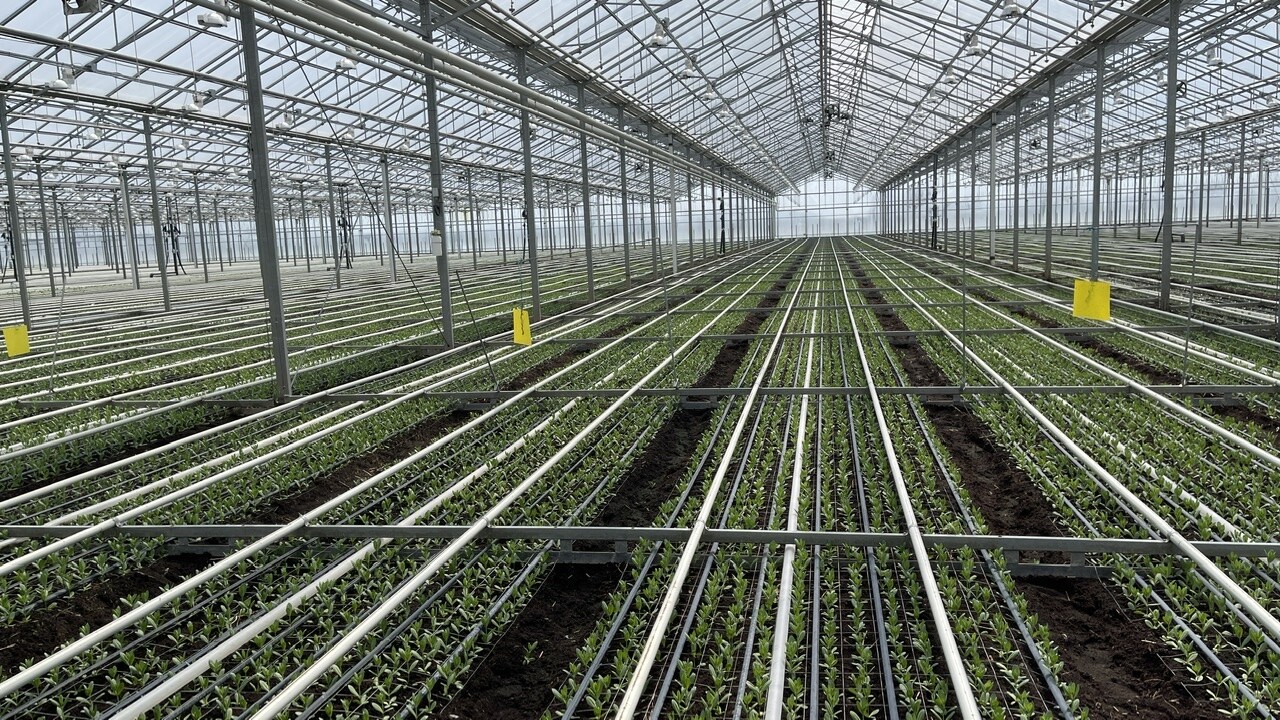
The nursery visit surprised me more than I expected. I am an armchair farmer. I like the idea of a farm, dislike the work, and occasionally dream that after I get rich I'll buy one and hire Mexican workers to run it while I take no responsibility. Inside the greenhouse I started calculating what it would cost. Adding up the components, I guessed it was a million-dollar Canadian investment. On the way I searched the name printed on the flower boxes and found the nursery's website, then looked up greenhouse costs. My estimate was about right.
The work of moving seedlings into the greenhouse still needs people. On a whiteboard on the wall, some of the notes were in English and Spanish, which made me think the workers were mostly from South America.
Halfway through, someone in our group asked the old man how his roses competed with Ecuador and Colombia. He answered directly: they don't. Countries on the equator have a natural advantage. Their roses grow tall and large and beautiful. We have no special edge over them. But we've been doing this locally for a long time, our costs aren't as high as people imagine, and being close by makes us flexible.
As we left I saw boxes and boxes of flowers packed for shipment to Florida. That reset my assumptions again. Florida's climate is obviously better for flowers than Canada's. Why build greenhouses here and then truck flowers to the southern United States? My guess is that the flower business has thin margins. For producers who already have the investment and production in place, the profit is enough to keep going. For a new investor, the capital cost is huge and the return isn't attractive enough to enter the fight.
Equatorial countries are all suited to rose growing, but several are politically unstable; Ecuador and Kenya are the relatively stable major exporters. I have the impression that roses from those countries look better, and I suspect they serve a different market from the local growers here. I'll have to go to Ecuador in winter and see for myself.