The first thing to understand about the made-in-China Model 3 is that its headline range is not a promise. Tesla range estimates have a way of inviting arithmetic, and the arithmetic is useful as long as it is treated as a starting point rather than a verdict.
An earlier comparison of Tesla and NIO ES8 owner data suggested a rough pattern: a Tesla's highway range tends to be around 80% of its EPA range. On a made-in-China Tesla, 80% of the official label is roughly the EPA figure, which means about 64% of the label is a reasonable highway estimate. For the long-range Model 3 with a 668 km label, that works out to roughly 430 km at highway speeds. The standard-range car is where the gap between the label and daily reality matters most.
The standard-range car and its two battery packs
On sale now is the Standard Range Plus. It was priced at 323,800 yuan before subsidies and 299,000 yuan after them, with Tesla's Chinese website quoting 445 km. That number follows China's national test cycle, effectively the NEDC figure.
Two battery suppliers make the picture slightly more complicated. Cars have been delivered with either Panasonic or LG Chem cells. The yellow energy-consumption label on the car shows 455 km for the Panasonic version and 445 km for the LG Chem version. The difference comes from pack capacity. The LG pack is 145.7Ah, the Panasonic pack is 148.8Ah, and both use a nominal 355.2V. That gives about 51.75 kWh for LG and 52.8 kWh for Panasonic.
Tesla delivers the two versions without giving buyers a choice. Chasing a 10-20 km difference in the official number is less useful than developing better driving habits.
EPA, displayed range, and the space between
EPA figures are closer to real use than NEDC, and the discontinued imported Standard Range Model 3 offers a reference point: about 407 km in the city, 361 km on the highway, and 386 km combined. The imported car had a 54 kWh pack and a 480 km Chinese-cycle rating. The domestic car has a 52-53 kWh pack and a 445/455 km rating, or roughly 93-95% of the imported car's official range. Scaling the EPA combined figure accordingly puts the domestic Standard Range at around 360-366 km.
Tesla's displayed range is estimated in a way that is closer to EPA than to NEDC. Owner reports collected for the domestic car show a full charge displaying about 375-385 km with the Panasonic pack and about 360 km with the LG pack. That is a wider spread than the official labels suggest. Under good conditions, the displayed figure is a fairly reliable guide; actual range can land close to it. It is still a guide, not a guarantee.
Why owner tests vary so much
Since deliveries began, range tests have produced plenty of disagreement. Some results have been far below the 445 km NEDC figure, including a highway test that returned just over 200 km. Another test around Beijing's Fifth Ring Road came in at nearly 340 km.
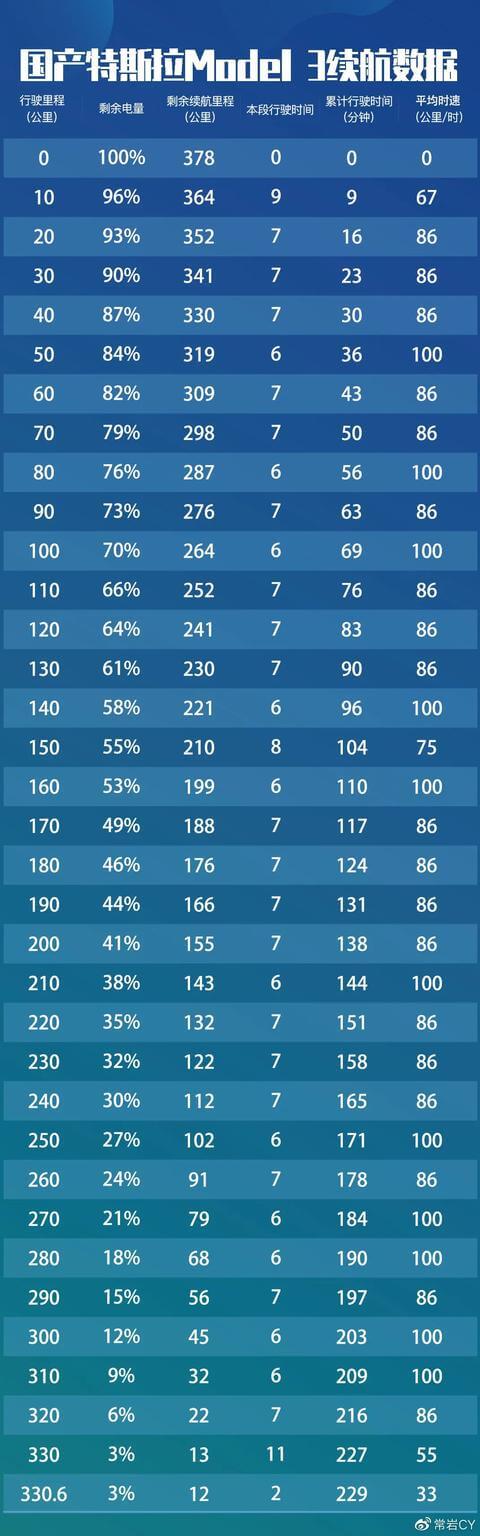
Such a spread is not surprising. Range depends heavily on temperature, driving style, route, and use case. It also matters that most tests so far have been run in relatively cold weather, especially in northern China. Those results are useful mainly as a winter-use reference, not as a year-round verdict.
Energy consumption offers another way to estimate range. The domestic Model 3's Chinese-cycle consumption is 12.5 kWh/100 km, while the EPA combined figure is 15.7 kWh/100 km. In daily driving, consumption commonly moves between 12 and 20 kWh/100 km, and the EPA number is a reasonable average to use. Dividing roughly 53 kWh of usable capacity by 15.7 gives about 337 km. Winter will reduce that.
Idle losses also deserve attention. Sentry mode and the car's standby consumption can add up, particularly in winter. Losing 10-20 km of indicated range overnight in cold weather is normal.
Is the standard range enough?
This is a personal question, but the standard-range car has clear limits. It is less suited to long-distance driving than the long-range version. Anyone with frequent long highway commutes should look elsewhere or accept more charging stops. Owners who can charge at home or at work will have a much better experience than those relying only on public charging.
EV owners generally avoid running the battery to empty or charging to 100% every time. Keeping a reserve is part of normal use. A practical estimate is that 80-85% of the range figures above represents safe usable range. That is the number to use when deciding whether the car fits a daily routine.
Consumption and running costs
The standard-range Model 3 may not satisfy everyone's range needs, but it has an advantage that is often overlooked: low average energy consumption. For the same distance, a more efficient car costs less to run. The logic is the same as with fuel economy in gasoline cars.
Take a simple comparison. One car has a 65 kWh pack and 350 km of real range; a Model 3 has a 52 kWh pack and also 350 km of real range. At a public charger charging 2 yuan per kWh, the Model 3 costs about 0.08 yuan less per kilometer. A smaller pack also means shorter theoretical charging sessions. Range tends to dominate the conversation, but consumption is part of the ownership equation.
Where the long-range version fits
Tesla's Chinese lineup is becoming more varied, with different range and body styles. The domestically built standard-range Model 3 is one option, positioned as an entry model that lowers the barrier. Tesla clearly wants that barrier to fall further. Costs are likely to come down, the standard-range price is likely to drop over time, and a more affordable China-specific model is plausible.
The long-range Model 3 has also arrived. It costs 40,000 yuan more than the standard range but adds more than 200 km of range. There is no universal right answer between the two. Longer range costs more; matching the car to actual needs and budget matters more than chasing the biggest number.
Buying early buys time with the car; waiting tends to bring a better price. A car purchase is never a purely rational exercise.