A married friend of mine has a seven-year-old daughter. We recorded a podcast episode together, and the conversation turned to the evening she lost her temper while helping her daughter with homework. That was how I learned that primary school is no longer the place I remember. First grade now includes logic. Both math and Chinese depend on word games. When we were in primary school, we spent nearly half a semester on pinyin, strokes, writing from 1 to 10, and giving each number a concrete meaning. Children today are expected to finish pinyin and numerals in one or two weeks and move straight into using them.
The word games matter because of a conversation my friend had with her daughter.
The mother asked the girl to write the numbers from 1 to 10.
The girl asked, hesitantly, 'I don't know how to write the to—what does to mean?'
Later the mother saw that the girl had written 10 after 9 + 3. She asked, 'Where did this 10 come from?'
The girl answered, again hesitantly, 'I wrote it.'
That was the point where my friend broke down.
To an adult, neither the question nor the answer is strange. The child is interrogating the prompt itself. Adults have learned to skip several steps and leave the logic implicit. The school, at that moment, has not taught the girl what 'to' means.
Logic, feeling, and the prefrontal cortex
Hearing that first graders are supposed to study logic produced the same reaction in both of us: shock. It looks less like education than a violation of human physiology.
The prefrontal cortex is among the last parts of the brain to mature. It is not fully developed until roughly age 25 and continues to be refined into the mid-30s. A rough division is useful. The front brain, dominated by the prefrontal cortex, handles emotional control, logical analysis, and self-control—the rational, calculating side. The back brain, dominated by the limbic system—amygdala, hippocampus, hypothalamus—handles emotion, feeling, memory, and bodily response—the intuitive, sensory side.
In other words, while the back brain is developing first, children need more attention to feeling, creativity, emotional expression, and language. If the front brain is overactivated too early, it can suppress the development of the back brain. A simple illustration makes the point:
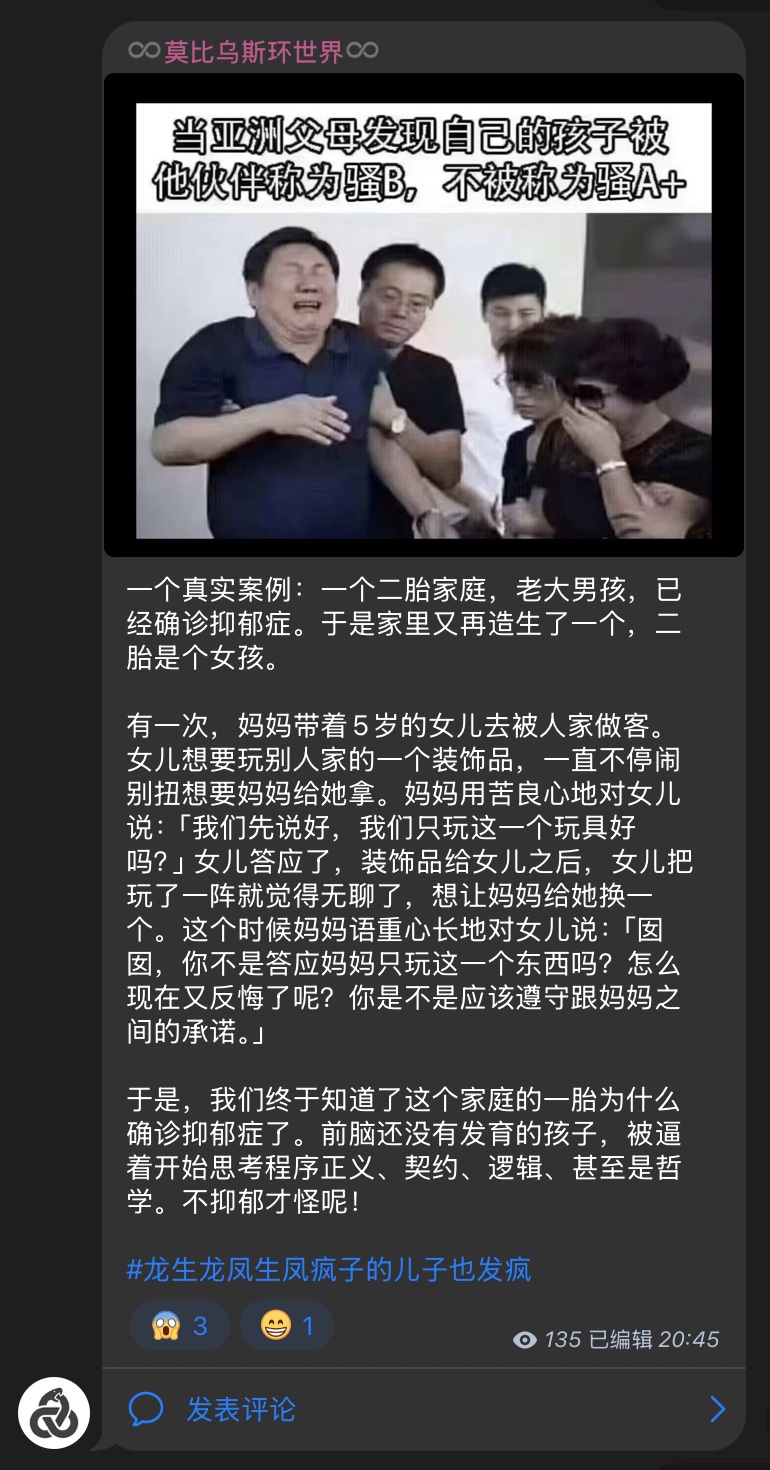
A child's brain is not built for logic, contracts, or philosophy. If a child cannot reach those things through emotion and feeling, she cannot produce the correct response in her own world. What she learns instead is that she is always the one who is wrong. So she stops expressing emotion. She stops telling her parents what she actually feels about a situation. She avoids further scolding and discipline.
Under the current Chinese education model, it would be a miracle if depression did not rise.
Intelligence, inheritance, and the purpose of education
Start with the conclusion: education is a mechanism for sorting people into social strata. It is a selection machine. The question is whether the Chinese version has become too blatant about it.
Plato thought education should help each person find the role that suited them and acquire the skills that role required. A city needed three kinds of people: decision-makers who protect truth and wisdom; guardians who maintain law and order; producers who solve material needs and supply. Education placed different people in those positions and thereby produced social justice. Education was the necessary tool of justice. The criterion was the tripartite soul: reason, will, and appetite. By assessing each person's dominant drive, one could assign them to the right role.
Utilitarianism made the sorting colder. Psychology and neuroscience suggested that each person's intelligence has an upper limit, and that acquired learning struggles to break through it. Intelligence affects how efficiently someone solves problems. It became a standard for deciding who fits which role.
One curious point: differences in intelligence are not necessarily hereditary. Royal families that married close relatives to keep bloodlines pure increased the odds of intellectually disabled descendants. If social roles were reassigned by intelligence, hereditary rule could be ended.
But the division of labor is triangular. There are far fewer places at the top than at the bottom. Education therefore performs a crucial selection function.
Structure, rules, and the pyramid
What follows may annoy committed communists, so read according to your politics.
Some societies have an agrarian base. Once basic subsistence was improved through cultivation, domestication, and breeding, surplus value appeared. Those who controlled the surplus formed an internal hierarchy. To make power permanent, inheritance became a way to resist high intelligence.
The consequences are not hard to see:
- Low-intelligence heirs at the top use their power to damage education, block class mobility, and protect the rule of power for its own sake.
- High intelligence and decision-making power come into conflict, and political persecution becomes a recurring game.
The power pyramid gives the top a qualification that cannot be redistributed. The middle and bottom are distinguished by surplus value. Education becomes the only route for the non-hereditary to reach the top. Malignant competition and power struggles become favorite traditions.
This is one inevitable outcome when an agrarian civilization enters communism. Modern society offers another idea: keep assigning social positions by intelligence. But educational freedom and equality are not automatically perfect. In the United States, some left-wing education reforms assumed everyone should enjoy equal educational resources. When the selection mechanism weakened and the cost of education fell, more students with lower intelligence entered the system, and a large amount of educational resources was wasted. Blue-collar workers began competing for scarce white-collar jobs, which lowered white-collar efficiency. White-collar workers, unable to bear the competition, began competing for low-skill, labor-intensive work. The result was more competition, and unemployment and crime rose together.
Dumbing-down education and the overmanaged child
Why has education become this involuted? Why does it add difficulty in ways that seem to defy nature? Is it because the average intelligence of society has risen? Anyone paying attention can see that in the information age and among Generation Z, independent thinking is being stripped away and politically domesticated.
The painter Chen Danqing once described the highest form of rule-by-dumbing-down as a condition in which people do not know they are being kept ignorant, do not care, and eventually keep themselves ignorant. The phrase is harsh, but it captures something about the present.
I have an unflattering view: education itself is not fair, and cannot be. Its results are unfair in a hidden way. Not everyone can rise. Education is also a means of manufacturing unfairness. Adding difficulty is the fastest way to separate individuals by intelligence, because intelligence is the sorting rule. Add inheritance to that, and the only route I mentioned earlier may no longer exist.
So what is education ultimately doing? Perhaps it protects the pyramid and compresses the top, producing a more stable and more deformed machine.
If we assume the worst about its purpose, inheritance has another opponent: high intelligence. If education can adjust the intelligence of the population downward, management becomes easier. Malignant competition happens in the middle and lower levels of the pyramid, so it never touches the interests at the tip. Most people can be made manageable, shaped into a crowd that forms internal checks and balances on its own.
This is an extreme extension of Plato's Republic, not a description of any specific person or group. Do not read it as an accusation aimed at you.
The child at the desk is not a small adult. She is a person whose back brain is still doing the work of growing. The question is why the system is in such a hurry to skip that.