I finally decided, on a Sunday afternoon, to revive the digest habit. But since January is basically already over, this first one is going to be a monthly roundup instead.
Life lately
Ever since November, it feels like I’ve just been moving from one holiday mood into another. I didn’t do anything especially dramatic for New Year’s, but on New Year’s Eve I had a daytime New Year meal at home with H, and then we spent the whole afternoon playing Overcooked! We were terrible at it—mostly me and R dragging the team down, honestly—but it was so much fun. We kept bursting into laughter the entire time, to the point that my throat actually felt hoarse by evening.
Last week, through a Discord community, I bought a secondhand Switch and Ring Fit Adventure from two people there. It really feels like I’m about to open the door to a whole new world, and I’m excited for it.
This week I also signed my job offer. I had roughly two options, and both seemed genuinely good, so I agonized over it for a long time. In the end, I chose the more traditional industry job, even though it pays a bit less. A big part of the decision was simple curiosity: I want to know what it’s like to work in that kind of company. Hopefully this isn’t a case of curiosity killing the cat.
I’ve heard the work-life balance there may be better, and I’m hoping that means more time to learn new things and keep developing my hobbies. Now I’m just hoping all the paperwork and visa stuff goes smoothly.
Once the offer was signed, I felt a huge sense of relief. I finally had the mental space to write up my reflections on last year, do some journaling, make a few things by hand, tidy the room, and generally slow down a little. It’s been one of the rare stretches of unhurried time since being laid off.
Reading: Reading Lolita in Tehran
I stayed up far too late to finish this book in one rush, and it left me with a lot of feelings. It has a memoir-like quality: Azar Nafisi returns to Iran after studying in the United States and finds herself living through the Islamic Revolution. During those dark and feverish years, she teaches Western literature at a university even though it sits uneasily—if not outright incompatibly—with the revolutionary climate. Later, because of her political stance, she leaves her position, but she selects seven women students and begins hosting a weekly reading group in her living room. Together they read Nabokov, Fitzgerald, Henry James, Austen.
What makes the book especially striking is how many layers it holds at once. It records the revolution, and the suffocating details of life under a theocratic authoritarian state. It also shows the personal strategies people use to endure that world, and it contains deep, tangled, often contradictory reflection. At the same time, it is full of literary discussion—Austen, Nabokov, Fitzgerald, and others—but those readings are never detached from lived reality. They are shaped by the experience of living in Iran, which gives them an angle unlike the usual classroom interpretation.
That kind of life is terrifyingly hard. But people who have lived through it often seem to carry a different weight in their words. Even ordinary observations feel charged.
A few parts stayed with me in particular.
The first is the classroom “trial” of The Great Gatsby. One side argues that the book is immoral, full of capitalist and imperialist corruption; the other says that this is nonsense born from a total misreading of the novel. I was, unsurprisingly, on the side of the novel, and the students’ debate sounded brilliant. But the most interesting observation is Nafisi’s: many students actually supported the book and admired it, yet said nothing, because they didn’t feel they could argue as confidently and fluently as those attacking it. They couldn’t fully explain why they liked it—they just did.
That struck me as incredibly perceptive. You see versions of this everywhere, even in the news. Plenty of people may have a clear position, but they never voice it, and what ends up dominating public expression is the more extreme, more self-assured camp. They are louder, and they sound certain.
The second thing is the book’s recurring argument about what fiction is for. It repeatedly suggests that novels cultivate imagination and empathy. A good novel is not tidy or black-and-white. It doesn’t simply tell you, “this person is right, that person is wrong.” It makes room for human complexity. Even characters we dislike, even characters we morally reject, are allowed to speak in their own voices; and even if we never agree with them, there is often still some small space in which we understand how they became who they are.
Nafisi also suggests that, in the modern novel, the true villain is often not the classic dramatic evil-doer but the person who lacks imagination and empathy. Humbert in Lolita becomes a kind of dictator figure in that sense: he has no real curiosity about other people or their inner lives, not even about Lolita herself. What matters to him is only his own perception of others. That is also how dictators operate.
In this framework, heroism changes too. It is no longer the legendary hero of grand narratives, but the person who insists on defending their dignity at any cost. And censorship, interestingly, behaves in a very similar way to the tyrannical imagination: it imposes one reading on everyone and tries to control how all people are allowed to respond.
A third thread that stood out is the condition of women. Life in Iran is oppressive; for women, it is even more so. The issue is not only the veil, but also education, and the obligations imposed in the name of family duty. The women in Nafisi’s reading group come from very different backgrounds: some are devout, some deeply rebellious, some have even been imprisoned. Their personal stories are all difficult in different ways.
A fourth point was one I had never really considered before: what this kind of political reality does to believers themselves. Near the end of the book, one student, Mahshid, talks about feeling her faith slipping away, about beginning to question it constantly. As a member of a minority, she had once felt she had to defend her faith at all costs. People had told her that under a just Islamic order, everything would improve. But once that “dream” actually arrived, it turned out to be nothing like what had been promised.
And then there is Nafisi’s writing about home. It is devastating. She describes the feeling of mourning a loss that has not yet fully happened, as though her private world were being crushed; of returning to streets she loved and missed, only to feel as though she were walking over the broken remains of memory itself. Before returning, even when she was homesick abroad, she had still believed home belonged to her, that she could return whenever she wanted. It was only after going back that she truly understood exile.
She eventually leaves Iran. The decision is painful, full of struggle and guilt. In the afterword, she writes that she was ultimately unable to stay with her mother through the final stretch of her life, and that this grief would always remain bound up with their shared hatred of totalitarianism. Nabokov once condemned totalitarian systems for kidnapping the emotional lives of the people they rule. That idea stayed with me.
On screen
The Makanai: Cooking for the Maiko House
I binge-watched this in one evening while assembling IKEA furniture.
The story follows two girls who go to Gion hoping to become maiko. One turns out to have natural talent for dance and performance, while the other turns out to be gifted in the kitchen and becomes the makanai—the cook who feeds everyone, especially her friend.
The whole show has a warm visual atmosphere, and the food looks wonderful. Kiyo is almost unrealistically kind: the sort of person who gives and gives without resentment, and who doesn’t become bitter just because she can’t compete in the same arena as someone else. Her smile is absurdly infectious.
I’ve seen people say the series softens or beautifies the realities of maiko life. I don’t know enough to speak with confidence on that. Still, the show does at least touch on some of the contradictions and possible reforms: why should marriage mean the end of a maiko’s career? Why should entertaining male drinkers be part of the arrangement? Even if this world is framed as artistic tradition, there remains the reality that many men still consume these women as a kind of product.
Quartet
Before watching, I somehow expected something goofy and overly theatrical, more in the spirit of a music-themed fantasy. Instead, it turned out to be one of those stories where damaged adults keep one another warm against a brutal world. No wonder it’s considered such a classic.
The series follows four not-quite-young-anymore people connected to music who seem to meet by chance: first violinist Maki Maki, cellist Suzume Sebuki, violist Yutaka Iemori, and second violinist Tsukasa Beppu. Together they form a quartet called Doughnut Hole and perform mostly at an upscale hotel.
As the story unfolds, each person’s secrets begin to surface. All four have painful pasts they would rather not discuss, and several of them also have less-than-simple reasons for getting close to Maki in the first place. There is suspicion, there are buried motives, there is emotional mess everywhere. But through playing music together, they also find solace. They build a rare kind of friendship. Their playing may not be enough to conquer the highest halls of prestige, but who could deny the happiness they find in it?
Performances
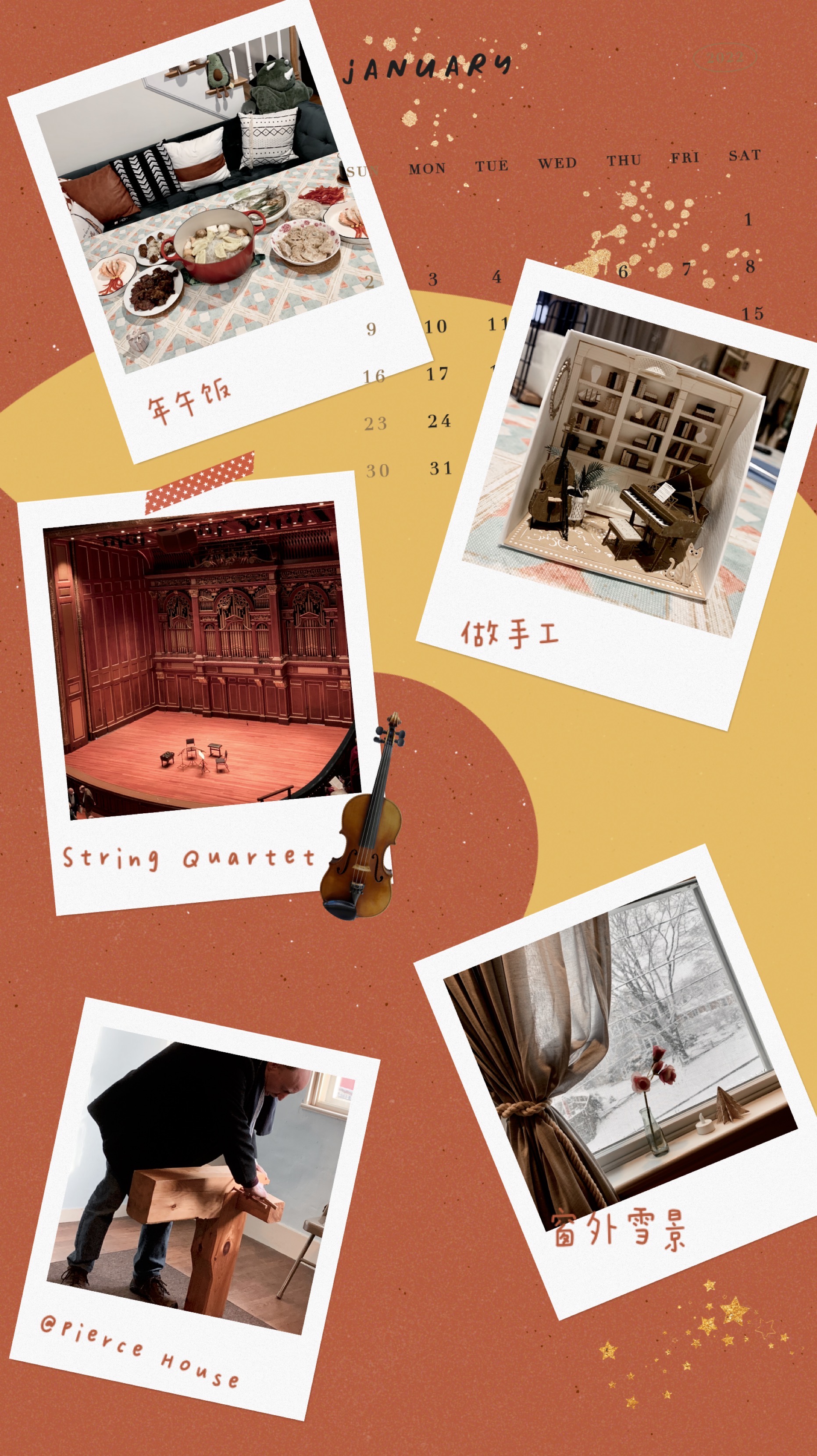
I watched Quartet and then immediately went to hear two actual string quartets. I loved both concerts.
Emerson String Quartet
The first was the Emerson String Quartet, in their farewell season before disbanding this fall. They played four works: Bartók’s String Quartet No. 2, George Walker’s Lyric for Strings, Shostakovich’s String Quartet No. 12, and Beethoven’s String Quartet Op. 59, No. 2.
The overall impression was sheer technical force. But Bartók and Shostakovich both left me a little dazed and disoriented, so if I’m being honest, Beethoven was the one I loved most that evening.
Danish String Quartet
The Danish String Quartet is a younger ensemble, and besides the standard classical repertoire they are also deeply engaged with folk music. The first time I heard them was actually through their folk album Wood Works.
Those folk pieces are very accessible—beautiful melodies, rhythms that are easy to latch onto, and much shorter durations too, which certainly doesn’t hurt.
At this concert, they began with three classical works: Haydn’s String Quartet, Op. 20 No. 3, Shostakovich’s String Quartet No. 7, and Britten’s Three Divertimenti. All three had something playful to them, a little sharp-edged, even a little rock-like in spirit. I especially loved Britten’s Three Divertimenti. His music seems to move between modernity and tradition in a way that remains approachable while still sounding unmistakably modern.
Compared with the Emerson concert, the Danish String Quartet felt much looser and more performative. They even stomped their feet at times—maybe to keep together? Though it didn’t feel like the most traditional thing. But more than anything, they looked like they were genuinely enjoying the music.
Their final “piece” was really a medley of folk tunes. I couldn’t tell you the names of any of them, but they were all vivid and immediately appealing. I’ve always liked folk music. It often feels plain in the best sense: not overloaded with decoration, not dependent on technical display, and yet deeply affecting.
During that folk set I also heard all kinds of string techniques I’d never encountered before, producing wonderfully strange sounds—some of them almost like something from electronic music. I wish I knew the names of those techniques.
BSO
I also went to the BSO twice this month. I don’t remember the second program all that clearly, so I’ll just mention the first.
I originally went for Midori, but what really caught me off guard was the modern work that followed: Eternal Stranger. There was an actor involved in the performance, and the piece imagines Beethoven as a migrant from the Middle East making his way to Europe, tracing his internal journey along the route.
It then moved directly into the funeral march from Beethoven’s Symphony No. 3 and his Leonore Overture. I barely understood most of the spoken lines, but it still felt like the first time I had truly grasped what people mean by a great performance.
Podcasts
New Year Specials from a long-running podcast series
This annual New Year series is already in its seventh year, which is kind of wild. This year’s format was especially fun: each day focused on one bird, paired with one book.
Both hosts have become fairly serious birdwatchers over the past year, so when they talked about each species they covered not just appearance, habits, and calls, but also the bird’s role in culture and symbolism. That part was unexpectedly fascinating. In contrast, I barely remember most of the books they discussed.
The one book that did stick with me was about a group of people who smuggled themselves into Hong Kong in the 1950s and 60s. That sounded especially interesting.
A podcast episode on women reformers in Chinese history
This episode was fascinating. It focused on women in Chinese political history—really only a handful of figures, if we’re being honest.
The guest argued that a good reformer is someone whose reforms genuinely improve people’s ability to live stable, ordinary lives, and who causes less disruption and suffering. By that standard, rulers celebrated for territorial expansion are not necessarily good reformers at all; expansion can devastate ordinary people’s lives and even nearly wreck an empire.
The episode also talked at length about how women in power have been stigmatized throughout history. In a deeply patriarchal society, assessments of women politicians become heavily distorted: what they did well is minimized, credited to male ministers, or brushed aside, while their mistakes are treated as entirely their own fault. Male rulers, by contrast, are granted much more generosity.
A substantial part of the episode also tried to reassess Empress Dowager Cixi. The guest’s view was that she was one of the most remarkable reformers in Chinese history. He argued that the Xinyou Coup ended the chaos created by the eight regents, that humiliating foreign debts had been repaid before she returned power to the Guangxu Emperor, and that ordinary people experienced roughly three decades of relative peace. He also described her as an active force behind the Self-Strengthening Movement and pointed to three separate waves of reform, especially the late Qing reforms. Even if those later reforms partly look like atonement after the Boxer disaster and its consequences, they still included efforts toward constitutionalism, women’s education, and attempts to address foot-binding and the eunuch system—strikingly modernizing moves.
What I liked most was that the episode genuinely widened my frame of reference and made me want to read more. It recommended several books, and I’ve added them to my list.
The Happiness Lab: Stop Looking for the Perfect Job — a “Good Enough Job” is Just Fine
This theme has become almost familiar over the past few years. People have been thinking much more deeply about what work is supposed to mean, and burnout, job fatigue, “lying flat,” quiet quitting, and all the rest have become part of everyday conversation. Even books critiquing work have been widely discussed.
This episode argues that we should stop tying our entire identity to work. We need more than one axis of selfhood. It also makes the important point that if you don’t define your own relationship to work, your employer will define it for you—and in most cases that means your job becomes your whole life.
One idea from the episode that I found especially useful was the warning against turning hobbies into work by stealth. Maybe you like running, but suddenly you feel that liking running means you must complete a marathon. That shift quietly transforms enjoyment into obligation. It’s important to let hobbies remain ends in themselves, rather than turning them into means toward yet another form of “achievement.”
A line I want to keep
人生には、三つ坂があるんですって、上り坂、下り坂、まさか。
There are three slopes in life: the uphill, the downhill, and the unexpected. (Quartet)