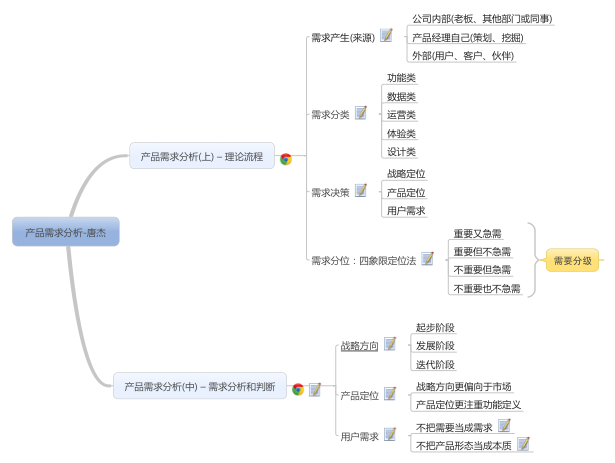
A mind map that lays out the requirements-analysis workflow makes a handy reference to keep at hand:
Once the analysis and decisions are complete, the results need to travel beyond your own notes. A report—usually a presentation with an outlined structure, delivered as a live walkthrough—is how those outcomes reach leadership or colleagues. It follows the same shape as the document that accompanies a product plan.
Here's what the outline should cover.
Requirement categories. List the requirements by type, and spell out clearly what each one is asking for. A requirement whose meaning is fuzzy at this stage will cause trouble later, so the classification doubles as a chance to clear up ambiguity.
Analysis and decisions. Go through the requirements and state the outcome: feasible ones stay, infeasible ones are dropped. In practice, this section focuses on the rejected requirements and the reasoning behind cutting them—accepted requirements rarely need defending.
Prioritization. Among the feasible requirements, indicate relative order. Several factors feed into this, with three main ones carrying most of the weight. Many companies call this the four-quadrant approach: important and urgent, important but not urgent, unimportant but urgent, neither. Whatever the labeling, the section should read clearly enough to show which requirements go first.
Staging. Prioritization then feeds into planning. Break the requirements into stages and assign them to different versions. If the list is short, a single iteration covers everything.
Presenting the deck is what turns the analysis into something the team can act on. The slides carry the structure; the spoken explanation carries the reasoning.
In many cases the analysis happens inside product planning, so no standalone requirements report is produced. That's not a problem in itself—the report is a communication tool, not an artifact to file away.