Education is one of the largest line items in many family budgets, and it is also where otherwise sensible parents lose their sense of proportion. The arms race is visible everywhere: in China it is tutoring classes, open and hidden; abroad it is the endless guides to getting into elite universities. Children end up learning quantities of exam technique and factual material they will never touch again after the college entrance exam or after they start work. The parents who have either climbed a class rung or secured their position have a keen sense of how much knowledge and contacts matter, and they plan their children's education with a precision and ambition that resembles a planned economy. Even birth dates are timed carefully. Some will believe in scams that do not even rise to the level of pseudoscience, such as quantum speed reading. One can only say that swindlers and fools make an excellent matching mechanism in human civilization, and even then there are not enough swindlers to go around.
This is a problem that can be treated as an account. If a family has enough resources, every dollar spent should have some expected return; otherwise, if people cannot feed themselves, other demands are meaningless. But whether the money is spent on primary-to-middle school transition, the high school entrance exam, the college entrance exam, or graduate school, the return is invisible at the time. You only see it when the child starts working and brings home a pay slip. Some research has been done on degrees. The chart below does show that higher degrees are associated with higher pay, but that does not necessarily prove that education has improved work ability. It may simply be that employers now use degrees as a screening threshold.

I should be clear about one thing: professional degrees here mean MD, JD, MBA and similar degrees that can be done only after a bachelor's. In China they correspond to professional master's and professional doctorates, strongly employment-oriented degrees. The main reason is that doctors, lawyers and similar professions require a great deal of internship to accumulate experience, while the ordinary PhD does not demand much practical experience. This is comparable to ordinary high school versus vocational high school: one trains ordinary people, the other trains engineers or workers. Public opinion in China has long been dominated by the college entrance exam participants from ordinary high schools, so there is an inexplicable sense of superiority toward vocational high schools. But the eventual treatment in vocational education is not much worse than in ordinary education, and it is a part of the system that cannot be ignored. Here I will still talk only about ordinary education, because I really cannot find much data on vocational education.
If a degree is expected to mean higher future income, all rational parents will invest in advancing their children's education. According to US Social Security Administration data, a man with a bachelor's degree earns $900,000 more over a lifetime than a man with a high school diploma; for women the figure is $630,000. A graduate degree raises lifetime earnings over high school by $1.5 million for men and $1.1 million for women. From this we can estimate that a graduate degree helps a man earn about $600,000 more over his lifetime, or a woman about $470,000. Or to put it another way, if you invest more than $400,000 in a graduate degree, you are robbing Peter to pay Paul. Still, I suspect most people who want a graduate degree cannot even put together $400, and the return is one thousand to one, so it is still worth it.
The same logic can be used to estimate the premium on school district housing. In first-tier Chinese cities the premium is roughly 30%, so a non-district home worth 5 million yuan is roughly equal to a district home worth 6.5 million, a difference of 1.5 million. In theory, if the lifetime income gap between a child attending college and not attending college is less than 1.5 million yuan, then the high premium is meaningless. I found data for Guangdong, shown below. Among urban residents, whether one attended college makes a lifetime income difference of 14.75 million yuan for men and 3.76 million yuan for women. One has to say that the premium on school district housing in China is still within a reasonable range; the gender difference, however, is far too large.
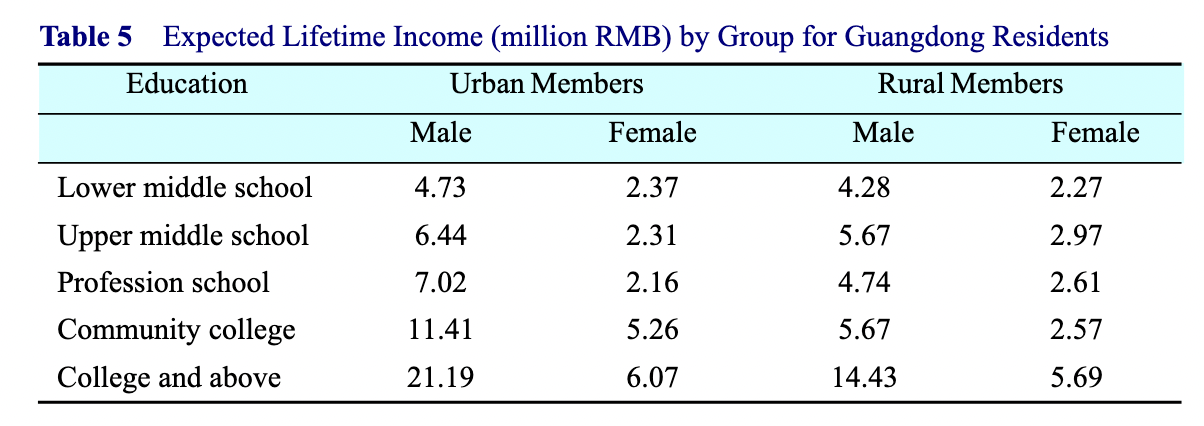
But school district housing is neither necessary nor sufficient for getting into a better school, and it is also a manifestation of unequal educational resources. How can educational resources be made fair? I think this should be considered from an investment perspective: price by return. If you produce a dud, charging dud tuition is unreasonable. By the same token, if you produce a talent, you should share in the talent's return instead of taking a one-time tuition fee and walking away.
In fact, tuition is a very superfluous thing. It cannot fairly display the results of education. It would be better to abolish it entirely and replace it with 1% of a student's work income, paid directly to the state for unified allocation, until retirement. From the lifetime income figures above, the lifetime tuition of a person with a college degree should be between 60,000 and 200,000 yuan. That price is actually higher than the current average state input per college student, about 20,000 yuan, and roughly in the same order of magnitude as current state subsidies plus student-paid tuition. Current per capita wage income in China is about 20,000 yuan, so this could bring in 280 billion yuan a year in education investment returns. The actual number would be lower, since not everyone is a college graduate, but wage income would still be the bulk of it. Higher education enrollment is 40 million. Average public education tuition in Beijing is about 5,000 yuan, so total higher education tuition is about 200 billion yuan. The extra 280 billion would be more than enough to eliminate tuition and also subsidize primary education by 80 billion. The extra money could be used to attack the chaos of school district housing and super universities caused by unequal resource allocation, by investing in non-key high schools and ordinary colleges and gradually leveling resource differences between schools. National education budget is about 5 trillion yuan a year, and higher education accounts for a quarter, about 1.3 trillion. An extra 80 billion is not a small sum, and it would be enough to do quite a lot.
The core of this strategy is to avoid a tax increase that the public resents. It borrows the free-to-play strategy of the hated internet companies: get people in first and then figure out the rest. A certain bald-seal avatar keeps calling for tax increases and socialized childrearing. That asks vested interests to cut into their own flesh, and it completely fails to win over the middle class. To push a policy, you have to let bygones be bygones and offer a sweetener first. College students are mostly at the poorest stage of their lives. Giving them free college and then asking for 1% is boiling a frog in warm water. And frankly, asking working people for 1% of income is not a life-or-death matter; everyone looks at take-home pay anyway. Technically it is fairly mature now. Employers already check degrees when hiring, so the money can be deducted and sent to the treasury; at most a Xuexin verification is needed, and that is not difficult. Schools should share educational risk with their students. They cannot just collect tuition and freeload off alumni donations.
Research has long found that the school one graduates from has limited influence on long-term career performance; what really affects career development is the college entrance exam score. A high scorer performs about the same in the long run no matter which school they attend. That is, the school brand is hollow and personal ability is real. If you rely on the brand to find a job, it may protect your floor, but long-term income is determined by personal ability. This is also why after the college entrance exam local universities scramble for high-scoring candidates: the school needs to rely on the student for fame, not the other way around. The reverse would drag the student down. Since schools must rely on students, they might as well rely on them all the way: take an equity stake in their own students, teach them for free, and let them repay the school from their income. That would be much better than the messy alumni associations of today.
This is not to say entrance exams should be abolished. Free higher education still needs a threshold, but the threshold is simply: pass the line and tuition is free. Would not eliminating exams still make parents pay for tutoring? In fact, even if exams were eliminated, parents would still pay for tutoring to meet the demands of a small number of elite universities. Look at the United States: many universities no longer consider the SAT, and that is not good news for students and parents, because they have to spend extra to discover the hidden admissions rules of each school. To reduce the burden at the root, the huge differences between schools must be balanced. Otherwise, the parents' chain of contempt will always produce meaningless involution. If they cannot send their children to tutoring classes, they will send them to Africa to experience life. The state should tilt resources toward ordinary universities and level differences between institutions. It is not a good phenomenon that resources now all go to Double First-Class universities. If you really want to concentrate investment and do public relations, give it to the Chinese Academy of Sciences. Concentrate forces to do big things. Let private capital mess around with universities.
As things stand, universities can achieve point breakthroughs in research, but not broad breakthroughs. Companies like Deepmind are where major results will come from in the future. AlphaFold2 was made by a team of 30 people burning money for five years, with average salaries of $300,000, and only then did they get a result far ahead of the second place. Universities relying on micro-innovation simply cannot support a team burning money at that scale. The team would either be disbanded after producing nothing for a while, or it would fail to attract talent because there was not enough money. Investing in elite universities basically means investing in professors' involution over papers. It would be better to invest in more universities and level the differences between them; that would have a long-term positive effect on local development. If higher education continues to be elitist, students will end up looking for the many ways to write the character hui. Research driven by the state should be placed in national laboratories; the rest should rely on enterprise investment and the market. Universities should be responsible for producing talent, not for keeping talent inside to do micro-innovation, which is a waste of resources.
Implementation does not need to be one-size-fits-all. Start with pilots. Students can choose to pay in full at once or to pay 1% over the long term. If they pay in full, that cannot count as a state subsidy, which may cause tuition to double. But compared with US higher education tuition, even doubling would not reach a fraction of the cost. A family with no money can simply choose free. Cancel the various national evaluation scholarships; private scholarships are never lacking, and national scholarships can be changed into honors. Each school can, according to its own finances, waive the support owed by its poorer graduates, but the money handed to the treasury for redistribution cannot be reduced by a single cent. Every year each school should publish a report on the support received from its graduates. Unlike donations, this reflects the distribution of support levels across all graduates, so parents can use it as a reference when choosing schools. Every school can produce one or two tycoons, but their cases have little reference value. During the policy rollout, people who have already graduated can voluntarily join the plan and define a share of income no higher than 1% to give back. New graduates who chose free education would be strictly enforced. Of course, this refers to public schools. Private schools can do as they like, but I suspect the first to respond to this policy would be newer private schools, because it would give potential students' parents a quantified expectation instead of a blind investment.
Someone will certainly say that it is unfair for low earners to pay less and high earners to pay more. Nothing in this world is completely fair. The reason for low earnings may be that the teaching was bad; the reason for high earnings may be strong ability. But 1% is an order of magnitude lower than a religious tithe. Rather than let these clever but empty middle-class exam machines support a rinpoche, it would be better to invest in education. Imagine if this money could ease the high premium on school district housing; then 1% of salary would be too cheap. If any first-tier university could offer similar educational resources, there would be no need to build a chain of contempt. If universal higher education really shared responsibility with parents for a student's lifetime income, what would there be to be anxious about? Take the long view, or you will not escape being treated as a fool by swindlers.
Some will ask what to do about students who go abroad. Do not bother collecting from them; the collection cost is too high. Enjoying a free domestic university education and then running overseas is common even today, when tuition is charged. It is true that this would lose some income, but as calculated above, the people working domestically can already support the system. All students who accept free domestic higher education and return to develop in China can pay 1% on the money they earn in China. There is no need to haggle over overseas students. Many of them would not contribute anything to China anyway, and being petty is more likely to cultivate an enemy. There is no fairness issue here either. Compatriots who exploit loopholes are refined egoists in any country, and such people have their own limitations that will catch up with them.
There are many other things that could be done with an investment lens, such as social security and pensions, but those do not need a sweetener because everyone is already used to them. Some things are still necessary. Take the population problem. Raising children really is a full-time job. As long as people can pass an exam proving they are qualified parents, parents with minor children should be paid a wage. The children of people who do not know how to be parents need state socialized childrearing as a safety net; otherwise they become victims of domestic violence or sources of social instability. Those who do not want to be parents merely lose one source of wages; it does not affect their current income.
The principle is simple: share the risk. Investment cannot mean eating the meat while letting others take the beating and the state provide the bailout. Linking income to risk is what motivates effort. Modern companies have used this principle to death: employee stock ownership. Only when an undertaking is tied to the future of the people doing it will they take it seriously. Education especially so.