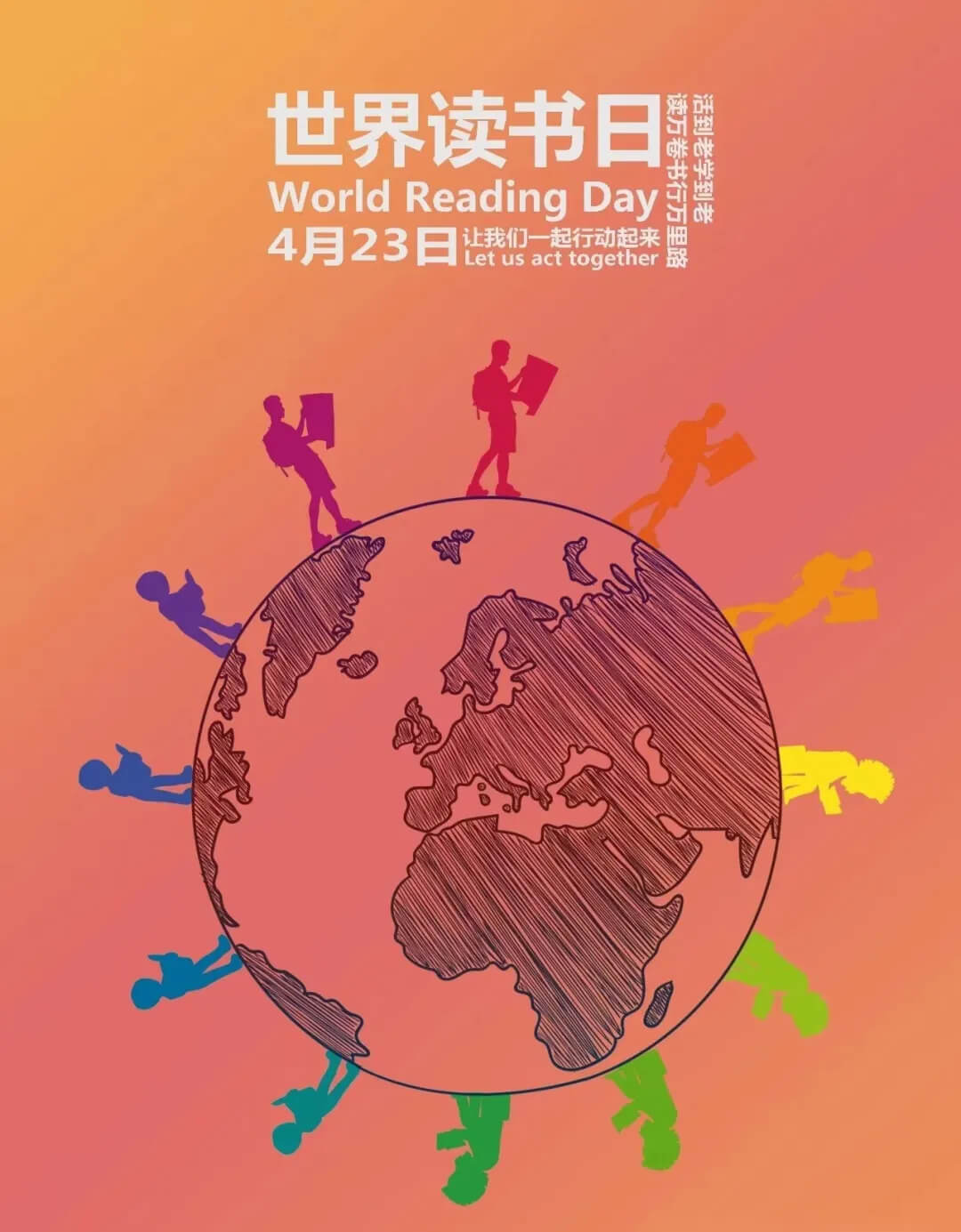
April 23 is World Book and Copyright Day, often called simply World Book Day. The idea was first proposed by the International Publishers Association and later submitted to UNESCO through Spain.
On November 15, 1995, UNESCO officially designated April 23 as World Book Day. The day was created to encourage more people to read and write, to honor the writers, thinkers, scientists, cultural figures, and literary masters who have contributed to human civilization, and to promote respect for intellectual property. Every year, more than one hundred countries hold reading campaigns, book events, and celebrations on this date.
Themes from Past Years
Over the years, World Book Day has carried different themes, each reflecting the hope that reading can become part of everyday life:
- 2022: I Love Reading
- 2021: Reading Makes Our World Richer
- 2020: Reading in Every City, Care in Every City
- 2019: World Book Day: You Read, I Listen
- 2018: Reading, It’s My Right
- 2015: Because We Read, We Are Happy
- 2014: The Earth and Me
- 2013: Embrace Spring, Chase Dreams
- 2012: Reading Makes Our World Richer
- 2010: Let Us Move Toward a Reading Society Together
- 2009: Let Us Grow Together Through Reading
Stories of Famous Readers
Mencius Learned Diligence
Mencius, the great thinker and statesman of the Warring States period, was not born scholarly. As a child, he was playful and did not enjoy studying. His mother moved their home three times in order to give him a better environment for learning. She also once cut a piece of woven cloth to teach him a lesson about perseverance. Eventually, Mencius understood that achievement required discipline and hard work.
Qu Yuan Read in a Cave
As a child, Qu Yuan ignored the objections of his elders and secretly went to a mountain cave to read the Book of Songs, whether in wind, rain, freezing cold, or harsh weather. After three full years, he had mastered all 305 poems in the collection. The folk songs and ballads nourished his imagination and helped shape him into a great poet.
Guan Ning Cut the Mat
In the Han dynasty, Guan Ning and Hua Xin were classmates and friends. One day, while they were reading together on the same mat, a high-ranking official passed by in a carriage. Guan Ning remained absorbed in his book, but Hua Xin went out to watch, full of admiration for the official’s status. Seeing that Hua Xin did not truly share his values, Guan Ning cut the mat in two and sat apart from him. Guan Ning later went on to achieve success in his own career.
Lu You’s “Book Nest”
The Southern Song poet Lu You was diligent and eager to learn from childhood. His home was filled with books: books on the desk, books in the cupboards, books piled on the bed. People called it his “book nest.” He wrote tirelessly throughout his life and left behind more than nine thousand poems, becoming one of China’s outstanding literary figures.
Pu Songling Collected Tales by the Roadside
The Qing dynasty writer Pu Songling built a small thatched pavilion by the roadside, where he recorded stories told by passing travelers. For decades he gathered material with great persistence, then devoted himself to writing with complete concentration. His efforts eventually produced Strange Tales from a Chinese Studio, a landmark work in classical Chinese literature.
Lu Xun Chewed Chili Peppers to Keep Warm
Lu Xun studied seriously from a young age. As a teenager at the Jiangnan Naval Academy, he performed so well in his first term that the school awarded him a gold medal. He immediately sold it on Nanjing’s Drum Tower Street, using the money to buy several books and a string of red chili peppers. On cold nights, when reading became difficult, he would chew a chili pepper until sweat rose on his forehead, using the heat to keep himself awake and warm. Through such determined study, he later became one of China’s most important modern writers.
Wen Yiduo Was “Drunk” on Books
Wen Yiduo was so absorbed in reading that people said he became “drunk” whenever he opened a book. On his wedding day, the bridal chamber was decorated and filled with festive excitement. Relatives and friends arrived early to congratulate him, but when the wedding sedan was nearly at the house, the groom was nowhere to be found. After a frantic search, he was discovered in the study, still wearing an old robe and completely absorbed in a book.
Hua Luogeng Read by Guessing
The mathematician Hua Luogeng had an unusual way of reading. When he received a book, he did not immediately read it from beginning to end. Instead, he thought about it first, closed his eyes, and imagined the structure and line of reasoning. Only after forming his own judgment would he open the book. If the author’s thinking matched what he had already anticipated, he would not continue reading in detail. This method saved time and, more importantly, strengthened his power of thought and imagination, preventing him from becoming a slave to books.
Hou Baolin Copied a Book by Hand
The master of xiangsheng, Hou Baolin, had only three years of primary schooling, yet through persistent self-study he became a renowned language artist. Once, in order to obtain a Ming dynasty joke collection titled Xuelang, he searched every old bookstall in Beijing but could not find it. Later he learned that the Beijing Library had a copy, so he decided to copy it out by hand. It was winter. For eighteen consecutive days, he went to the library through fierce wind and heavy snow, eventually copying the book of more than one hundred thousand characters in full.
Mao Zedong Made Time to Read
For decades, Mao Zedong remained extremely busy, yet he always found time—sometimes only a few minutes or seconds—to read and study. His former residence in Zhongnanhai was filled with books. They were on the bedroom shelves, the desk, the dining table, the tea table, and even across the bed, leaving only enough space for one person to lie down.
Poems on Reading
Encouraging Learning — Yan Zhenqing, Tang dynasty
Lamps burn at midnight, roosters call at dawn;
This is when a young man should be reading.
Black-haired youth who does not study early
Will regret too late when his hair turns white.
This poem reminds people to value learning acquired through effort, to make use of youth, and to cultivate oneself through diligent study. If one waits until old age, regret may come too late.
Reading on a Winter Night, Shown to My Son Ziyu — Lu You, Song dynasty
The ancients spared no effort in learning;
Work begun in youth was completed only in age.
What is gained from paper always feels shallow;
To truly understand, one must practice it oneself.
Reading should not become empty memorization. Knowledge and action are connected: one must read, think, understand, and then test that understanding through practice. Without practice, even a person who has read many books may become nothing more than a storehouse of lifeless words.
Reflections on Reading, No. 1 — Zhu Xi, Song dynasty
A half-acre square pond opens like a mirror,
Sky light and cloud shadows drift together.
How can it be so clear?
Because fresh living water flows from its source.
Continuous reading keeps the mind supplied with “living water.” It remains deep, clear, and renewed because its source never dries up.
Reading — Yu Qian, Ming dynasty
Books are affectionate, like old friends;
Morning and evening, in sorrow and joy, they stay close.
Three thousand characters pass before my eyes,
And not a trace of dust remains in my heart.
Reading cultivates refinement. The more one reads, the more the mind is lifted away from petty distractions and vulgar thoughts.
Reading — Pi Rixiu, Tang dynasty
What is family wealth to me?
Scrolls are stacked along the beams.
In my quiet study I open a book at dawn,
And speak alone with sages.
To read is to converse with wise people across time. A good book can feel like a true friend, even when its author lived in another age.
Farewell to Dong Chuan — Su Shi, Song dynasty
Clothed in coarse silk and plain cloth, he lives his life;
Yet a belly filled with poetry and books makes the spirit shine.
A person’s temperament carries the trace of the books they have read.
Twenty-Two Rhymes Presented to Assistant Minister Wei — Du Fu, Tang dynasty, excerpt
In my youth,
I was already received as a guest of the capital.
Having read ten thousand scrolls,
My brush moved as if aided by a spirit.
When one has read widely and deeply, writing becomes more fluent and inspired. As the familiar saying goes, if one reads three hundred Tang poems by heart, even without knowing how to write poetry, one can still recite it.
Written After Reading — Xiao Lunwei, Qing dynasty
The human heart is like a good seedling;
Nourished, it grows.
Seedlings are watered by springs;
The heart is nourished by reason and righteousness.
One day without reading,
And no fine thoughts fill the chest.
One month without reading,
And the eyes and ears lose their freshness.
Knowledge in books is nourishment for the heart. It helps people understand reason, morality, and the principles by which life is lived.
Reading — Lu You, Song dynasty
Though I may long for five acres of fields,
The purpose of reading is still for the people.
My eyesight by the lamp is no longer what it was,
Yet I still assign myself twenty thousand tiny characters.
Even after retreating to the countryside and growing old, Lu You continued reading under the lamp despite failing eyesight. To learn throughout life is a precious quality.
Moving House, No. 1 — Tao Yuanming, Eastern Jin dynasty
I once wished to live in the southern village,
Not because I had divined the house as lucky.
I heard there were many plain-hearted people there,
And I was glad to spend mornings and evenings with them.
We admire fine writing together,
And discuss doubtful meanings with one another.
Reading can bring people together. Good writing is to be appreciated in company; difficult passages can be explored with friends. In reading, one may also find freedom from fame and profit, and discover quiet pleasure in ordinary life.
Sayings About Reading
- “There are three requirements in reading: the heart must be there, the eyes must be there, and the mouth must be there.” — Zhu Xi
- “Books are affectionate, like old friends; morning and evening, in sorrow and joy, they stay close.” — Yu Qian
- “A bird that wishes to fly high must first flap its wings; a person who seeks progress must first read.” — Li Kuchan
- “In setting one’s ambition, think of true character; in reading, one must put in hard effort.” — Ruan Yuan
- “Read three hundred Tang poems thoroughly, and even if you cannot compose poetry, you will be able to recite it.” — Sun Zhu, preface to Three Hundred Tang Poems
- “Only when books are needed does one regret having read too little; only after going through difficulty does one understand how hard things are.” — Lu You
- “Old books can be read a hundred times without weariness; read them well and think deeply, and you will understand for yourself.” — Su Shi
- “One obsessed with books will write well; one obsessed with art will master skill.” — Pu Songling
- “Read a book a hundred times, and its meaning will reveal itself.” — Records of the Three Kingdoms
- “Fine writings are to be appreciated together; doubtful meanings are to be analyzed with one another.” — Tao Yuanming
- “In the world we live in, without reading it is completely impossible to understand people.” — Maxim Gorky
- “The more I read, the more I feel the emptiness within.” — Shelley
- “Reading is my only entertainment. I do not waste time in taverns, gambling, or any kind of bad game; and my diligence in my work remains, as necessary, tireless.” — Benjamin Franklin
- “The more you read without thinking, the more you will feel that you know much; but the more you read and think, the more clearly you will see that you know very little.” — Voltaire
- “No one reads a book merely as a dead object. Everyone studies themselves through books, either to discover themselves or to control themselves.” — Romain Rolland
- “Find in what you read the things that can lead you deeper, and cast aside everything else—everything that overburdens the mind and draws it away from the essential.” — Albert Einstein
- “Reading without thinking is like eating without digesting.” — Polk
- “Reading without reflecting is like food undigested.” — Burke
- “Reading that cannot be applied makes the books one has read no better than waste paper.” — Washington
- “Books make some people learned, but they also make some who cannot digest them foolish and confused.” — Petrarch
Read ten thousand books, travel ten thousand miles. The grace of books, the vitality of thought, the freshness of spirit, and the uprightness of character all become part of one’s bearing. Believe that persistent reading will, in time, leave something beautiful behind.