Product managers have to stay in a learning mode all the time. This is true for people who have just entered the field, and it is just as true for those who have worked in product for many years. Product work changes quickly, and the knowledge involved is broad enough that no one can rely only on what they already know.
Below are several learning habits and methods that are especially useful for new product managers, but they are also worth revisiting even after gaining experience.
1. Do not ask before thinking
Not asking before thinking does not mean working behind closed doors. In real work, when a task requires cooperation, coordination, or input from colleagues, you should communicate actively and ask for help when needed.
The problem is a different kind of behavior: asking broad conceptual questions without first thinking, researching, or narrowing the problem. Before asking others for advice, you should at least study the topic once on your own. Try to break the problem down, reduce its scope, and make the question precise enough to be discussed.
This often happens to people who are new to product management. Because they lack experience, they may not yet know where to begin when looking for a solution. The key is not to stop asking questions, but to learn how to prepare a better question.
2. Learn how to search for information
The ability to search and filter information directly affects work and learning efficiency. Two common scenarios can show how this works: product planning and functional requirements.
① Product planning
Suppose a company wants to build an e-commerce product. For a newcomer with no relevant experience, this can feel overwhelming. Someone who asks without preparation may simply ask, “How do you build an e-commerce website?” But e-commerce contains many different business models. Different models have different functional structures, and even within the same model, product positioning will change how features are defined. A question that stays at such a general level is unlikely to receive a useful answer.
For someone starting from zero, the better approach is to search for information first, reduce the scope of the problem, and then solve it step by step.
A practical starting point is to search for an introduction to “e-commerce” through a search engine. Encyclopedic sites are often the most complete for this kind of basic concept, such as Baidu Baike or Wikipedia.
After reading this kind of introduction, you will find that e-commerce includes different product forms and models, such as B2B, C2C, B2C, O2O, B2B2C, and so on. Once you understand these models, you can usually determine what you are actually supposed to build, because the company’s business type largely determines the product model. For example, a retail company is most likely working with a B2C model, and the core demand of its e-commerce product is to sell the company’s goods online.
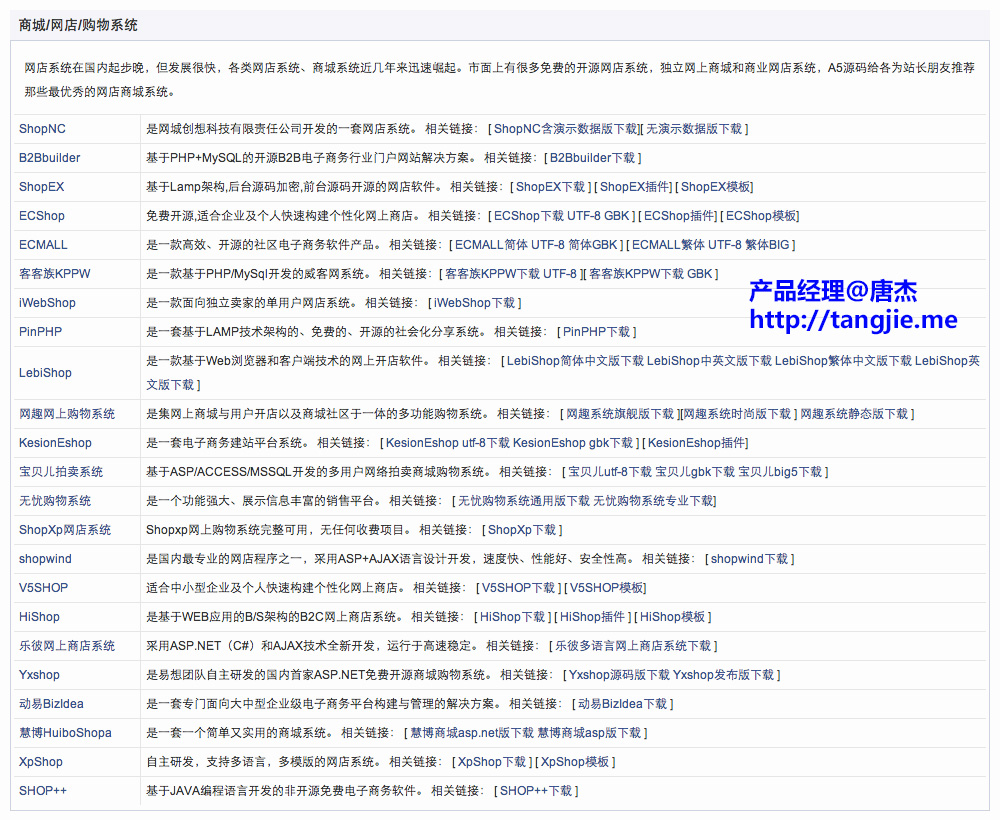
Once the model has been clarified as B2C, the next step is to study benchmark websites and competitors in the same category. Look at their front-end functions and user experience. At the same time, you can download open-source B2C programs from the internet to deepen your understanding of both front-end and back-end functional structures.
The web has been developing for many years, and during the earlier “webmaster” era, open-source web programs grew rapidly. For almost any product model you can think of, there are corresponding open-source programs available in China or abroad. The simplest way is to search for “B2C 开源程序”. In popular fields, you can usually find many ready-made programs.
Studying other websites lets you see only the surface-level front end: pages, flows, navigation, and visible interactions. But the back-end structure is usually hidden. Open-source programs help fill this gap because you can inspect and use the management system behind the product, which makes it easier to understand how the product is organized internally.
Through this process, the original vague question of “e-commerce” is narrowed down to “B2C product design.” Then, by studying open-source programs, you can understand the functional structure of both the front end and the back end. At that point, it becomes much clearer where to begin.
② Functional requirements
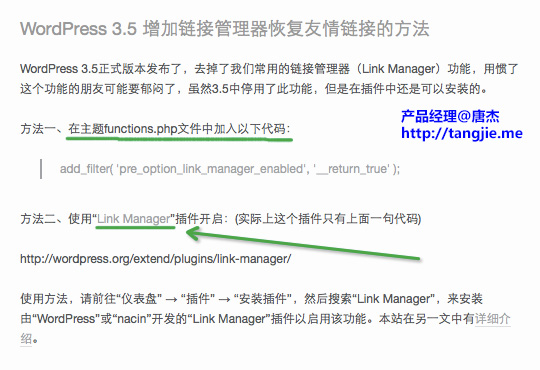
Another example is a functional requirement involving WordPress. WordPress is one of the best-known open-source blog programs in the world, so solutions to many of its problems can be found online. After version 3.5, WordPress removed the “Links” function from the admin panel. Many users did not read the update notes, so they later wondered why they could no longer find the “Links” feature or how to restore it.
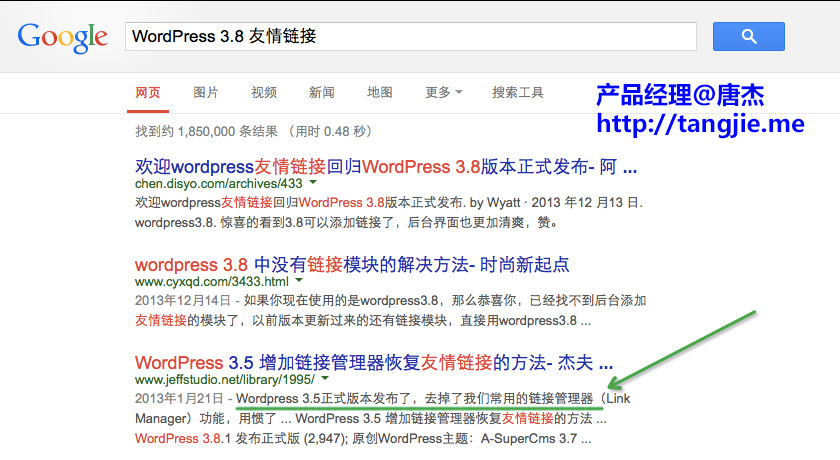
For this kind of requirement, searching is very straightforward. You only need to set three keywords: the program name, the version number you are using, and the keyword for the problem you want to solve. For example, searching Google for “WordPress 3.8 友情链接” brings up relevant explanations in the first few results, including two ways to restore the links feature.
One solution is to modify the code. The other is to install the official plugin. Comparing the two, users who do not understand technology can simply install the official link management plugin and solve the requirement cleanly.
These two examples show that searching is not just typing words into a search engine. It is a process of defining the problem, choosing accurate keywords, narrowing the scope, and judging which solution fits your situation.
3. Set learning tasks for yourself
When learning product management knowledge or product-related software, it is common to feel powerless or uncertain. You may understand the concepts and learn how to use the tools, but still feel that something is missing. This feeling is normal. It happens because you are learning for the sake of learning, without a specific demand, objective, or task.
The way to solve this is to create a concrete requirement and turn it into a learning task.
For example, imagine that you are the product manager of Baidu Music and need to redesign a music player, either for web or mobile. From there, go through the product manager’s workflow from beginning to end. Use the knowledge and tools you have learned, and write a product requirements document.
A task like this forces you to reorganize what you have learned and output it once in your own way. During this process of practice and output, your understanding becomes deeper, and the knowledge is more likely to settle into something you can actually use.
4. Learn feature implementation first
Product manager is a role that requires many kinds of experience. For beginners, jumping into a huge knowledge system too early can easily lead to confusion. A more practical path is to start as a function-oriented product manager. This is one of the hard skills of product work: learning the tools used in the job and understanding the functional structures of different product models.
Work software is usually the easiest part to learn. Many IT tools share common patterns, so once you understand one, it becomes easier to get started with others.
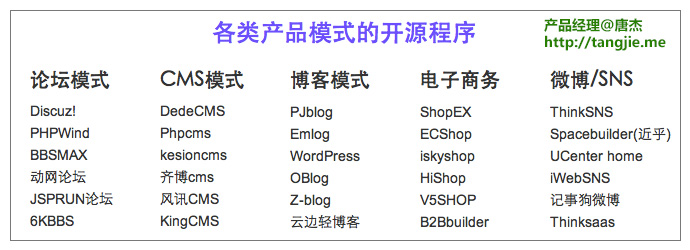
The functional structures of different product models can also be learned through open-source programs. You can build a program environment yourself, download and install open-source software, and then use it directly. By doing this, you can observe how different products are structured and how their functions are organized.
Learning work tools and common product models first allows you to enter the field gradually, from shallow to deep. Starting with feature implementation helps build the basic concepts needed for product work and creates a foundation for later product design knowledge.
5. Then learn product planning
After you have mastered the skills around feature implementation, learning product planning becomes much easier. Once the basic product knowledge is in place, the next step is the long-term accumulation of internet industry knowledge.
Product management is a comprehensive role. Much of the work is intangible, almost like water: it has no fixed shape until the product manager turns it into something concrete. Whether the final result stays like water or becomes ice depends on the product manager’s understanding of the internet industry and the product domain. A product manager’s experience and knowledge structure determine the depth and dimensions of the product.
This is similar to language. Knowing basic grammar and word order is not enough. You also need vocabulary and experience before you can form different sentences and express different meanings.
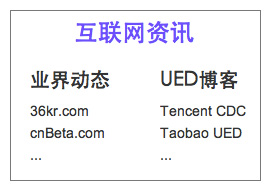
The accumulation of knowledge and experience cannot be completed in a short time. Because the internet industry iterates so quickly, learning has to happen every day. A direct method is to subscribe to mainstream technology and product blogs so that you can keep up with industry trends and new knowledge sharing.
When reading these sources, if you encounter terms or concepts you do not understand, use a search engine to look them up. If some knowledge is especially hard to understand, there is no need to rush. In the early stage, it is enough to maintain a high reading volume and absorb a little every day. Knowledge builds up slowly.
6. Use more products and observe more carefully
There is a saying: only when your eye is trained can your hand improve. For product managers, this means looking at more products, trying more services, and gradually building judgment through exposure. The more you see, the easier it becomes to recognize good structure, weak experience, and useful design patterns.