Happy New Year. The first two weeks of 2024 ended up being unusually full: a BSO concert, a trip to the Worcester Art Museum for a Rembrandt etching show and an unexpected armor try-on, a Sunday at Harvard with the Glass Flowers and historical scientific instruments, and a reading of Escape from Freedom that felt like being personally called out as a modern person. There were also movies, documentaries, variety shows, and a fair amount of delightfully useless knowledge along the way.
Life lately
The first snow of 2024
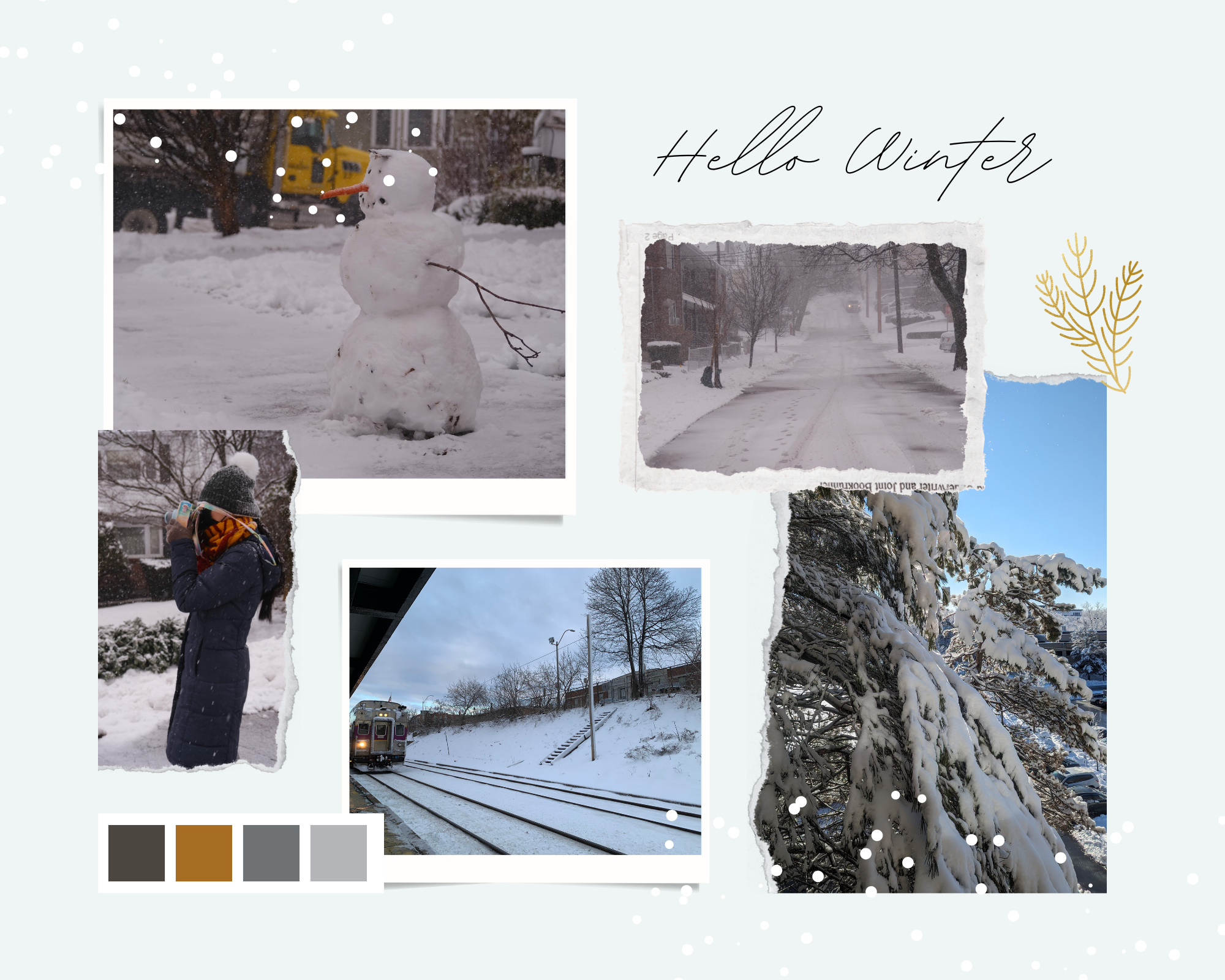
On January 7, the first real snow of the year arrived, and it was a big one. For some reason, we decided to go out right when it was coming down the hardest. By the time we walked back, the wind and snow were so intense I could barely keep my eyes open. Completely impractical, but the atmosphere was impeccable.
Worcester Art Museum: Rembrandt, mosaics, and armor
The Saturday before the storm, we went to the Worcester Art Museum. It was my first time in Worcester, and the city felt much larger than I had imagined. The original reason for going was a Rembrandt etching exhibition, and it absolutely delivered.
The show covered etchings from different periods of Rembrandt's career and also explained some of the technique behind them. There were notes on things like drypoint, where the shallower incisions create a softer, more blurred effect, and on how different kinds of paper can change the final result. What struck me most was how Rembrandt could create contrasts of light and shadow in etching that felt almost painterly. He was also astonishingly economical: sometimes just a few lines were enough to establish an entire background, sharpen the contrast, and pull attention exactly where he wanted it. His storytelling ability was incredible too. The three-print sequence on Abraham's sacrifice of Isaac was genuinely tense to look at.

The museum itself turned out to be far richer than I expected. It is especially known for its huge Roman mosaics and for a medieval church interior moved from France. But the most fun part of the visit, easily, was the arms and armor section, where there was actually a hands-on try-on station.
The piece we got to wear covered the forearm and elbow. It was heavy, but much more flexible than I expected. The guide explained that this part protected the arm and elbow very well, though someone later figured out that if you hit a joint with a hammer you could jam the armor anyway, which was a fairly funny reminder that armor and weapons were in a constant arms race.
The guide also shared a lot of stories around armor and warfare more broadly. One point that stayed with me was that many fighters were really just peasants without elite protection, sometimes going into battle with farm tools in hand. The stories did not always connect neatly with one another, but they filled in a huge gap in my knowledge.
I also really liked the Faith Ringgold special exhibition, especially the group of works that juxtaposed the celebrated “great achievements” of white America with the historical trauma endured by Black Americans, Declaration of Freedom and Independence.
Harvard on a free Sunday
This Sunday's outing was to Harvard's Museum of Natural History, mostly because Massachusetts residents get in free on Sundays.
We took the bus in the morning and discovered that it only took about ten minutes. We parked near the bus stop, which turned out to be the ideal arrangement: less walking in the cold, no dealing with Cambridge traffic, and no headache over parking.
Inside the museum there were children everywhere, presumably because free Sunday is also perfect for family outings. We started with the famous Glass Flowers. I had seen them once years ago with my mom and had been stunned then; seeing them again, I was still stunned. My companion was seeing them for the first time and was equally blown away.
While we were there, a museum staff member mentioned a presentation, so we joined that too. The backstory is wonderful. The museum had a new space to fill with botanical material, and Professor George Lincoln Goodale spent a long time searching for the right solution. He eventually found Leopold and Rudolf Blaschka, the father-and-son glass artists known for making astonishingly realistic glass marine invertebrates. Goodale wrote to ask whether they would make glass botanical models, but they were too busy and declined. So he traveled by ship to Germany to meet them in person, and in the end he secured a ten-year contract under which they would work exclusively on the glass flowers for Harvard. The presentation also introduced the patrons behind that contract, Mary Lee Ware and her mother Elizabeth C. Ware, and described the painstaking methods used to pack and ship the fragile glass pieces from Germany to Boston.
This visit also gave me a clearer sense of how the flowers were made. The models are built around wire armatures, with glass applied over the wires to form stems, leaves, and other plant structures. Different parts were then assembled with animal-based glue. A technique called lampworking was used to apply molten glass onto wire; with an alcohol lamp, the artists could melt glass and shape an extraordinary variety of forms. The exhibition also mentioned that some parts involved more traditional blown-glass techniques, though I am still not sure which parts those were.
What makes the Glass Flowers so uncanny is not just the overall shape, but the texture. The Blaschkas used painted pigments, blown fibers on the glass surface, and tiny added droplets of glass to recreate botanical detail with absurd precision.

After that we moved quickly through the rest of the Museum of Natural History and the Peabody Museum: minerals, fossils, taxidermy, collections from Central and South America, and more. Two Peabody exhibitions stood out: Resetting the Table: Food and Our Changing Tastes, and All the World Is Here, on the formation of anthropology in the United States.
In the afternoon, after lunch, we went to Harvard's Collection of Historical Scientific Instruments. The space is not large, but it is packed. Surveying instruments, astronomical models, telescopes, microscopes, laboratory apparatus, even an entire cyclotron lab installation—it felt possible to trace a miniature history of science just by walking through the rooms.
My one complaint is that the display is fairly warehouse-like, and the labels on individual objects are limited. I kept wishing for videos showing how the instruments were actually used, or what the experiments looked like in practice. We also saw the special exhibition Surveillance: From Vision to Data, which looks at how human bodies and lived environments have been turned into data across history, and how that data becomes a tool for surveillance, whether voluntarily or under pressure. It was thoughtfully done and a little unsettling.

BSO, Stravinsky, and a not-great Central Perk detour
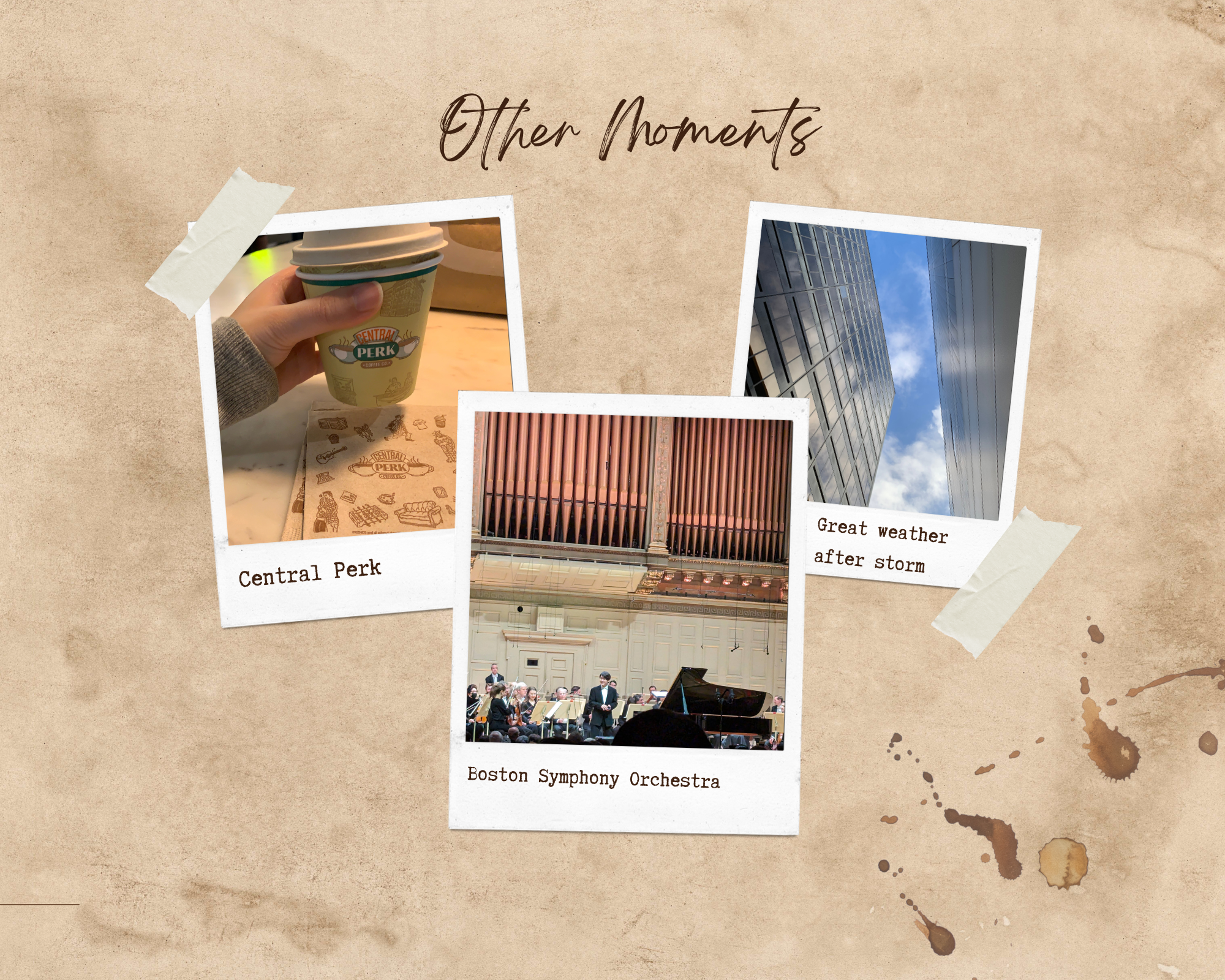
Last Thursday I finally made it back to the BSO, for their first concert of 2024. The program was Ravel's Piano Concerto for the Left Hand and Stravinsky's The Rite of Spring, and I liked the evening a lot overall.
The soloist in the Ravel was Seong-Jin Cho, whose technique was just ridiculous. It was my first time hearing this concerto live, and it made me think again that concerts are visual as well as auditory experiences. Actually seeing an entire concerto played with only the left hand was far more viscerally impressive than simply knowing, from a recording, that that was what was happening.
The Rite of Spring was exciting too. Watching the timpanist happily throwing himself into it—head shaking and all—was weirdly infectious.
Before the concert I also met up with a few online acquaintances in person, which was lovely.
That same day I stopped by the Friends-themed Central Perk cafe, and honestly I would not especially recommend it. The atmosphere lacked the warm, slightly worn comfort of the TV version, and the drinks were expensive. The paper cups and napkins did have a lot of Friends details I liked, though.
Book: Escape from Freedom — 5/5
I picked up Escape from Freedom after hearing about it while reading At the Existentialist Café, and I would absolutely recommend it.
Written on the eve of World War II, the book asks—through the lens of social psychology—why Nazism was able to take hold in Germany. Fromm's argument is that economic structures, individual psychology, and social ideas interact with and reinforce one another. Over the course of history, humans have gradually freed themselves from external constraints—religious authority, monarchy, and so on—and become more individualized. That process increases personal power, but it also deepens loneliness, especially under the atomizing tendencies of capitalism. To escape that unbearable isolation, people may willingly surrender autonomy in exchange for security. A system like Nazism offers exactly that kind of enormous force to submit to: one no longer feels alone, and one no longer has to bear full responsibility.
The book is about the rise of totalitarianism, but reading it now, as a modern person, I kept feeling uncomfortably seen.
One passage that hit hard is Fromm's discussion of false thinking—the way people adopt ready-made opinions without realizing they have done so. He gives the example of asking a fisherman and two summer visitors about the weather after all three have heard the forecast. The fisherman has practical experience and genuinely thinks it through. He may agree with the forecast or disagree with it, but either way his answer is his own, and he can explain how he arrived there. One of the visitors knows he does not know much and simply says so. The other believes he must have an opinion, so he repeats the forecast as if it were his own conclusion, then retroactively invents reasons. What matters is that he does not even realize he is echoing authority.
That example felt brutal because I am deeply unlike the fisherman. A big part of the reason is that I am afraid my own thinking will be wrong, so I instinctively gather information, evidence, and other people's views. It made me wonder whether we should spend less time obsessing over whether a thought is correct and more time asking where it came from. Do I actually believe this? Did I arrive at it myself? And am I willing to say something imperfect if it is genuinely mine? Being wrong is less frightening than being insincere; worst of all is not even knowing that one is being insincere.
Another passage, on conformity, felt just as sharp. Fromm notes that people will stand before a famous painting—say, a Rembrandt—and declare it magnificent even when they feel no real response, simply because they think they are supposed to. The same thing happens in music, in perception, in public life. People see a landscape and experience it through the postcard version already in their heads. They attend an event in person and only feel it becomes real after reading the newspaper account.
Independent judgment is obviously not something one develops overnight. But maybe one place to start is very small: when looking at a painting or listening to a piece of music, ask what the actual response is before asking what one is supposed to think. Even if the judgment turns out to be clumsy, or years later you decide your younger self had terrible taste, that is still better than borrowing a response whole.
This reminded me of a video I saw on Instagram of a child reacting to famous paintings. Asked whether he liked Van Gogh's Starry Night, he said not really, maybe it just was not for him. Asked about Girl with a Pearl Earring, he responded with something like, what's so exciting about that? When told many adults love it, he said adults probably say that just because they are kind. But when shown The Scream, he immediately loved it because it made him feel 😱. That kind of honesty is so rare in adults. Education and social pressure gradually wear away both our contact with ourselves and our courage to say what we actually feel.
Fromm's critique of modern education connects directly to this. He argues that contemporary education often undermines original thought by overemphasizing factual accumulation—really, information accumulation. There is a sad superstition, he says, that knowing more and more facts automatically produces real knowledge. Students are crammed with disconnected information until they no longer have time to think at all. Thought without factual grounding is empty, but sheer information overload obstructs thought just as effectively as ignorance does. That feels even more true in the so-called information age, where thinking often seems to have been left far behind.
Fromm also argues that modern desires are often false in the same way modern thoughts are false. Of course some of that comes from laziness or fear, but society also trains us into prefabricated wanting. Get good grades, get a good job, earn more money, buy a bigger house, drive a better car. We rarely stop to ask whether these are truly our own desires. And even when we do ask, we quickly push the question aside, because it is heavy and difficult. Following the crowd is much easier.
His solution at the end is idealistic. He proposes that only a form of “positive freedom” can allow individualization without loneliness—a mode of freedom in which people act spontaneously and realize themselves fully, without compromise. In a society where economic interest so often becomes the sole measure and meaning of activity, this feels hard to imagine. But it is also hard not to want the world he is describing.
Watching lately
Oppenheimer — 4/5
I finally watched Oppenheimer, and I did think it was quite good. The fractured timeline gives it a kind of participatory suspense that I enjoyed. But I also felt that the story itself is so inherently rich—with so many possible angles and tensions—that the film's success can feel a bit inevitable.
What I did not like was the stereotyped depiction of scientists: all cosmic frequencies in the brain and frantic chalkboard scrawling. The women also felt underwritten; it was never very clear why they were drawn to Oppenheimer or why he was drawn to them. And the sound design often seemed far too eager to manipulate the audience's emotions.
Maestro — 3/5
I watched this after hearing on Sticky Notes that it was the Bernstein film. I do not know Bernstein especially well as a person; I have mainly encountered his music and his Young People's Concerts, and knew only broadly that he was bisexual.
After finishing the movie, I was not entirely sure what it wanted to say. It centers mostly on Bernstein's relationship with his wife: how they met, how happy they were, how he cheated, and eventually Felicia's death from cancer. By the end my response was less insight than a vague “well, that world is messy.” There is also an absurd amount of smoking in the film. The score, naturally full of Bernstein's music as composer or conductor, was good.
The Solitary Gourmet 2023 New Year's Eve Special — 5/5
For the New Year period, a Solitary Gourmet special feels practically mandatory. This year Goro did not get to eat soba, but he did go to Taiwan for pickled cabbage hotpot and night-market snacks, all of which looked excellent. Being unwillingly swept into a folk performance and a delivery errand felt very on-brand: even on New Year's Eve, Goro remains Goro.
Best in Miniature, Season 1 — 5/5
I strongly, fervently recommend this competition series. It is heaven for anyone who loves miniatures.
Eleven miniature artists compete to build tiny houses, from the structural shell to the interior decoration of each room to the landscaping outside. Watching them slowly construct their ideal homes with all kinds of techniques is immensely satisfying. The artists themselves are very different from one another, and so are their houses: some are historically grounded, some highly modern, some strongly thematic.
The pacing is also refreshingly brisk. It never drags.
The winning artist specialized in miniature haunted houses, and the final work was unbelievably eerie and convincing, full of motion and atmosphere. The show makes it obvious that miniature work is a total synthesis of skills: paper, clay, woodworking, painting, sewing, all of it. It also requires physical stamina, because they work for eight or ten hours at a time, and enormous patience, because making something that small look clean and detailed takes so much effort. And then on top of all that, you still need imagination.
A video on Mesopotamian writing and the historical background of the Epic of Gilgamesh
One other thing I enjoyed recently was a video about the writing traditions of ancient Mesopotamia and the historical context of the Epic of Gilgamesh. The creator makes extremely information-dense videos on prehistoric art, Egyptian art, Mesopotamian art, Greek art, and more. The only problem is that they are very long and packed with material, so by the end I often feel that I learned a lot and retained very little.
Podcasts
Hidden Brain — “Making the Most of Your Mistakes”
I thought this episode was excellent. Overemphasizing “never make mistakes” does not actually reduce mistakes; it mainly reduces the reporting of mistakes. The real issue is not achieving errorlessness, but catching errors before they produce serious consequences.
Bowu Zhi — Episode 222: The Northern Qi Mural Museum
The excavation site featured in A Feast of Lines has finally become a museum. It sounds wonderful, and the fact that it preserves the site in place makes it feel especially precious. I really want to go.
Flip Radio Special — a hard-core discussion of whether “Chinese has been polluted”
This was an interesting episode, even if I have already forgotten chunks of it. One point that stayed with me was the argument that many internet abbreviations are primarily an aesthetic issue rather than a moral one. I can see that, even if I still find many of them aesthetically unbearable.
Another point was that some words really can be “polluting” in the sense of flattening thought. A good example is the term often used to describe hypercompetitive pressure. It already carries a built-in negativity, which can narrow discussion, but it also functions as a conversation stopper. Someone describes a situation, and the response becomes: well, everything is just like that now. End of discussion. That kind of shorthand makes deeper analysis harder and does nothing to move toward solutions.
Bu Sang — “The most familiar stranger”: talking about a late-2023 trip to Taiwan
My last and only trip to Taiwan was nearly ten years ago, when I was still too young and clueless to understand much of anything. I would really like the chance to go again.
A passage worth keeping
One of the most striking ideas in Escape from Freedom is that desire can be just as unoriginal as thought. People often assume the only problem is that they cannot obtain what they want. Much less often do they stop to ask whether what they want is truly theirs.
At school, one wants good grades. As an adult, one wants greater success, more money, a larger house, a better car, the ability to travel. But if one pauses in the middle of this frantic pursuit and asks, what then? If I really get this new job, if I really get the luxury car, if I really travel—what is it for? Do I actually want these things? What is the goal I am pursuing? The questions are frightening precisely because they shake the foundation of one's activity and challenge one's desires themselves. So most people hurry to suppress them and continue chasing what they assume to be their own aims.
That feels uncomfortably true.
And that was the first half of January: snow, museums, music, miniatures, and a book that made ordinary modern life look a lot less innocent.