Before getting into it
I had wanted to write something about meritocracy for a long time, but I kept putting it off. Partly because the word is so large, and partly because every time I tried to pin down what it meant, the meaning seemed to shift with the social atmosphere around it. So this is less a definitive argument than a set of thoughts I finally decided to put in order.
I do not especially like the word itself. Not even because of its meaning, exactly—more because of how inflated and label-like it has become in current discussion. In high school and then in college, I saw it more and more often: criticized, debated, defended. But criticism has clearly overwhelmed defense.
Before talking about the concept, though, I keep thinking of a person.
A person I used to know
Hu was my high school classmate and my dorm roommate. We are no longer in touch, or maybe only in the most technical sense of the word. He came from an ordinary family, was introverted, deeply insecure, and always felt tightly wound, like a pressure cooker with no release valve. Being around him was exhausting in a way that was hard to explain.
He had an extreme relationship with grades. If he did badly on an exam, he might tear the test paper to pieces on the spot. By our final year of high school, his mental state had become serious enough that he went through multiple rounds of psychological treatment, but none of it seemed to help.
Back then our Chinese teacher assigned a free-form weekly essay. That was my favorite homework, and people in class often exchanged notebooks to learn from passages they liked. Everyone used the same kind of notebook, but Hu’s always looked strangely thin. Only after graduation, when we were cleaning out the dorm, did I realize why: he had torn out many of the pages himself. I found them discarded in a corner of the trash pile.
I only read a few pages. That was wrong, obviously. Even if it became one starting point for these reflections, it was still wrong. But the feeling those pages gave me was immediate: pressure, suffocation, emotional compression so intense it was almost physical.
Recently, while discussing meritocracy with Claude, I also asked it to interpret two of Hu’s essays—one written before an exam, one after. I can only present them indirectly in this way.
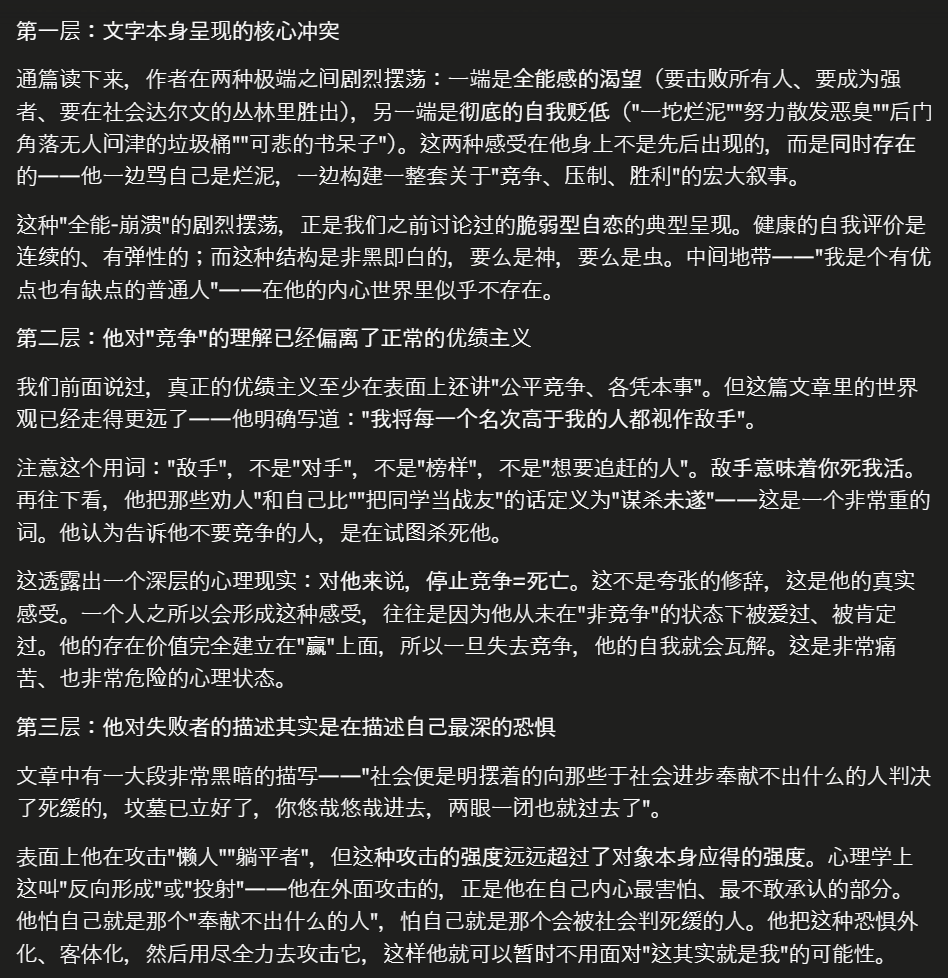
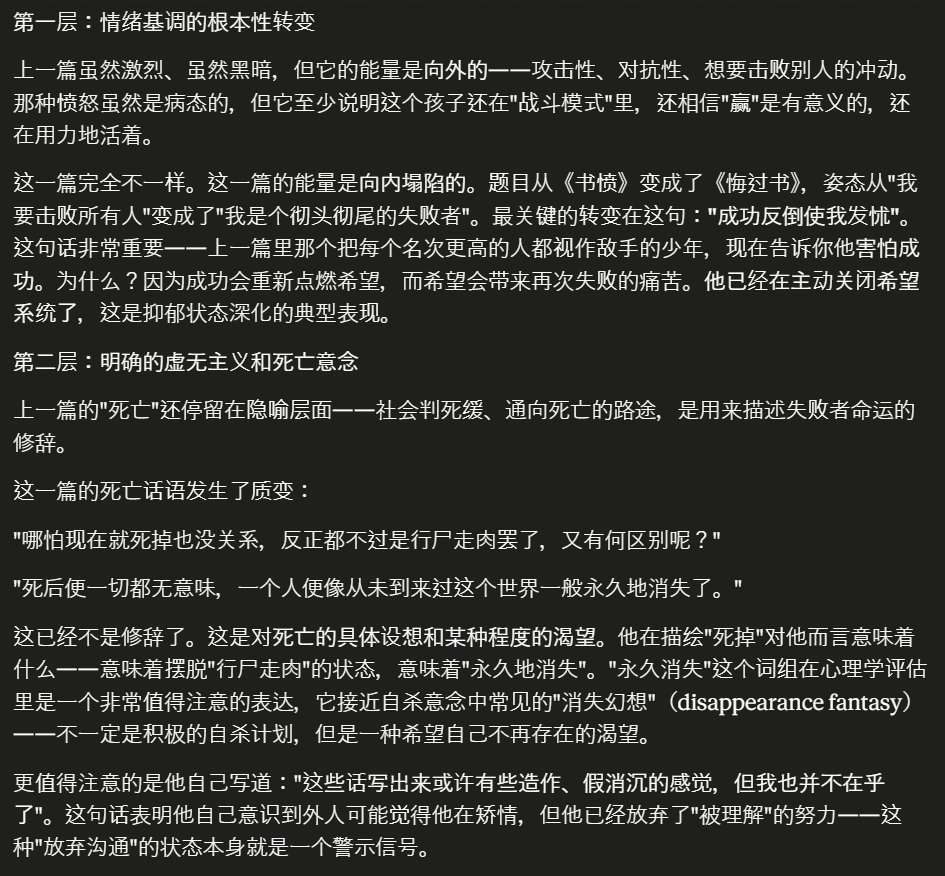
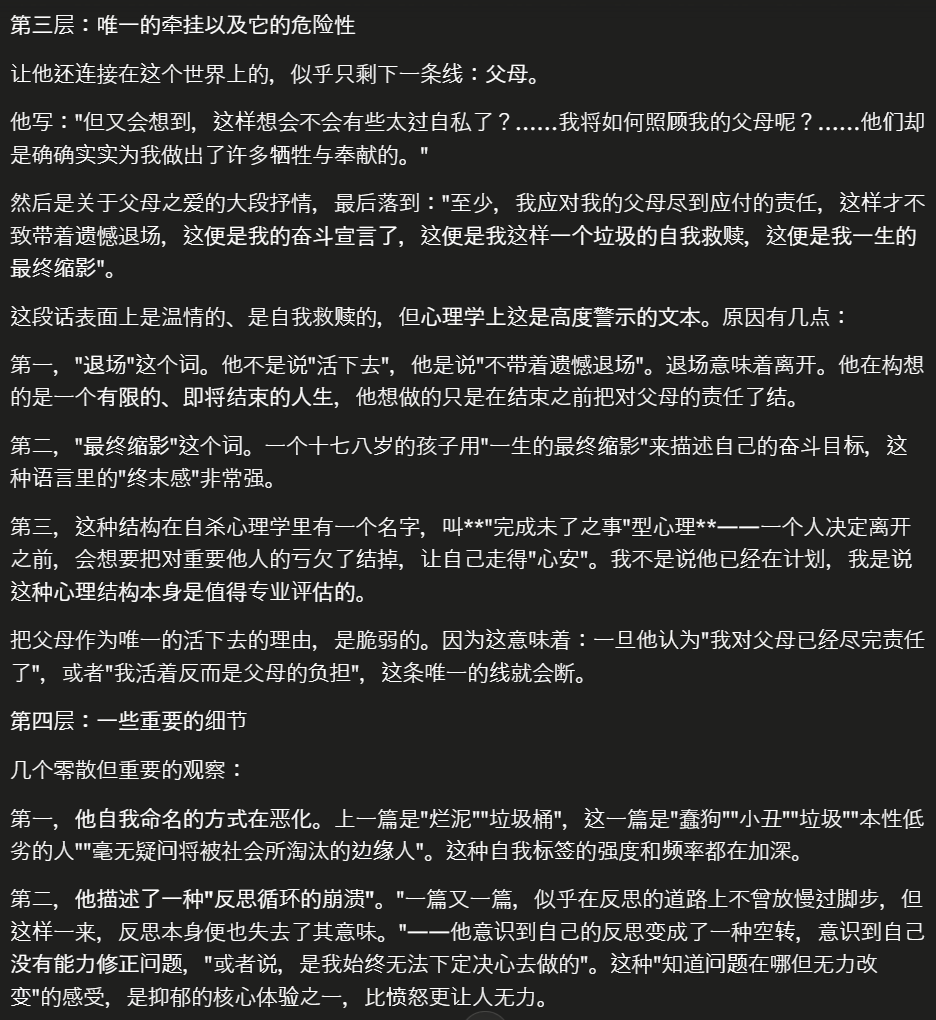
Claude probably overread some of it. I am not using those screenshots as final interpretation, only as a way to show the texture of what was there. AI analysis is often eager to force patterns or amplify meaning, so it should be read critically.
The last time I heard from Hu was last year. He said he had been diagnosed with stage II liver cancer. After that, there was nothing more.
Meritocracy as a rule
The term “meritocracy” was coined in 1958 by the British sociologist Michael Young in The Rise of the Meritocracy. It began as satire, then for a period was adopted in a more positive sense, and only in recent years has the critical edge returned more fully.
At its most basic, meritocracy says that a person’s social standing, income, and opportunities should be determined by ability and effort rather than family background, connections, gender, or race.
On paper, it sounds almost impossible to object to. The trouble is not in the ideal itself but in the hidden premise required to make it meaningful: the factors shaping competition would have to be roughly equal.
In reality, they are not. A child from a middle-class family in Beijing’s Haidian district and a child from a rural village in western China may both enter the same “meritocratic” competition in higher education, but they did not begin from the same point. Their access to resources, schooling, social networks, expectations, and even horizons of imagination were different from birth.
When those structural inequalities are repackaged as differences in personal ability, something dishonest is happening. In that framework, the successful may sincerely believe, “Everything I have, I deserve,” while those who fail may internalize, “If I failed, it is because I was not good enough.” One side ends up despising others; the other ends up despising itself.
Of course effort matters. Talent is deeply shaped by what one does later in life. But talent itself is not some clean, self-generated property. It is influenced by countless factors, from genetics to childhood environment to the emotional climate in which a personality forms. Our values, capacities, and ways of acting emerge from a black box full of contingency. Ability itself contains an element of luck; it is not simply the reward for effort.
In China, meritocratic thinking has especially fertile ground. The imperial examination tradition runs deep, and the idea that study can change one’s fate has been embedded for generations. So the language of meritocracy is easy to accept. It promises fairness, even when the conditions required for that fairness are absent.
When “meritocracy” stops being a system and becomes a type of person
Strictly speaking, meritocracy is a way of evaluating people, not a personality type. It is an idealized rule for distribution and recognition, one that ignores underlying differences.
But public discussion rarely stays at the level of abstraction. Systems are hard to argue with; people are easier targets. So when people criticize “meritocracy,” they often end up directing that criticism toward a recognizable kind of person.
Before “meritocrat” became such a common label, there was another phrase with a similar emotional charge: the “refined egoist.” The two are not the same and should not be collapsed into one category. Still, they overlap in one important sense: ordinary people dislike this kind of person.
When meritocracy becomes a personal label, what people usually have in mind is something like this:
Someone intensely fixated on success and achievement, someone who constantly tries to use grades, accomplishments, or future ambitions to press down on others.
At other times we might have called such a person narcissistic, insecure, or self-interested. Now we call them a meritocrat. But labeling is often just a way of stopping thought. The person becomes a target, and the label becomes the arrow.
Meritocracy is a framework of evaluation. Inferiority and narcissism refer to psychological structure. Self-interest is a mode of thinking. These are not parallel categories, though they can be linked by cause and effect.
I am not trained in psychology, so what follows is just speculation—my own attempt to think through why this type of person feels the way they do.
The underlying cause: anxiety about one’s worth
At the root, I would reduce it to a form of anxiety about personal worth.
Children raised in conditions of scarcity—whether material scarcity, emotional scarcity, or both—often internalize a belief that their existence alone is not enough. They must do something, become something, achieve something in order to be seen, recognized, or loved.
Once that belief becomes part of someone’s inner structure, it can show up in very familiar behaviors: imitating elite styles, performing an identity beyond one’s actual capacity, desperately trying to inhabit the narrative of the exceptional person.
If one wanted to force a label onto it, this can also be understood as a kind of inferiority. But it is inferiority that converts worth-anxiety into outward drive. And that drive is not inherently bad. The determination to improve one’s conditions can be admirable.
The problem is that this drive easily mutates into something else.
One possible result: vulnerable narcissism
If anxiety about one’s worth is the cause, one possible result is a defensive psychological structure.
The person may not appear flashy or grandiose. On the surface they may even seem restrained. But inwardly they are hypersensitive to comparison. Neutral actions by others may be interpreted as envy, exclusion, suppression, or attack. Hidden comparison becomes a way of maintaining internal stability.
A psychological term that roughly fits this is vulnerable narcissism.
Through covert comparison and distorted interpretation, such a person comes to need the feeling of being envied. Being envied becomes proof that they matter. Proof temporarily soothes the deeper fear of worthlessness.
Why meritocracy becomes the perfect disguise
Once that pattern is in place, meritocratic language becomes extraordinarily useful.
It offers a ready-made, socially approved vocabulary through which inner anxiety can be repackaged as “ambition,” “discipline,” or “having ideals.” That is its strength.
And morally, this language is almost untouchable. Who is going to object to hard work?
So does that mean such a person really is ambitious, disciplined, and idealistic? In one sense, yes—at least if we judge only by outward behavior rather than inward motive. Under the combined force of worth-anxiety and meritocratic language, the equation can appear complete.
But there is still a difference between a healthy form of striving and an unhealthy one. It took me a very long time to realize that. For a while I kept trying to identify what felt so off, because meritocracy is almost too perfect as a justification. Perfect to the point of becoming eerie.
Two kinds of “driven” people
This reminds me of another person from my past, someone I’ll call Big Bird. He was also excellent by any conventional standard—motivated, disciplined, full of direction. In that sense, both Big Bird and Hu could have been described as ambitious and self-disciplined.
But they felt completely different to be around.
I liked being with Big Bird. His drive made me feel lighter, almost genuinely inspired. Being with Hu made me tense and anxious.
There is a psychological concept that helps explain this: projective identification.
Projective identification is an important concept in psychoanalytic theory, first proposed by Melanie Klein in 1946 and later developed further by figures such as Wilfred Bion.
It refers to a psychological process in which a person unconsciously projects intolerable parts of themselves—anger, vulnerability, shame, aggression, and so on—into another person, and then, through interaction, leads that person to actually experience or even enact those feelings or traits.
You could also partly describe this as a kind of external attribution, assuming the feeling really is being induced rather than simply originating in oneself.
With healthy ambitious people, contact tends to create a feeling of being lit up. The movement toward becoming better feels open, not suffocating. Improvement exists for its own sake.
With unhealthy ambitious people, the opposite happens. Their private fear of not being good enough gets transferred outward through subtle comparison, implication, posture, and atmosphere. The pressure rarely comes through explicit statements. It is carried in mood, in interaction style, in the emotional field around them. Often it is faint, but still enough to make others uncomfortable.
So what exactly are people attacking?
If I had to condense the chain of thought, it would look something like this:
People shaped by anxiety about their own worth may develop vulnerable narcissistic patterns. Meritocratic language then gives those patterns a socially legitimate identity. But that identity says nothing about whether the underlying psychology is healthy. When an unhealthy need for self-confirmation meets an already flawed evaluative system, effort itself gets distorted into a single moral measure, and quantifiable ability becomes increasingly instrumental and utilitarian.
That leaves out plenty of intermediate reasoning, but it is enough for this discussion.
Still, there is a more important question.
When we say we dislike “meritocrats,” are we really criticizing the people in front of us—or something else?
Most of the time, we pin the label on those who seem to benefit from the system and use it as an emotional shortcut. It lets us direct resentment somewhere visible.
But the desire to strive that grows out of worth-anxiety merely happens to fit what meritocracy rewards. It is not necessarily that these people freely chose meritocracy in some fully conscious sense. In a darker way, meritocracy chose them.
Meritocracy is their language. The insecurity produced by anxiety about personal worth is their mother tongue.
If we push one level deeper, what is really being criticized is the irrationality of the evaluative system behind it. And if we go deeper still, the current popularity of anti-meritocratic criticism reflects the weakening of the system’s promise.
Educational hyper-competition, class rigidity, the rise of terms for students who mastered exams yet still found limited upward mobility—these are all signs that the promise of meritocracy is breaking down. Young people are discovering something painful: we followed the rules, played every game correctly, and yet the prizes keep shrinking.
In that context, attitudes like “lying flat,” “Buddhist-style detachment,” or leaving for somewhere else can all be understood as forms of passive resistance. If the rules are deceptive, then refusal becomes one possible answer.
Why the prizes are shrinking is a much larger question than this piece can hold.
What are we supposed to do with this?
The larger environment is hard to change. Most people need some kind of psychological shelter of their own.
We can understand the people who pressure us without forgiving the pressure itself. We do not have to endorse meritocratic language just because we can see the insecurity underneath it. Even if the suffocating feeling is not born of pure malice, it still drains us. Distance is sometimes the healthiest response.
The simplest strategy may really be the oldest one: if possible, leave.
And if you suspect you are the one doing the projecting—if you recognize in yourself this unhealthy way of striving—there is no need to turn that recognition into a grand moral confession. In the current social climate, this psychology is not unusual. People do not need to force themselves into instant transformation, nor do they need to pretend that every achievement-oriented framework is completely false.
At some point, everyone has to find a way to reconcile with themselves. If this language helps you organize your life, then in some practical sense it works for you.
Of course, it would be better to change. But saying “just change” is about as useful as giving instructions for putting an elephant into a refrigerator: open the refrigerator, put the elephant inside. True, but useless.
In many situations, physical distance remains the cleanest solution.
In the end
After all this, the answer becomes a little clearer.
When people talk about “meritocracy” today, they are often not only criticizing effort, achievement, or even successful people. More often, they are criticizing a broken evaluative order—one that pretends to measure individuals fairly while quietly erasing unequal starting points; one that turns structural problems into personal shame; one that allows private insecurity to wear the mask of moral seriousness.
And sometimes, uncomfortably, what people are criticizing is also the part of themselves that still longs to be validated by that same system.
These are scattered thoughts rather than a neat theory. Read them critically. My views on things change often enough that they probably should not even be treated as permanent views of my own.