A company-organized outdoor training program took place the week before last. These activities usually leave behind at least a few useful lessons, and after combining my own reflections with what some colleagues shared, I put together the following notes.
Rather than treating each exercise as just a game, it was more meaningful to look at what each one revealed about teamwork, communication, trust, and execution.
Trust Fall
This exercise made the idea of trust feel very concrete.
- From the platform, the pressure is real. You do not feel as grounded as you do on flat land, so fear comes naturally. In that moment, you have to overcome that fear yourself and believe in your own action; otherwise, even the way you fall can become unstable.
- For the people below, confidence matters just as much. When catching a teammate, you need genuine confidence in the group’s ability to protect them, and that confidence must also be visible to the person on the platform.
- Trusting others is essential. The person falling backward is placing full reliance on teammates, and that requires pushing past instinctive fear. Once trust is strong enough, that fear starts to fade.
- In the end, the whole activity depends on mutual trust. It only works when every member of the team has built a solid trust relationship with the others.
N People, N+1 Legs
This challenge had less to do with physical strength than with coordination.
- The key was matching pace and staying in rhythm. If one person fell out of step, the entire team’s speed suffered. At times, one person could end up being dragged by others; if someone fell, several people might go down together, affecting the whole group.
- Mindset also mattered. Everyone had to stay calm, keep a unified pace, and pay attention to the teammates beside them. Some people naturally take larger steps, others smaller ones. Adjusting to each other greatly reduces the chance of falling and also improves overall speed.
The Double-Plank Bridge Cart
This exercise also centered on coordinated teamwork, but with a stronger emphasis on communication and adaptation.
- The group had to keep adjusting through communication until a shared method emerged.
- Trust and understanding between teammates were necessary throughout.
- When mistakes happened, it helped when people pointed them out directly instead of hiding them. That made it easier for the team to identify problems quickly.
- Setbacks were inevitable, but the right response was to keep going rather than get discouraged.
- Direction mattered. Moving in a straight line avoided wasted effort and unnecessary detours that would hurt the final result.
- One very practical lesson was not to underestimate female teammates. Women could also take on the task of pulling the rope to increase the plank’s stride and help the team move more effectively.
Building the Tower
This activity highlighted the difference between wanting a result and being able to execute a workable plan.
- Discussion and questioning were both necessary. Without enough challenge and debate, a team can become too focused on the end goal and ignore the real difficulty of execution.
- Good ideas from others were worth studying. Learning from a stronger approach, absorbing it, and improving on it helped expose our own blind spots.
- Ambition needed limits. A team cannot focus only on building higher and higher; it has to think more comprehensively.
- When cracks appeared, temporary fixes at the top were ineffective. The solution had to address the problem at its source. Simply clipping something on above the crack did not really solve anything.
- Division of labor had to be clear. If everyone did the same thing, efficiency dropped.
- Execution ultimately made the difference. Similar plans can produce very different outcomes, and the deciding factor is often how firmly and consistently the team carries them out.
Red and Black: The Business Competition
This exercise was especially revealing when it came to interests, negotiation, and the difference between short-term gain and shared success.
- Competing only for small personal benefits or narrow group interests is not a workable approach. The bigger goal should be a win-win outcome for the whole.
- Benefiting others first is, in a sense, the foundation of becoming unbeatable in this kind of business game.
- One useful negotiation sequence was: state, plant, seek common ground while reserving differences, then confirm. First, clearly state your team’s view or principle. Then get that idea into the other side’s thinking so they can understand and accept it. After that, bring the two sides’ positions together, aim for consensus while acknowledging differences, and finally use some form of commitment or constraint to protect the shared objective and reach mutual benefit.
- Positive intention matters. Each thought should be constructive, serving both oneself and others.
- Positive speech follows from positive thinking. If the mindset is right, the language used in negotiation and cooperation becomes more constructive as well.
- Positive persistence is also important: hold to the right principles and position. Tactics may be flexible, but principles should not be abandoned, and each person should make their fullest contribution to those principles.
Stepping on Numbers: PDCA in Practice
This activity was a direct reflection of the PDCA cycle.
- Plan: With four chances available, the first step was to observe, discuss, and come up with a reasonable execution plan as a team.
- Do: Once the plan was agreed on, everyone needed to carry it out exactly and take responsibility for their own part.
- Check: After acting, the team needed to review the outcome, identify weaknesses, analyze why they occurred, and think about how to prevent them.
- Act / Adjust: After identifying the problems and finding better methods, the team had to revise the earlier plan and improve it, setting up the next PDCA cycle more effectively.
Counting Off: Leadership in Action
This was another exercise where speed mattered, but the deeper lesson was about method, focus, and accountability.
- Method is crucial. A good method is one of the foundations of success.
- Analysis comes first. Good methods do not appear by accident; they are thought through, and practice is what tests whether they actually work.
- Learning from others is efficient. If another group is significantly faster, the right response is to observe why, identify the gap, and improve your own weaknesses.
- Practice is non-negotiable. Strong results do not happen instantly. Team chemistry comes from repetition, adjustment, and continued coordination.
- Goals shape motivation. Is the team trying to challenge itself, take first place, or simply avoid punishment? The answer affects the intensity of execution.
- Concentration is decisive. This was fundamentally a game of time, and even half a second could shift a team from first place to last.
- People need to take responsibility. If the result is poor, the team should face the consequences without complaining.
- Reflection matters. Real improvement comes from identifying one’s own shortcomings and learning from others’ strengths, not from staying isolated and endlessly tinkering in a closed loop.
A Competency Model Based on Execution
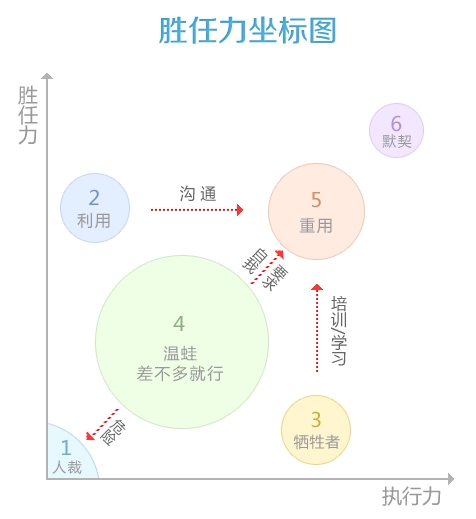
Two concepts sit at the center of this model:
- Competency refers to a person’s ability to do the work required by their role, including skills, work experience, communication ability, and related capacities.
- Execution is the ability to deliver results within a set time frame without compromise or discount.
Six Talent Types Through the Lens of Competency and Execution
The model divides people into six broad types.
1. Low competency and low execution
This group is often made up of newly hired employees. They are unfamiliar with the company, lack much work experience, do not communicate proactively, and tend to be overly passive in their work.
2. High competency but low execution
These are people with strong ability and years of experience who are fully capable of performing their jobs well, yet they execute poorly. They may place themselves in opposition to the team or even the company, communicate with colleagues unwillingly, and operate in a highly self-centered way. This type is often seen among long-time employees with a proud or aloof personality.
3. High execution but low competency
This group is enthusiastic, proactive, hardworking, and willing to put in effort, but their ability is still limited, so the methods they use may be off target. This is commonly seen among recent graduates and employees who have not been working very long.
4. Balanced competency and execution, but stuck in a plateau
These people are relatively stable. They work and communicate in a consistent way, usually handle tasks smoothly, and do not run into major trouble. The limitation is that they often feel “good enough” is enough. They do not strongly pursue refinement or excellence, and their working style becomes repetitive and unchanged. This group is often made up of long-serving employees who have stayed at the same company for many years, no longer feel much freshness in the work, yet are not willing to change their current state. In many companies, this is the largest category, and it is also where many employees hit a bottleneck.
5. High competency and high execution
These people not only perform strongly but also work in a way that aligns with the company’s culture. They move forward together with the organization and are often supervisors or core team members.
6. Very high competency and very high execution
At the top are people with strong influence and decision-making ability. This group is typically senior management, capable of shaping the direction and even the fate of the company.
Looking back, the value of the training was not in the activities themselves, but in how clearly they exposed the mechanics of teamwork: trust has to be built, coordination has to be practiced, methods have to be tested, and good ideas only matter when execution is strong enough to turn them into results.