The most important thing I did in June was write fanfiction.
It started because I was reading Jin Ping Mei. I got through a dozen or so chapters, then stopped around the point where Pan Jinlian marries Ximen Qing. The early adulterous episodes are just too entertaining, and I love writing that lingers on how one person looks at another until desire feels like a waterfall—obsessive, overflowing, impossible to hold back. That was enough to wake up my urge to write for my little pairing again. Also, it had simply been too long since I’d had any fresh fic for them, and I really, really wanted to read one.
So from June 10 until yesterday, I buried myself in a new story for half a month and finished a piece called Lover. It came out to exactly 24,000 words. It isn’t the longest thing I’ve written, but it definitely felt harder than some of the others—not especially breezy or joyful to write. Still, I’ll set that feeling aside for the moment and talk about the story itself. A Q&A format seems like the easiest way to sort through what I was thinking.
What kind of story is it?
After finishing it, the description that feels closest is probably: a bootleg folk-edit version of Infernal Affairs II. The timeline is completely scrambled, and the world has been rearranged around my pairing into a parallel universe.
In this version, Ah Yan and Brother have known each other since childhood, and before they fully understand anything, they’re already in love. That part is basically Infernal Affairs 0: a youth story.
Intercut with it is a second timeline, where the adult Brother has become Ah Yan’s secret, unspeakable lover—the hidden mistress version of a gangster melodrama, all sorrow and underground longing. In that timeline, Brother loses his father, survives an assassination attempt, and still gets his midnight execution scene. That is Infernal Affairs II, except filtered through my own unofficial edit.
How did I build the plot?
At the beginning, I didn’t actually know with much clarity what the story was going to be. I only knew a few details for sure.
First: in this version, Wong Chi-shing never arranges a murder-for-hire. That let me dodge some canon trajectories I don’t like, such as Luk Kai-chung’s death.
I wanted the overall tone to be warm, with as few regrets as possible, so with a wave of the hand I simply spared a lot of people. Law Kai-yin became Ah Yan’s mysterious senior brother, and I even let him cross over slightly with a pairing from The Tale of Rose that I could never get over, pairing him off in passing with insurance agent Huang Meigui.
Second: Brother and Little Brother had to know each other when they were young, and both the meeting and the falling-in-love would take up a significant portion of the story.
Third: even if I dodged all the original predetermined fates, Brother’s alley execution scene still had to happen. Why? Because I wanted to write a Hong Kong cops-and-guns shootout. The result, admittedly, did not fulfill that ambition very perfectly.
In terms of plot function, there was one thing that mattered more than anything else.
Because the boys meet early here, love also begins very early. But Brother is still a triad man in this setting, and because of the reverse chronology we know Ah Yan still becomes a cop in the end. That creates a contradiction that needs careful handling.
So in the early planning, each part of the youth storyline had a distinct purpose.
When they first meet, Ah Yan doesn’t know who Brother really is. So the first section—eating together, spending the summer together—exists to gradually reveal that Ah Yan and Brother are biological brothers.
The second section, where Ah Yan works at the neighborhood convenience stall, exists to bring him into contact with Luk Kai-chung and set him on the path toward police academy.
The third section, where he works at the maid café, exists to reveal through Wong Chi-shing—not Luk Sir, it had to be someone else—that Brother is actually triad.
The order matters a lot. If Ah Yan learns Brother is triad first and then still decides to go to police academy, it feels odd and unconvincing. If he starts pursuing the academy first, and only afterward learns the truth, the emotional effect is stronger. Both Ah Yan and Brother still carry that youthful innocence that believes nothing will really change. But later, they’re forced to confront the question: does growing up mean you and I must from now on belong to different identities?
I personally think this is the most skillfully handled part of the story, or at least the part with the most craft in it. Whether readers feel the same, I have no idea.
About the ending
I actually considered several endings.
One involved Ah Yan catching Brother after he kills someone, just as a colleague is about to appear—so Ah Yan helps him hide the gun. I was very sincerely trying to steal from Decision to Leave, and I even had the line in my head that “a lover is someone who keeps your secret for you.” So the hidden-gun ending was the one I felt most drawn toward.
Another version had Luk Kai-chung, Ah Yan, and Brother facing off in a three-way confrontation at the end, echoing the opening. Ah Yan, his heart in knots, would fail to defend Brother in front of Luk Sir at first, but finally make that choice in the end.
But the ending I actually wrote came to me during yesterday’s lunch break:
The shots were fired on the fourteenth. Ah Yan remembered clearly that it was dusk when the man walked into the station and said he had come to cooperate with the statement-taking. For a moment everyone stopped what they were doing. The last note of his voice dissolved into the air, soft as if it had drifted out of a dream. Ah Yan led him to the interview room. They began at 7:15; when the statement was done it was 10. By the time he came out, Ah Yan had already left.
At 11:14, the gunfire started. Bang, bang. He fired one extra shot. Bang. The bullet buried itself in flesh with a muffled thud. He believed a sworn brother’s loyalty deserved a bullet delivered with solemnity. Then the whistle split the alley. The police arrived faster than expected, but there was only one of them. In the murk, Ah Hau saw a face under a cap brim cut in half by light and shadow, calm without the slightest trace of surprise.
“Ngai Wing-hau,” the man said. The black hole of a gun barrel and a pair of eyes he seemed to know. Word by word, he said, “Drop the gun.”
“Ah Yan.” He said his name and shook his head lightly.
The bullet entered the back of that man’s skull like a nail through wet wood. Black blood spread behind his neck like a crack, and then he fell at last with a heavy thud, like the pounding of a heart.
Ah Hau remembered then that years ago, beside Sam, he had seen this man before.
Ah Yan’s lips moved, as if with the stammering hesitation of first love, confession half-formed. He walked closer, trying to hear clearly. At last he heard Ah Yan say: Run.
This is more extreme than any version I had planned before. In it, Lau waits for Brother to finish off Hon Sam, planning to swoop in afterward and arrest him—maybe to go claim credit in front of Mary, which is how I imagine it, though I didn’t write that part. Then Ah Yan appears and shoots Lau through the head from behind, telling Brother to run.
What can I say? I’m very pleased with the slight misdirection in that passage, the way it tries to obscure the situation for a moment. But to readers it may feel abrupt, because the foreshadowing before and after is too faint. In the end I didn’t manage the kind of strong, striking, leopard-tail ending I wanted. Nor did I fully achieve the Hong Kong spy-thriller flavor I had hoped to write.
Even the epilogue explains things rather simply. I was also quietly trying to borrow some of the gun-swapping logic from Mad Detective, though I doubt anyone would notice.
The internal determination process for the case took a year. In that time three inspectors were replaced, there were two oral hearings, and one mistaken archive retrieval. Personnel shifted, the system changed, and Ah Yan changed his cap badge once as well. In the autumn of 1997, the file was finally sealed into a cardboard box, and no one cared anymore about the six bullets from that night.
So there’s still an enormous distance between what I imagined and what I actually managed to realize. If I scored the ending strictly for execution, it would only get a 60. But because I’m so pleased with my own little narrative trick—possibly one no one but me will appreciate—I ended up giving myself an 86. Somewhere in the B+ to A- range.
Why add an epilogue?
The epilogue’s main job is simply to answer: what happened afterward?
If the story stopped at that ending, it would leave readers unsettled. Was Ah Yan judged? Did he go to prison? Could he still be a cop? Could he still be with Brother?
A story’s essence often lies in what it leaves unsaid, but I didn’t want this to become the kind of story that leaves you uneasy after finishing it. I wanted certainty. I wanted the reader to know that the things they feared would not happen, and that when the story is over, Ah Yan is still with Brother.
In the epilogue, Ah Yan goes off to write wuxia novels. I originally wanted to use his writing to create a really beautiful allegorical tale, but in the end I didn’t. Mostly because a novel-within-a-novel shouldn’t have that kind of top-down power to map fate too neatly.
So the book Ah Yan writes becomes a sweet little wuxia story instead: a bad older brother from a valley of villains leaves the mountain, wanders around, makes friends who can protect him, and then returns home happily, without injury and without losing anything. It’s a wish, really. A soft place to put that tenderness.
My favorite parts
The scenes I enjoyed writing most were probably the youth and adolescence sections. I had a lot of fun with them. I love writing slightly foolish kids, and I especially love this version of Ah Yan: a workaholic little fool so in love his brain turns to paste, with no shame left and barely any self left either.
But my favorite passages are two specific ones.
The first is the murkier emotional texture of Ah Yan’s youth:
In Ah Yan’s life, that period never counted as especially bright days. The daylight was gray-white all day long. Wind flipped the front pages on the newspaper rack: fifty years unchanged, a beautiful new Hong Kong. But how could a little neighborhood stall without even a cash register compete with the brightly lit 7-Eleven at the corner? It wasn’t that he never felt the uncertainty of an unreadable future. And yet, on nights that lonely, when he saw Brother’s figure coming from across the street, Ah Yan truly felt that as long as it was with this person, anything would be fine. Kissing under a low-watt bulb until their lips were wet also counted as sharing hardship with Brother.
The second is the scene on the day of the funeral, when Ah Yan runs into Brother on the street and lights his cigarette for him, and that thought arrives: does growing up mean you and I now belong to different identities?
The radio said more people were needed on Canton Road. Ah Yan left his senior to guard his own past. No new developments; he radioed back, Area all clear, and then from the corner of his eye caught a flash of silver, sharp as a blade. The gleam of the car body seemed to dim the whole street around it. Ah Yan followed instinct, and there the man really was, standing by the newsstand at the corner, coat draped over one arm, reading with his head lowered.
Ah Yan walked closer to see. He looked so intent that Ah Yan assumed he was reading the South China Morning Post, but in fact he was idly leafing through a student newspaper, looking at a tiny wuxia column no bigger than a block of tofu. Thieves and killers, heroes and assassins—always the same kinds of people. Feuds and love, black and white overturned—always the same kinds of stories. Ah Yan thought: one day I’ll sit in this position. It was 6:15 then, a deep-blue morning. His heart was strangely quiet. He only asked whether he had eaten breakfast. The man shook his head, an unlit cigarette between his fingers. Ah Yan held out a light; the man leaned in with the cigarette between his lips, and the flame struggled once in the wind. Ah Yan cupped it carefully with his palm and saw his eyelashes lower, the folds at his eyelids deepening by another two lines. People with larger eyes have that problem: if they wake early without enough sleep, it shows immediately.
The man exhaled a stream of white smoke and looked at him, as if he wanted to say something. But in the end there was no need to say it, no need to ask. Ah Yan thought of the night he came and asked: how long are we going to go on like this? It turned out Brother’s grief in love had cut deepest; his rare loss of composure came from that. Ah Yan still dreamed, now and then, of things from before. Brother was no different from how he had once been. It almost seemed as if Ah Yan himself were no different either. You and I. Does growing up really mean you and I must from now on belong to different identities? he wondered. When Brother had finished the cigarette, they went their separate ways.
Even rereading it now, that sudden surge of feeling catches me off guard. It makes my heart go soft.
About the sex scenes
There isn’t actually that much to say about the porn.
This time I wrote the character as intersex, but apart from one particularly in-your-face section, I don’t think the erotic material is all that inventive. The truth is that there had been no fresh explicit fic for my pairing in the tag for so long that I had to write it myself. But my libido, apparently, can only sustain around 10,000 to 15,000 words. Usually I start out full of enthusiasm, with a porn-to-plot ratio of something like 3:1, and then by the later sections I’ve basically run out. The porn disappears and all that’s left is plot.
The clearest example is the maid café section. At first I had every intention of writing some cross-dressing into it, but by then the can of sexual energy was completely empty, so it never made it onto the page.
This is one of the things I’m most often dissatisfied with in my own writing: the erotic scenes are distributed unevenly, entirely based on whatever impulse seizes me at the moment, without any sustained concept behind them. And too much explicit material can also affect the story’s structure, or interfere with how readers receive the other tender, romantic material.
But really, what can be done? I wrote the whole thing because I wanted to read this pairing in exactly that kind of overwhelming, waterfall-like erotic intensity.
Am I satisfied with it?
Not really—at least not fully.
After finishing it, I didn’t feel especially satisfied. In my own mind, it isn’t one of those genuinely good narrative works. I was even a little depressed after I finished, and found myself thinking of it as a rather poor novel.
But later that evening, after sitting with myself a bit more carefully, I changed my mind slightly. It may not be a perfect story, but perhaps it is a story that can make someone suddenly smile while they’re reading.
I stuffed it with a lot of things I personally love: light-comedy bits like Ah Yan’s various jobs, the maid café, Silly Keung popping up abruptly like a mole from underground, or the sticky, clingy opening where the two of them are secretly carrying on an affair. In the later half, I also like the shift in emotional register: Brother gets hit with all these clingy, intimate words from Ah Yan and can’t quite figure out what is wrong with this kid, while also feeling a little alarmed. Or that ending part where Ah Yan sees on videotape that Brother tells Hon Sam he’s leaving—actually lying to him—and Ah Yan is left hollow inside, thinking Brother plans to go alone. Then Brother is shot and disappears without a trace, and Ah Yan’s fear only grows sharper and more bitter. Brother, meanwhile, is deeply shaken: how could you possibly think that? Those are all parts I’m fond of.
In terms of completion, I’m still unsatisfied with the ending, but I think the rest is more or less fine. Nearly everything I wanted to accomplish before the ending did make it into the story, so I don’t feel much regret there, even though of course there were also scenes I wanted that never got used. Overall I’d probably give it an 80.
As for the prose: because there’s so much dialogue, the language this time is very simple. I’m still chasing a crisp rhythm and a concise style, but I don’t feel this piece represents any particular progress compared with the previous ones.
What was the writing process like?
The process was not smooth at all. I dragged this story out a few hundred words at a time and got stuck constantly. I’m not even entirely sure why.
Part of it, I believe, is that this time I started writing without fully thinking through the chain of cause and effect or the ending, and without clarifying all the functions of the plot in advance. That led to contradictions in the final section, and I had to go back and almost rewrite most of chapters 01 and 02.
Another reason is that a lot of this was written on weekday nights, or during lunch breaks at work. My head wasn’t particularly clear when I sat down. There were too many stray thoughts still floating around, so everything came slowly and with effort. Most nights I could only write a few hundred words before going to bed frustrated. Anyone who follows my timeline probably saw me trudging through it like an exhausted draft animal. But maybe that’s just something I have to get used to.
I more or less wrote the whole thing live in public, in a strange way, and oddly enough I never seriously considered giving up. Even though it was painful, I kept writing every day in an orderly way. So I discovered that even if you only write a few hundred words at a time, they do accumulate. In the end, something that had no shape at all became a story with at least some degree of completion. Because I was stuck so often, it felt as if it took forever—but really it only took a little over two weeks.
There was also one small incident last weekend: because the writing was going so badly, I had a bit of an emotional collapse and ended up lying on the floor unable to do anything. In my original estimate, the story should have ended around 20,000 words. I’m usually very accurate when I predict length. This time, hitting the expected word count and realizing there was still so much left unfinished was what tipped me over; it made me realize that failing to complete something according to plan triggers very serious self-doubt in me. The extra length came almost exactly from the unplanned maid café section.
So in the future, I probably need to leave myself more room for unexpected material I suddenly want to write—or simply relax more about the process.
The thing I handled worst this time was confidence. I was tense, and there was a lot of self-doubt. But I still finished because I was writing something I loved, and because scenes I was eager to reach were waiting ahead. Persistence is gradually becoming one of the few qualities in myself that I can affirm with some sincerity. That probably counts as a small kind of progress.
A few last things
During the writing of this piece, I gave up a lot of research. I only checked whether certain things should or should not exist in the period the story is set in, and didn’t lose myself in endless wiki wandering. I’m quite happy about that, because research only slows down the speed at which I spread my nonsense.
At the same time, I didn’t open the original film even once, which proves that I apparently know Infernal Affairs II by heart already.
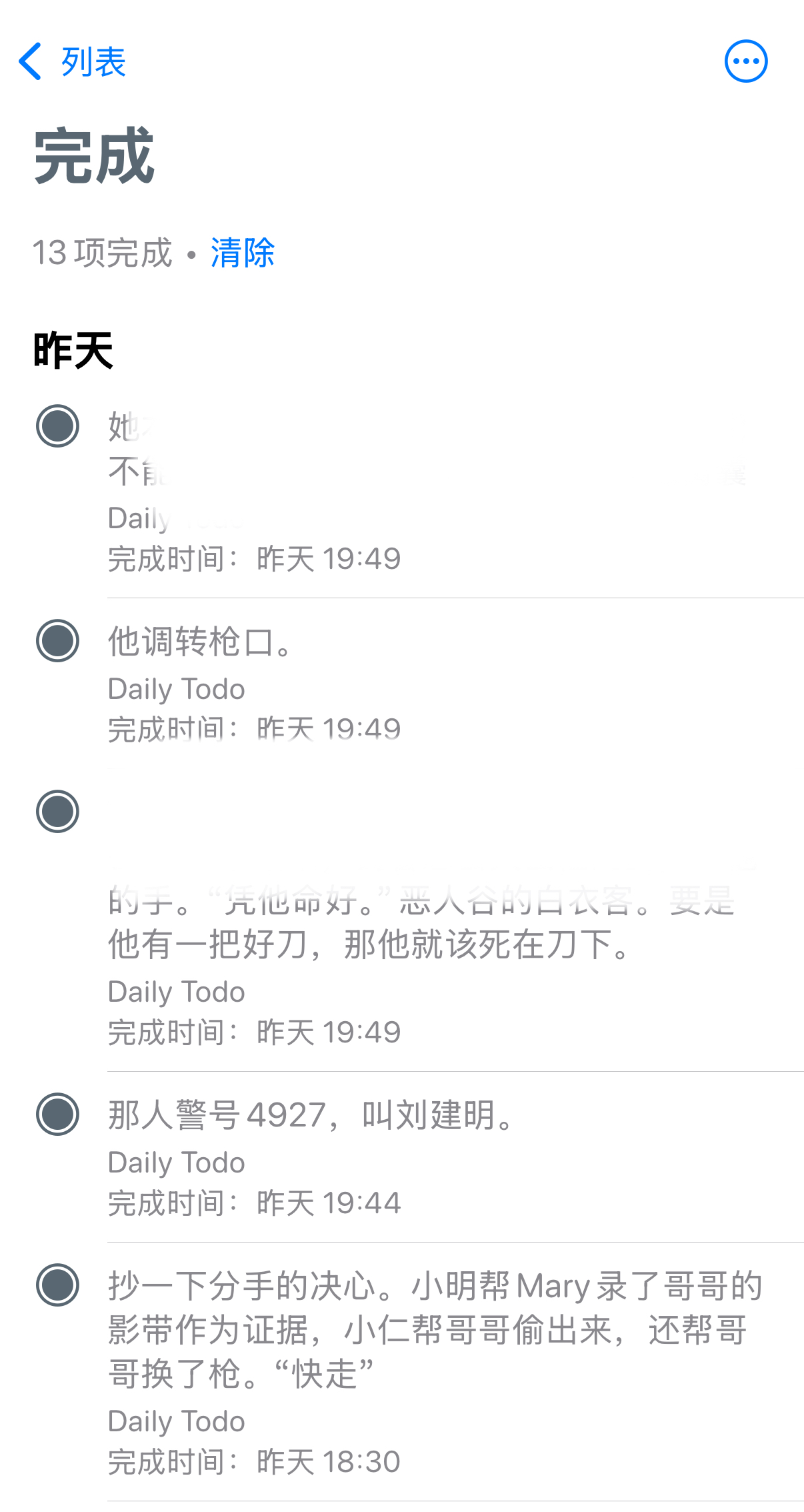
Another practical matter: this time the plot had too many moving parts, and there are too many people I care about on social media, so I couldn’t just throw every idea onto my timeline and retrieve it when needed like I used to.
I had previously used Cubox to save interesting things I saw online, plus little flashes of inspiration. It’s clunky, and I don’t like the interface, but as a collection tool it’s genuinely useful. I need features like smart lists, and the cross-platform support was good too. But once the discount disappeared, it became too expensive, so I stopped using it.
My current substitute is the Reminders app on my phone. I can make lists there too—manually, of course. Once I’ve written a scene, I just check it off and archive it. You can add notes, insert images, attach tags, and I discovered it can even make smart lists. It’s a simplified replacement, but it works.
These notes are a bit messy, but they’re all honest to how I felt in the moment. Maybe if I come back to them later, I’ll feel differently again. For now, this is enough.
And then I remembered one more thing. A little fan video for this pairing has been sitting on my blog for a month. I didn’t announce it everywhere because the edit wasn’t that good. But now seems like as good a time as any to mention it. It’s a fairy tale too—just the cruel version.